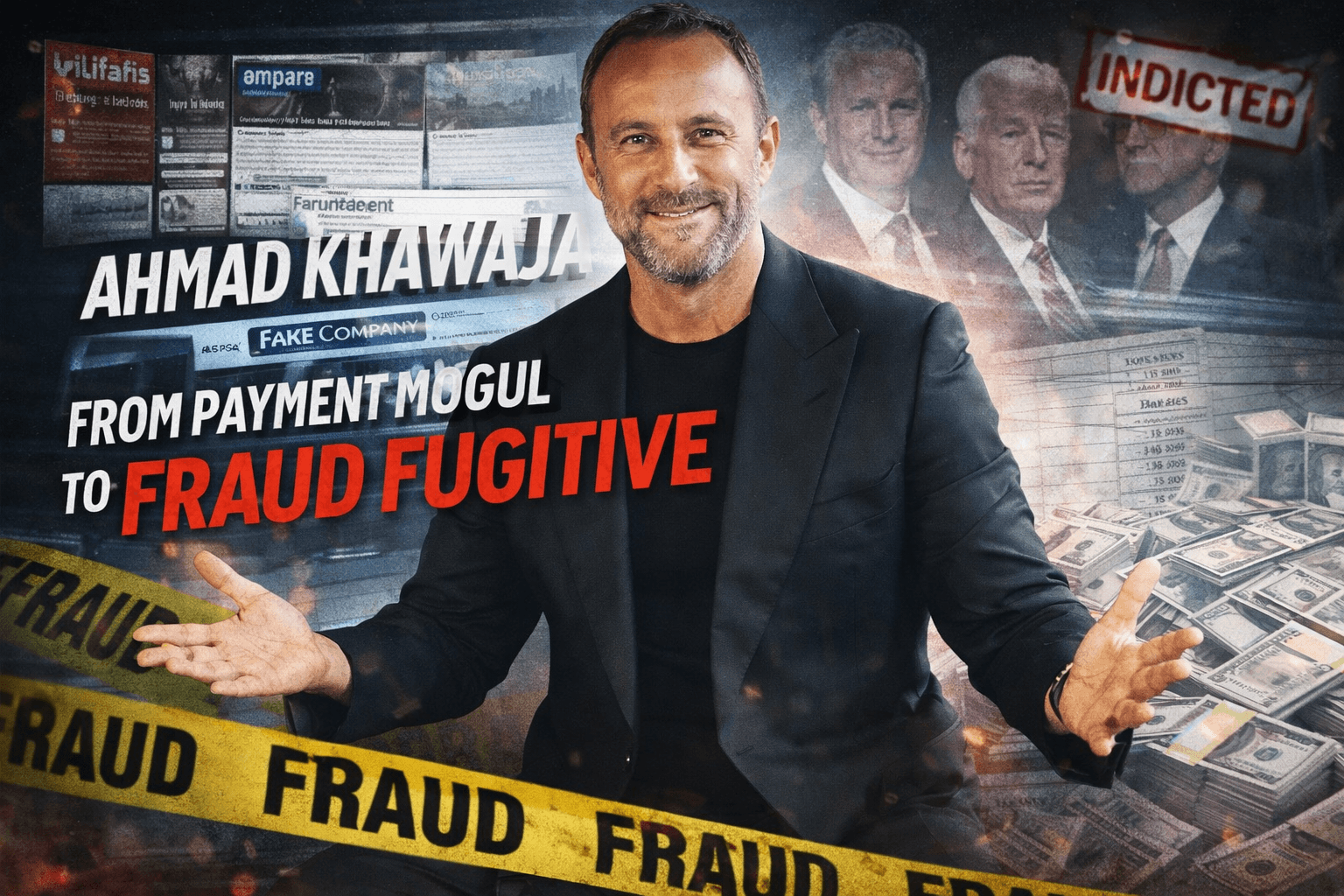
Who is Ahmad Khawaja?
He is a Lebanese American businessman who founded Allied Wallet, a company that helped online businesses accept card payments across the world.
What did he build?
He created a payment processing platform that sat between merchants and major card networks, giving him a key position inside the digital payments system.
Why is he being talked about now?
U.S. authorities have accused him of being involved in a large scale payment fraud case and a separate political funding controversy.
What is his current situation?
He has been described as a fugitive while fighting legal battles outside the United States.
Why does his case matter?
Because it raises serious questions about how money moves through global systems and how easily those systems can be misused.
The Rise Before the Fall
For years, Khawaja looked like another fintech success story. Allied Wallet grew at a time when online payments were exploding. E commerce was taking off and businesses needed simple ways to accept payments from customers across borders. That is where companies like his came in.

Allied Wallet positioned itself as a solution. It promised access. It promised speed. For many businesses, especially smaller ones trying to scale, that kind of service was valuable. Payment processors are not always visible to the public, but they sit right at the center of how money moves online. If you buy something from a website, there is a good chance a processor like this is working in the background.
That position brought power. It also brought responsibility. Because whoever controls access to payment networks decides who gets to operate inside the system.
When Questions Started to Surface
As the company expanded, regulators began looking closer at how some of its clients were getting approved. Investigators later claimed that certain businesses using the platform should never have been allowed in the first place.
The concern was not just about risky clients. It was about how those clients were being presented to banks and card networks. According to court documents, businesses were sometimes described in ways that did not match what they were actually doing. On paper, everything looked clean. Behind the scenes, the activity told a different story.
This is where the term transaction laundering comes in. It sounds technical but the idea is simple. A payment looks normal, but the real purpose of that payment is hidden. It is like putting a mask on a transaction so the system does not question it.
Inside the Alleged Fraud Operation
Prosecutors later described a system that was much bigger than a few bad accounts slipping through. They claimed there was a network built to keep questionable businesses running inside the financial system.
Fake companies were set up. Websites were created to look like ordinary online stores. If someone checked quickly, nothing seemed off. But those sites were not always selling what they claimed to sell. Payments would go through those fronts while the real activity stayed hidden.
Another piece of the puzzle was how transactions were labeled. Every payment carries a code that tells banks what kind of purchase it is. That code matters because it helps flag risky activity. Investigators say those codes were sometimes used in misleading ways. High risk payments could appear as something as simple as a retail purchase.
There was also the issue of repeat offenders. Businesses that had already been flagged or removed from the system did not always stay out. Some were able to return under new names or new company structures. That created a loop where the same activity could continue even after being caught once.
The numbers attached to the case are hard to ignore. Authorities say more than 150 million dollars moved through this setup. That scale is what turned this from a compliance issue into a criminal case.
The 150 Million Dollar Flow
The figure tied to this case gives a sense of scale, but it does not tell the full story. The money did not move in one large transfer. It moved in pieces. Smaller transactions, repeated over time, each one blending into the background.
That is part of what made it effective, according to investigators. Large, unusual transfers tend to get attention. Smaller, routine payments do not. When those smaller payments add up, the total becomes significant, but the individual pieces remain hard to track.
Authorities say more than 150 million dollars passed through this structure. That number suggests a system that was not just working occasionally, but consistently.
There is also the question of how those transactions were labeled. Every payment carries a code that tells banks what kind of purchase it is. That code matters because it helps flag risky activity. Investigators claim that some of these labels did not match the real nature of the transactions.
If a payment is described as a standard retail purchase, it moves smoothly. If it is tied to a high risk category, it may be stopped or reviewed. Changing that label changes how the system reacts.
The People Around Him
Khawaja was not operating alone, at least according to investigators. Mohammad Diab was described as someone deeply involved in the day to day operations. His role connected to how merchants were brought onto the platform and how the system functioned on a daily basis.
Amy Rountree handled internal processes. That meant dealing with the operational side of the business, the part that keeps everything running smoothly on the surface.
Then there was Thomas Wells, who acted as a bridge between merchants and the payment system. His job, according to the allegations, was to bring clients into the network, including those that might not have passed standard checks elsewhere.
Each role was different, but together they formed what prosecutors described as a coordinated setup rather than a random collection of actions.
A Separate Political Storm
While the payment fraud case was building, another issue emerged that pushed Khawaja’s name into a different spotlight. This time it involved politics.
He was accused of working with George Nader, a figure linked to officials in the United Arab Emirates. The allegation was that foreign money was being routed into U.S. political campaigns in a way that hid its true source.
The method, according to authorities, involved making the funds look like legitimate business transactions before they were turned into political donations. On the surface, the donations appeared to come from a lawful source. In reality, investigators say the origin was something else entirely.
This part of the case added a different kind of weight. It was no longer just about financial systems. It was about influence and access at a political level.
Arrest and Life in Limbo
In 2020, Khawaja was arrested in Vilnius following an international warrant. For a moment, it seemed like the legal process would move quickly.
But the situation did not end there. He was released on bail and has remained in Lithuania while fighting extradition. Since then, the case has stretched into a long legal battle, with proceedings moving slowly and questions still hanging in the air.
What makes the situation more unusual is the contrast between his legal troubles and his reported lifestyle. Despite claims of financial strain, reports suggest he has continued to live comfortably. That gap has raised eyebrows and led to further scrutiny from authorities.
The Bigger Picture
Step back from the details and a larger pattern starts to appear. Modern financial systems run on trust. They depend on the idea that the information being entered is accurate. If that assumption breaks, the whole system can be misled.
Payment processors sit at a critical point in that system. They decide which businesses get access and how those businesses are represented. If something goes wrong at that stage, it does not stay contained. It spreads through banks, card networks, and even regulators who rely on the same data.
That is why this case has drawn attention beyond just one company. It shows how a system designed for speed and efficiency can struggle when faced with carefully structured deception.
Where Things Stand Now
The legal process is still ongoing. Charges in the United States include fraud related offenses and allegations tied to political funding. These are serious claims with heavy consequences if proven.
At the same time, Khawaja has denied wrongdoing and challenged aspects of the case. Like many complex financial investigations, the final outcome may take years to fully play out.
Final Thoughts
The story of Ahmad Khawaja is still unfolding. It sits at the intersection of finance, technology, and politics. For some, it is a case about alleged fraud on a massive scale. For others, it is a reminder of how global systems can be stretched in ways they were never designed for.
What remains clear is this. When money moves quietly through systems built on trust, it does not take much to change how that system behaves. And sometimes, the change is not visible until a lot of damage has already been done.
Source :
https://www.justice.gov/archives/opa/pr/businessman-sentenced-35m-foreign-conduit-contribution-scheme
https://www.lrt.lt/en/news-in-english/19/2005452/despite-millions-in-debt-us-fugitive-khawaja-lives-in-luxury-vilnius-hotel?srsltid=AfmBOoreLQUC9dzRiKrnlG-
https://frankonfraud.com/4-charged-in-massive-150m-merchant-fraud/
https://behindmlm.com/payment-processors/ahmad-khawajas-allied-wallet-fraud-indictment/
————-
Disclaimer:
Some content on Reportingscams.com is published under our guest post program and is provided by third-party contributors. Reporting scams does not create, verify, or take responsibility for the views, accuracy, or claims expressed in such content.