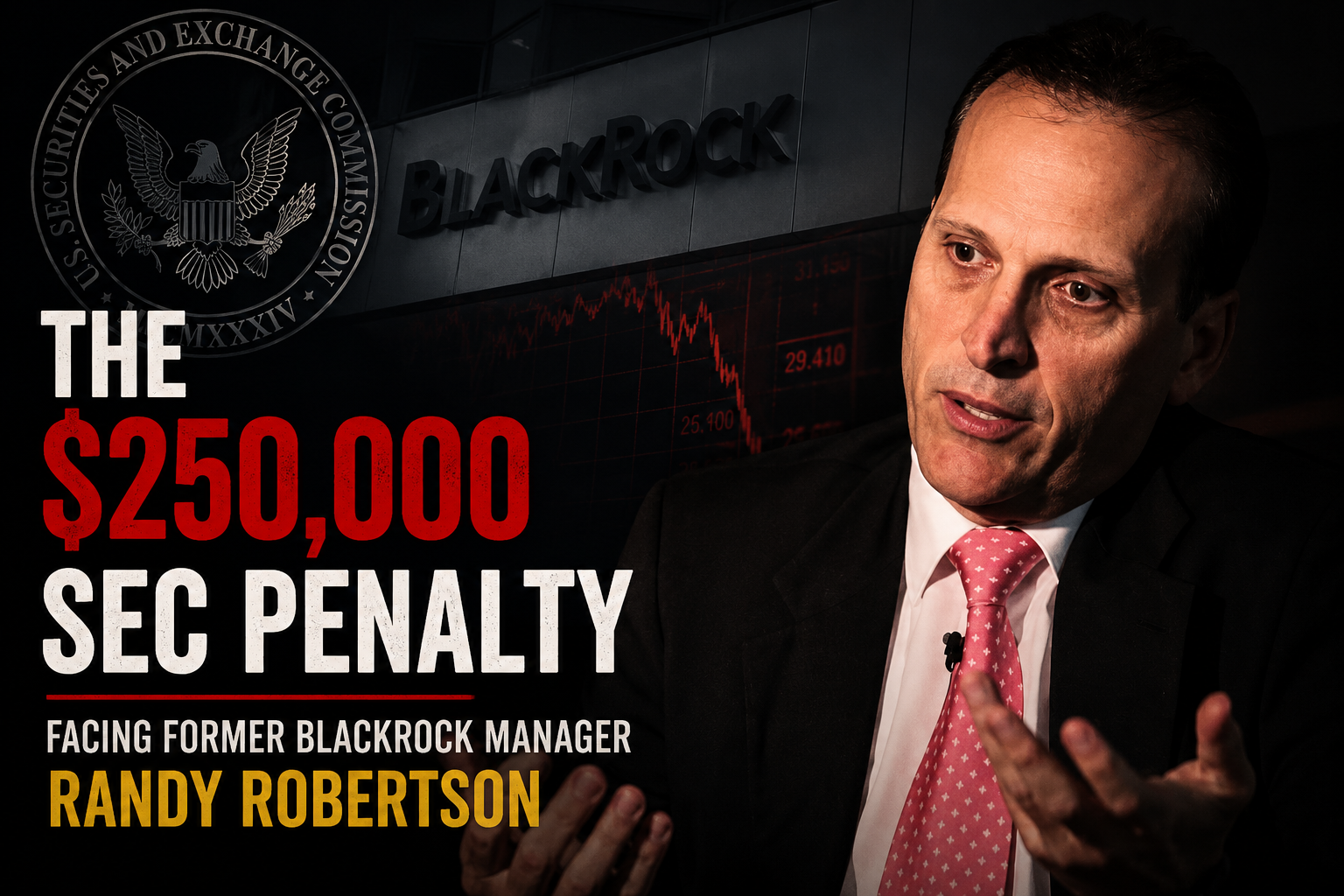
The former BlackRock portfolio manager at the center of a $75 million film-financing relationship has re-emerged in the investment industry after paying a $250,000 SEC penalty over an undisclosed conflict of interest that involved efforts to advance his daughter’s acting career.
Robert “Randy” Robertson, now 62, was once a senior figure in BlackRock’s structured-credit business, leading the firm’s Securitized Asset Investment Team while also serving as a co-portfolio manager of the BlackRock Multi-Sector Income Trust, or BIT. Today, his professional biography identifies him as the founder and chief investment officer of Procyon Capital Management, a structured-credit investment firm. The public record, however, preserves an extraordinary account of how a relationship with a Hollywood film company became intertwined with one of the investments Robertson helped oversee.
The SEC’s January 2023 enforcement action did not accuse Robertson of stealing investor money or participating in the criminal fraud later committed by Aviron founder William Sadleir. But regulators concluded that he failed to disclose a conflict of interest while BIT, the publicly traded fund he co-managed, poured tens of millions of dollars into Aviron and its affiliated entities. The case offers a reminder that conflicts in the investment world do not have to involve cash payments or direct kickbacks to create serious problems.
Robertson joined BlackRock in 2009 after spending roughly a decade at Wachovia Capital Markets, where he held senior roles in residential and consumer assets, according to BlackRock disclosures. At BlackRock, he rose to managing director and headed the firm’s Securitized Asset Investment Team. His responsibilities also included managing part of BIT, a closed-end investment company traded on the New York Stock Exchange and focused largely on fixed-income and asset-backed investments.
The chain of events that later attracted regulators began around February 2014. According to the SEC’s administrative order, Robertson was exploring possible secured-lending opportunities connected to the print and advertising costs of film distribution, an area in which the regulator said he had no prior experience. During discussions with a firm that sourced such opportunities, Robertson asked for help finding potential opportunities for his daughter in the film industry and sent the sourcing firm her résumé and photographs.
Later that year, the sourcing firm introduced Robertson to William Sadleir, who was developing a film-distribution business and looking for financing opportunities. Robertson attended meetings with Sadleir’s team and brought his daughter to at least one of them, where her acting career was discussed. Sadleir subsequently offered to help her regardless of whether BlackRock ultimately invested. Screenplays were shared, meetings were arranged and potential industry connections were discussed.
Those early conversations did not immediately produce a BlackRock investment. The relationship resumed in 2015 after Sadleir formed Aviron Group and its film-distribution operation. By then, the personal and business relationships were running alongside one another. The SEC said Robertson again brought his daughter to a business meeting with Sadleir, while Sadleir continued discussing possible ways to help her pursue acting.
In October 2015, BIT and Aviron entered into a lending arrangement that could provide Aviron with up to $38 million. Robertson played a primary role in identifying and selecting the investment and later a significant role in overseeing it, according to the SEC. BIT initially provided $12 million to fund film print and advertising expenses. Robertson later recommended continuing and expanding the investment, even as some of Aviron’s film releases performed inconsistently and the value of the fund’s position fluctuated downward.
By July 2017, Robertson had recommended increasing BIT’s exposure to Aviron to $75 million, making it the largest investment in the fund’s portfolio under the arrangement described by the SEC. The broader figure eventually referenced in the regulator’s detailed order was approximately $85 million in aggregate funding through the secured lending facility. The distinction matters because the SEC’s public announcement commonly cited the loans as reaching $75 million, while the administrative order describes approximately $85 million invested over the life of the facility.
The conflict came into sharper focus in 2018. Robertson’s daughter independently sought networking opportunities with Aviron, and Robertson provided her with contact information for a senior executive. He also emailed the executive, saying his daughter would reach out and expressing appreciation for any guidance. Shortly afterward, according to the SEC, the executive helped her obtain a small speaking role in a film in which Aviron held distribution rights. The film had previously been considered for BIT financing.
Robertson was informed that his daughter had been offered the role and that efforts were also being made to connect her with casting agents in Los Angeles. The SEC said he nevertheless did not disclose the situation to BIT’s board of trustees or seek guidance from BlackRock’s legal or compliance staff.
The overlap became especially significant in March 2019, when Aviron sought another $10 million from BIT to support the U.S. distribution of the same film in which Robertson’s daughter had appeared. Robertson helped frame the decision for the investment team and recommended providing the financing. BIT approved the $10 million loan in two tranches. The loan was due to be repaid in May 2019, but Aviron failed to repay it.
The SEC’s case against Robertson unfolded against a much larger scandal involving Aviron itself. Sadleir, Aviron’s founder, owner and chief executive, was later accused by regulators and prosecutors of defrauding BIT and misappropriating funds from the investment. The SEC alleged that at least $13.8 million had been diverted, while federal prosecutors described fraudulent schemes involving more than $30 million connected to the approximately $75 million invested in Aviron.
The criminal allegations against Sadleir went far beyond the conflict-of-interest issues involving Robertson. Prosecutors said Sadleir created a sham company designed to resemble the legitimate media business GroupM Worldwide, used fake documents and a fabricated identity called “Amanda Stevens,” and diverted more than $25 million for his own benefit. Prosecutors said some of the money was used to purchase a Beverly Hills home for approximately $14 million.
Sadleir ultimately pleaded guilty to two counts of wire fraud and was sentenced in September 2022 to six years in federal prison. In a separate California case, he pleaded guilty to bank fraud and money laundering connected to $1.7 million in fraudulent COVID-relief loans obtained for Aviron entities. He received an additional 41-month sentence in that case, with prosecutors documenting $282,566 in losses to the Small Business Administration. Those cases involved Sadleir’s own criminal conduct. Robertson was not charged as a co-defendant in those criminal prosecutions.
BlackRock terminated Robertson on February 27, 2020, after learning of the undisclosed conflict while preparing litigation against Aviron, according to the SEC’s order. The regulator later concluded that Robertson’s failure to disclose the conflict violated Section 206(2) of the Investment Advisers Act, a provision addressing transactions or practices that operate as a fraud or deceit upon an advisory client. The SEC’s order notes that proving a violation of that particular provision does not require proof of intent to deceive and can rest on a finding of negligence.
In January 2023, Robertson settled the SEC proceeding without admitting or denying the agency’s findings. He agreed to cease and desist from future violations, accepted a censure and agreed to pay a $250,000 civil penalty. The settlement was an administrative resolution, not a criminal conviction, and the SEC’s public action did not accuse him of misappropriating the millions later linked to Sadleir’s fraud.
At the time of the SEC order, Robertson was listed as a resident of Ponte Vedra, Florida, and the regulator identified him as 62 years old. His public investment adviser record also identifies his full registered name as Robert Randy Robertson. Publicly available records show that he is not currently registered as a broker or investment adviser representative, although that status does not by itself establish what professional activities he may undertake outside those registrations.
Robertson’s current professional presence appears to be through Procyon Capital Management, whose website identifies him as founder and chief investment officer and describes his experience across structured credit, whole loans and securitized assets. The firm’s published leadership page also lists investment professionals including Deputy CIO Joseph Piscina, Senior Portfolio Manager Peter Leffler, Senior Portfolio Manager Sam Hassan, Chief Operating Officer Sayyid Ali and investment banker Christopher John. Separately, Procyon Advisors, a registered investment adviser operating under the Procyon name, continues to maintain SEC registration. The public records reviewed for this article do not establish that Procyon Capital Management and Procyon Advisors are the same legal entity, so they should not be treated as interchangeable without further documentation.
The Robertson case is unusual because the central issue was not a secret payment, a bag of cash or an obvious financial transaction flowing directly to the portfolio manager. It was the possibility that personal favors involving a family member could compromise, or appear to compromise, the judgment of a professional responsible for investing other people’s money.
That distinction is precisely why the story matters. Investors may assume conflicts are easy to spot, but the most consequential ones can emerge through personal relationships, professional favors and opportunities that never appear on a traditional balance sheet. A $250,000 penalty was ultimately imposed on Robertson, while the broader Aviron relationship later exposed investors to a far more serious fraud carried out by the company’s founder. The two cases were legally different, but they intersected around the same investment.
The lesson is not that every conflict leads to fraud. It is that disclosure exists to ensure decision-makers, trustees and investors can judge those relationships before the consequences become clear. When a portfolio manager is helping direct tens of millions of dollars toward a company that is also assisting a member of his family, silence can become a risk of its own. In financial markets, trust is often built long before money is lost, and it can be damaged just as quickly when investors discover that important relationships were never put on the table.
————-
Disclaimer:
Some content on Reportingscams.com is published under our guest post program and is provided by third-party contributors. Reporting scams does not create, verify, or take responsibility for the views, accuracy, or claims expressed in such content.