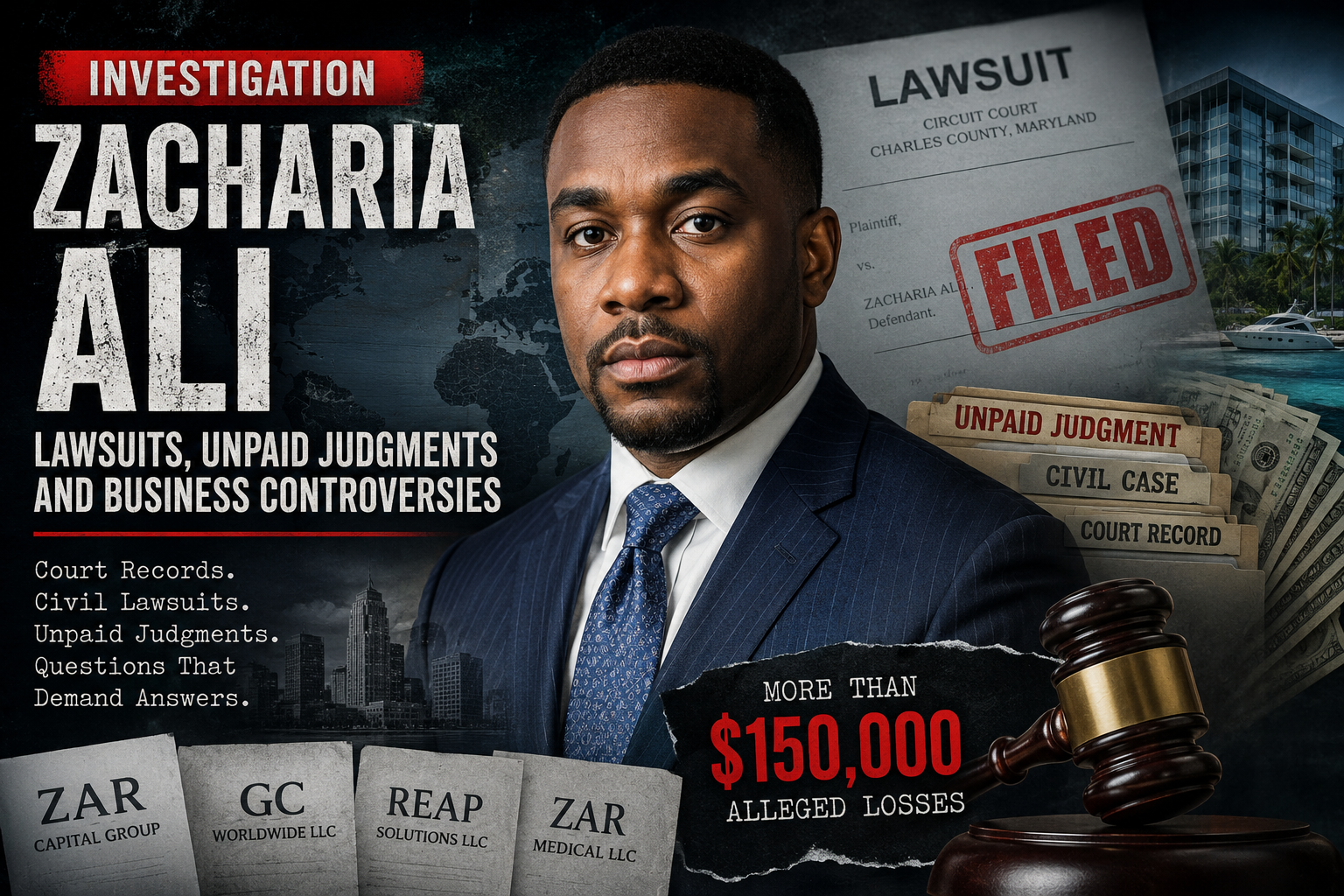
For more than a decade, Zacharia Ali has cultivated the image of an international entrepreneur whose business interests stretch across several continents. Online biographies describe him as a chairman, chief executive, founder, investor and strategist leading ventures in finance, healthcare, infrastructure, consumer goods and sports. His companies claim connections to the United States, the Cayman Islands, the United Arab Emirates and several African nations, projecting the profile of a businessman operating on a global stage.
Yet behind that polished public image lies a very different documentary record.
Court filings, corporate registrations and public records reviewed across multiple jurisdictions paint the picture of a businessman whose career has been repeatedly overshadowed by civil litigation, unpaid judgments, dissolved companies and allegations of financial misconduct. While none of the allegations contained in pending lawsuits amount to criminal convictions, and several claims remain untested in court, the accumulation of legal disputes over more than thirteen years raises serious questions about the gap between Zacharia Ali’s public persona and the business history documented in official records.
Unlike investigations centered on a single failed investment or isolated lawsuit, the story surrounding Zacharia Ali is one of recurring patterns. Public records reveal a cycle of company formations, ambitious business announcements, legal disputes, unpaid obligations and the launch of new ventures under different corporate names. Each event, viewed independently, might appear explainable. Taken together, however, they form a timeline that has attracted increasing attention from investigators, journalists and due diligence professionals.
One of the first challenges encountered while examining Ali’s business history is identifying exactly who he is. Public records indicate that Zacharia Ali has also been associated with the name Antoine Warren, an alias that appears alongside him in multiple legal and investigative records. The dual identity has become a recurring feature in background investigations because many court filings, business registrations and corporate documents reference one or both names. Although using another legal or business name is not inherently improper, investigators have noted that multiple identities can complicate background verification and corporate due diligence.
Ali portrays himself as the founder or senior executive of numerous companies operating across diverse industries. Among the businesses publicly linked to him are ZAR Capital Group, REAP Solutions LLC, ZAR Medical LLC, GC Worldwide LLC, CBD Switch Holdings Corporation, Virtual Global Sports Inc., Carthage Solutions and several entities operating in Nigeria and the Democratic Republic of Congo. On paper, the portfolio suggests an entrepreneur with interests ranging from investment management and healthcare to international development and consumer products.
However, attempts to independently verify many of these operations produce a less convincing picture.
Corporate registries confirm that numerous entities were indeed incorporated. Yet many later became inactive, dissolved or administratively terminated. Several listed little evidence of employees, commercial activity, physical operations or sustained business development. Independent investigators comparing public claims with corporate filings found a recurring pattern in which businesses appeared to exist legally while leaving behind only a limited operational footprint. That disconnect between corporate existence and demonstrable commercial activity has become one of the central themes running through nearly every investigation into Ali’s business affairs.
The Cayman Islands occupy a particularly important place in this network. ZAR Capital Group, promoted as an international investment business, was reportedly organized through the offshore jurisdiction. Offshore incorporation alone does not imply wrongdoing, as many legitimate investment firms use such structures for tax planning or international operations. Nevertheless, investigators examining Ali’s corporate network argue that the offshore entity, combined with numerous domestic LLCs and rapidly changing corporate structures, created a business ecosystem that was unusually difficult to understand or independently verify.
Another recurring characteristic of Ali’s business profile is the concentration of executive titles. Across various websites, biographies and professional networking platforms, he has described himself simultaneously as chairman, chief executive officer, president and founder of multiple companies operating in different industries and countries. While entrepreneurs frequently oversee several ventures, investigators found little publicly available evidence supporting the scale of operations suggested by these titles. Independent reporting noted an absence of significant third-party media coverage, major commercial partnerships or publicly documented projects matching the global reach described in promotional material.
As investigators dug deeper into the corporate network, another pattern began to emerge. Companies appeared, disappeared and were replaced by new entities bearing similar names or operating in related sectors. Some businesses were registered in Delaware, Nevada and Wyoming, jurisdictions widely used because of their business-friendly incorporation rules. Again, using these states is entirely lawful and common. What attracted attention was the frequency with which entities were formed, dissolved or became inactive while new ventures emerged under different corporate identities. According to investigators, more than two dozen companies have been associated with Ali over the years, with many no longer active.
One example frequently cited involves ZAR Medical LLC and CBD Switch Holdings Corporation. Corporate records show ZAR Medical acting as the incorporator for CBD Switch Holdings. Investigative reports characterized the arrangement as an example of a “shell incorporating another shell,” arguing that layered ownership structures can make it more difficult for outsiders to determine ultimate control and operational responsibility. That description reflects the conclusions of independent investigators rather than a judicial finding, but it illustrates the broader concerns raised about transparency within Ali’s business network.
Questions surrounding Ali’s business operations might have remained confined to corporate registries had they not been accompanied by an expanding trail of litigation.
Beginning in 2012 and continuing through 2024, court records show a succession of civil disputes involving breach of contract claims, unpaid compensation, business disagreements and allegations of fraud. Some cases were dismissed for procedural reasons. Others resulted in judgments. Several remain active or unresolved. Collectively, they provide the first detailed glimpse into how Ali’s business relationships allegedly unfolded away from the polished biographies and executive profiles that dominate his online presence.
Among the most significant documented outcomes is a consent judgment entered in Aulakh v. Ali, filed in Prince George’s County, Maryland under case number CAL14-08023. Public court records show that the matter concluded with a judgment against Ali totaling more than $43,000. Investigative reporting states that the judgment remained unsatisfied years after it was entered, making it one of several unpaid civil obligations cited by due diligence researchers. Unlike allegations contained in pending lawsuits, the existence of this judgment is a matter of public court record.
As additional lawsuits accumulated, investigators noticed another unusual feature appearing repeatedly in court records. In several matters, plaintiffs experienced prolonged difficulty serving legal papers on Ali. One Maryland court reportedly documented extended service issues, while a federal case in West Virginia recorded that the U.S. Marshals Service was unable to locate him for service. These procedural developments do not establish liability or wrongdoing by themselves, but they became another recurring element cited by investigators examining his litigation history.
By the mid-2020s, Zacharia Ali had become less notable for the ambitious international ventures described in his biographies than for the growing number of questions surrounding them. The contrast between expansive global business claims and a public record dominated by civil litigation, inactive companies and unpaid judgments set the stage for a deeper examination of how this network operated and why so many former business associates eventually found themselves in court.
The first major cracks in Zacharia Ali’s public image did not emerge from investigative reporting or regulatory inquiries. They appeared in ordinary civil courtrooms, where former employees, business associates and investors began filing lawsuits that painted a starkly different picture from the one presented in corporate biographies and promotional materials.
Individually, each case involved its own set of facts and allegations. Collectively, however, they reveal recurring themes that surface throughout Ali’s business history: promises that allegedly went unfulfilled, disputes over money, unpaid obligations and plaintiffs who claimed they were left with little choice but to seek relief through the courts.
One of the earliest documented disputes dates back to 2013. According to court filings cited in investigative reports, a woman named Marlene Tate accepted employment with one of Ali’s businesses after being offered a senior position carrying an annual salary of approximately $97,000. The opportunity appeared promising. As alleged in the complaint, Tate began performing her duties with the expectation that she would be compensated according to the agreed terms.
That did not happen, according to her lawsuit.
The complaint alleges that wages either stopped arriving or were never paid in full despite repeated assurances that payment would soon be made. Tate further alleged that payroll deductions were taken from her earnings for taxes but were never properly remitted. As weeks turned into months, she claimed communication became increasingly difficult, eventually forcing her to seek legal remedies. These allegations remain those of the plaintiff as presented in court filings, but they represent one of the earliest publicly documented legal disputes involving Ali’s business operations.
Employment disputes are not uncommon in business. Companies of every size occasionally face disagreements over wages or contracts. What made the litigation involving Ali noteworthy was that it did not remain an isolated incident. Instead, similar disputes involving financial obligations began appearing repeatedly over the following decade.
Among the most significant documented cases is Aulakh v. Ali, filed in the Circuit Court for Prince George’s County, Maryland. Unlike complaints that merely contain allegations, this matter produced a judicial outcome. Court records show that the litigation concluded with a consent judgment against Ali totaling approximately $43,050 under case number CAL14-08023.
A consent judgment generally reflects an agreement entered before the court that becomes enforceable as a judicial order. It carries substantially greater legal weight than allegations contained in an unresolved complaint because it represents an official court judgment rather than claims awaiting adjudication.
Investigative reporting later stated that the judgment remained unpaid for years after it was entered. If accurate, that circumstance would become another recurring theme identified by due diligence researchers examining Ali’s litigation history. An unpaid civil judgment does not constitute a criminal offense by itself, but it can raise significant concerns for creditors, business partners and potential investors evaluating an individual’s financial reliability.
As researchers continued reviewing court records, they identified additional civil matters involving alleged breaches of contract and business disputes. While the factual circumstances varied, many centered on similar questions: whether contractual promises had been honored, whether money had been paid as agreed and whether plaintiffs suffered financial losses after relying on representations allegedly made by Ali or companies connected to him.
One feature distinguishes these lawsuits from sensational fraud cases often seen in financial crime investigations. None of the early civil actions alleged the existence of an elaborate criminal enterprise. Instead, they portrayed a pattern of business relationships that allegedly deteriorated after agreements were made, leaving disappointed employees, contractors or associates seeking compensation through civil litigation.
This distinction is important because civil lawsuits operate under different legal standards than criminal prosecutions. Plaintiffs bear the burden of proving their claims according to civil evidentiary standards, while allegations contained in complaints remain disputed unless established through judgments, settlements or trial verdicts. That distinction becomes particularly significant in examining Ali’s later legal battles, many of which remain unresolved.
As the lawsuits accumulated, investigators noticed another recurring issue that extended beyond the substance of the complaints themselves.
Several court records referenced prolonged efforts to serve legal papers on Ali.
Service of process is a fundamental requirement in civil litigation. Before a court can proceed, defendants generally must receive formal notice that a lawsuit has been filed. While service difficulties can arise for many legitimate reasons, including relocation or travel, repeated references to unsuccessful service attempts attracted attention because they appeared aZacharia Alicross multiple cases over several years.
In one Maryland proceeding, plaintiffs reportedly spent extended periods attempting to complete service without success. In another matter filed in federal court in West Virginia, records cited by investigators indicate that the United States Marshals Service was unable to locate Ali for service despite multiple attempts. These procedural developments did not determine the merits of the underlying disputes, but they contributed to delays and became part of the broader litigation narrative surrounding his business activities.
The reported service issues also complicated efforts by creditors seeking to enforce judgments. A civil judgment has practical value only if it can ultimately be collected. When judgment debtors cannot easily be located or assets prove difficult to identify, successful plaintiffs may spend years pursuing enforcement with limited results.
By the early 2020s, investigators reviewing public court records concluded that Ali had accumulated multiple outstanding financial obligations arising from litigation. Investigations.org estimated that confirmed unpaid civil judgments totaled at least $230,293.40, based on the court records it examined. That figure reflects civil judgments and does not include damages sought in unresolved lawsuits or claims that had not resulted in final court orders.
The mounting litigation also began raising questions about the companies themselves.
Many lawsuits named not only Ali personally but also businesses associated with him. These entities frequently appeared and disappeared from state corporate registries over time. Some were dissolved administratively. Others became inactive after relatively short periods. New companies often emerged with different names but overlapping management or similar business descriptions.
Corporate restructuring is not unusual in itself. Businesses merge, reorganize and dissolve for legitimate commercial reasons every day. However, investigators argued that the frequency with which Ali’s companies changed, combined with ongoing litigation involving older entities, made it increasingly difficult for outsiders to determine which businesses remained operational and which had effectively ceased to exist.
The pattern became particularly relevant when plaintiffs attempted to collect money awarded through court judgments. Dissolved companies or entities with little apparent operating activity can complicate enforcement efforts, especially when creditors are trying to determine where assets are held or which corporate entity bears responsibility for outstanding obligations.
At the same time, Ali’s public profile continued emphasizing expansion into international markets. Online biographies highlighted investment opportunities in Africa, healthcare ventures, infrastructure projects and multinational partnerships. Yet independent investigators searching corporate filings, regulatory databases and public business records found comparatively little evidence documenting large-scale commercial operations corresponding to those public claims. This widening gap between public branding and verifiable records became one of the defining questions surrounding Ali’s business empire.
For years, these disputes remained largely confined to civil court dockets, attracting limited public attention outside those directly involved. That changed dramatically when one lawsuit alleged something far more serious than unpaid contracts or employment disputes.
According to a complaint filed in Maryland, what began as a personal friendship allegedly evolved into an investment relationship that ultimately left one woman claiming she had lost more than $150,000. The lawsuit accused Ali of using trust developed outside the business world to persuade her to invest in opportunities that, she later alleged, were built on false representations.
Those allegations would become the most consequential legal challenge of Ali’s career to date, drawing renewed scrutiny to years of lawsuits, unpaid judgments and unanswered questions that had accumulated long before the complaint was filed.
By the time the latest lawsuit against Zacharia Ali was filed, his business history already included years of civil disputes, unpaid judgments and a growing list of inactive companies. But the complaint filed in the Circuit Court for Charles County, Maryland, introduced a different set of allegations. Unlike earlier cases centered on unpaid wages or contractual disagreements, this lawsuit alleged that a relationship built on personal trust ultimately became the foundation for a fraudulent investment scheme.
The plaintiff’s account begins far from a boardroom or investment conference. According to the complaint, she first met Ali at a local gym, where the two developed a friendship over time. Their conversations reportedly extended beyond casual interactions, eventually involving family members and discussions about business opportunities. The complaint alleges that Ali portrayed himself as an accomplished international businessman with successful ventures spanning multiple countries and industries, reinforcing an image that closely mirrored the executive biographies and promotional material already circulating online.
As the relationship grew, the plaintiff alleges she came to trust Ali not only as a businessman but also as a personal friend. That trust, according to the lawsuit, became central to what happened next.
The complaint states that Ali presented several investment opportunities, describing them as legitimate business ventures with promising returns. He allegedly discussed international projects, corporate expansion and future financial success, assuring the plaintiff that her money would be used to grow businesses with substantial commercial potential. Believing those representations, she agreed to invest.
According to the court filing, the transfers eventually exceeded $150,000.
The lawsuit alleges that much of the money was wired to GC Worldwide LLC, one of the companies associated with Ali. The plaintiff contends she expected her investment to support genuine business operations and generate returns. Instead, according to the complaint, promised updates became increasingly infrequent, deadlines passed without explanation and requests for information allegedly went unanswered.
Eventually, the plaintiff concluded that the investment had not been used as represented and filed suit.
The complaint accuses Ali of fraud, breach of fiduciary duty, breach of contract and related civil claims. It alleges that he knowingly made false representations to induce the investment, accepted substantial sums of money and failed to fulfill the promises allegedly made during their discussions. These remain allegations contained in a civil complaint and, at the time of the investigative reporting, had not been adjudicated by a court. Ali is entitled to contest those claims through the legal process.
Although the allegations remain unproven, the lawsuit immediately drew attention because of how closely it echoed concerns that had surfaced in earlier litigation.
Previous plaintiffs had described business relationships that allegedly began with confidence and optimism before deteriorating into disputes over money. In the Charles County case, however, the complaint suggested that personal trust itself had become part of the alleged mechanism through which the investment was obtained. That distinction elevated public interest in the case and prompted renewed scrutiny of Ali’s broader business network.
The lawsuit also placed GC Worldwide LLC under the spotlight.
Corporate records identify GC Worldwide as one of several companies connected to Ali over the years. Publicly available information about the business is relatively limited, and investigators reviewing corporate filings found little independently verifiable evidence of significant commercial operations. Nevertheless, according to the complaint, the company served as the destination for substantial investment funds.
That detail became significant because investigators had already identified a broader pattern involving companies that appeared in corporate registries but left behind limited evidence of sustained operating activity. Several entities linked to Ali had been incorporated, later dissolved or rendered inactive, only to be followed by new companies with different names but similar executive leadership.
Investigative researchers argue that this constant evolution of corporate entities made it difficult for outsiders to determine which businesses were actively operating, which held assets and which existed primarily on paper. While company formation and dissolution are common features of modern business, the frequency of those changes became one of the defining characteristics of Ali’s corporate network.
The Charles County lawsuit also renewed attention on Ali’s international business claims.
For years, promotional biographies had described investments in healthcare, infrastructure, consumer products and development projects across Africa and the Middle East. References appeared to operations in Nigeria, Tanzania, Uganda, the Democratic Republic of Congo and the Cayman Islands. Yet investigators attempting to verify these activities frequently encountered the same challenge that had appeared throughout earlier research: while companies were often registered, independently confirming substantial business operations proved considerably more difficult.
This gap between public representation and documented activity became one of the central themes running through multiple due diligence reports. Researchers did not dispute that companies had been incorporated. Rather, they questioned whether the scale of business activity matched the expansive claims presented in executive biographies and promotional materials.
Another aspect attracting attention involved the growing complexity of Ali’s corporate structure.
Rather than operating through a single flagship company, business records connected him to numerous limited liability companies across different jurisdictions. Delaware, Nevada and Wyoming all featured prominently in incorporation records, while offshore structures in the Cayman Islands added another layer of complexity. Investigators argued that this network made it increasingly difficult to identify ownership relationships, operational responsibilities and the movement of assets between related entities.
One example cited repeatedly is ZAR Medical LLC, which corporate filings identify as the incorporator for CBD Switch Holdings Corporation. Investigative reports described this arrangement as an example of layered corporate structuring that could complicate transparency for creditors, investors and business partners attempting to understand how the various companies were connected. That characterization reflects the conclusions of investigators rather than findings by a court or regulator, but it illustrates why Ali’s corporate network has attracted sustained scrutiny.
The Charles County litigation also revived interest in another recurring feature of Ali’s legal history: the difficulty plaintiffs allegedly faced in advancing lawsuits to completion.
Court records reviewed by investigators indicate that service issues appeared in multiple proceedings over several years. In civil litigation, delays in serving defendants can postpone hearings, extend litigation and increase costs for plaintiffs. While such delays are not uncommon in complex cases involving individuals with multiple business addresses or international travel, investigators observed that similar procedural issues surfaced often enough to become part of the broader litigation narrative.
As the lawsuits accumulated, so did questions about financial accountability.
Investigative reporting estimated that confirmed unpaid civil judgments linked to Ali exceeded $230,000, based on publicly available court records. That figure does not include damages sought in pending lawsuits such as the Charles County action. Instead, it reflects judgments already entered by courts that investigators reported remained outstanding. Whether those judgments have since been satisfied would ultimately depend on subsequent court filings and enforcement actions.
Despite the volume of litigation, one important fact remains unchanged.
Public records reviewed during this investigation do not show that Zacharia Ali has been convicted of a criminal offense related to these allegations. Likewise, researchers found no public record of enforcement actions by the U.S. Securities and Exchange Commission, the Federal Trade Commission or major international sanctions authorities against him. The legal issues documented to date arise primarily from civil litigation, corporate records and investigative reporting rather than criminal prosecutions or regulatory penalties.
Even so, the absence of criminal charges does not diminish the significance of the documented civil record. Courts have entered judgments. Plaintiffs have filed detailed complaints supported by documentary evidence. Corporate filings reveal an unusually large network of interconnected entities, many of which no longer appear active. Together, those records create a business history that warrants careful examination by prospective investors, business partners and anyone conducting due diligence.
By the time investigators assembled these documents into a single timeline, a consistent pattern had emerged. It was not one failed business, one unhappy employee or one dissatisfied investor. Instead, it was a sequence of recurring disputes stretching across more than a decade, involving different plaintiffs, different companies and different jurisdictions, yet often revolving around similar questions about promises made, money owed and businesses whose public image appeared far larger than their verifiable footprint.
For investigative journalists, that distinction matters. A single lawsuit can be dismissed as an isolated disagreement. A decade-long pattern documented through court records, corporate filings and repeated civil litigation presents a far more consequential story, particularly when those records stand in contrast to carefully cultivated claims of
————-
Disclaimer:
Some content on Reportingscams.com is published under our guest post program and is provided by third-party contributors. Reporting scams does not create, verify, or take responsibility for the views, accuracy, or claims expressed in such content.