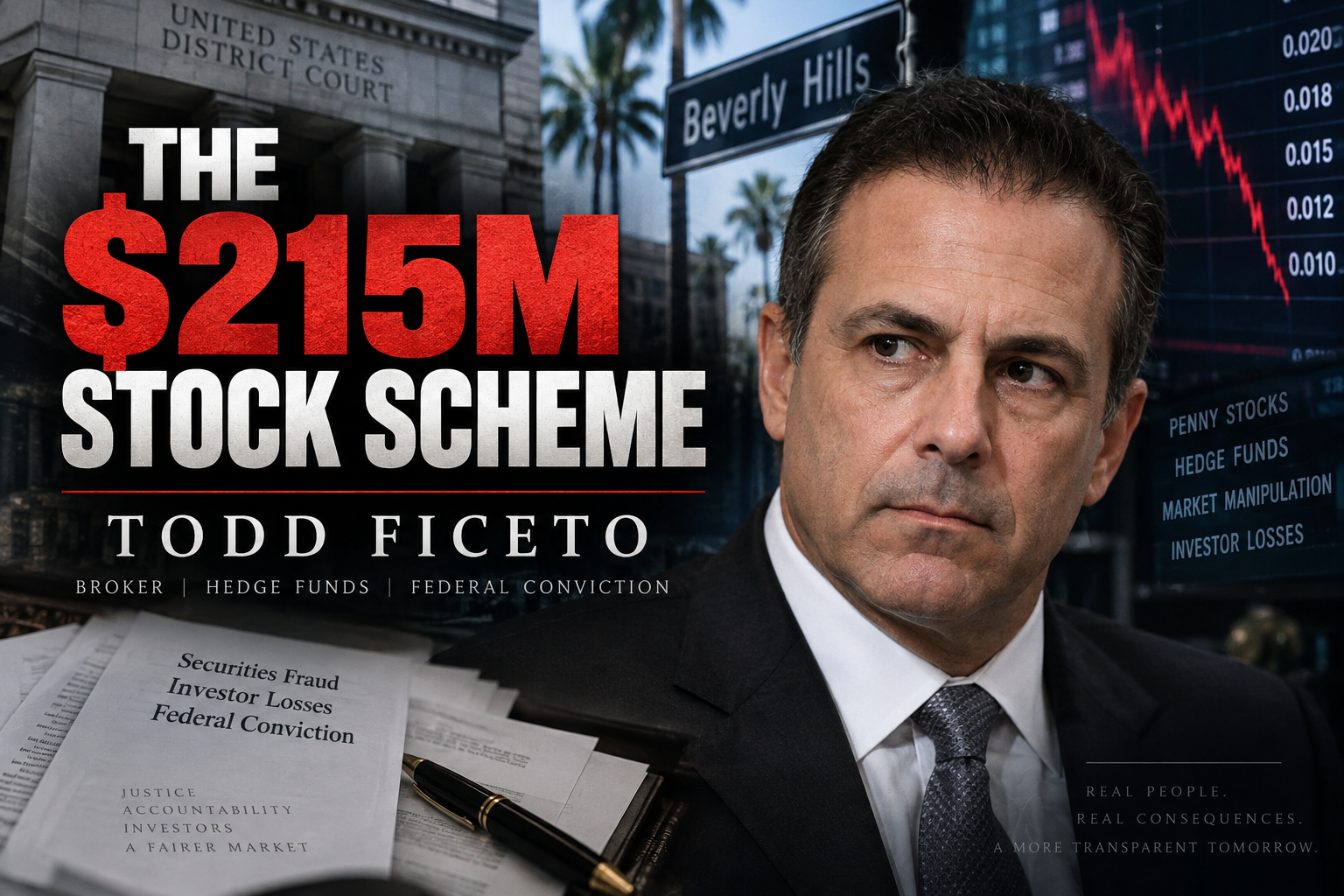
Todd Michael Ficeto’s name became tied to one of the more complicated U.S. penny-stock fraud cases of the 2000s, a scheme that moved between hedge funds in the Cayman Islands, a broker-dealer in Beverly Hills, traders in Canada and investment operations in Spain. What began as an investigation into the collapse of Florian Homm’s Absolute Capital Management eventually produced a federal criminal conviction against Ficeto, a six-year prison sentence, more than $215 million in restitution and a trail of regulatory and civil proceedings stretching across more than two decades.
Ficeto, whose full name is Todd Michael Ficeto, was a California securities professional and the president and co-owner of Hunter World Markets Inc., a Beverly Hills broker-dealer. His business partner was German financier Florian Wilhelm Jürgen Homm, the founder and chief investment officer of Absolute Capital Management Holdings, or ACMH. Homm managed eight offshore hedge funds known collectively as the Absolute Funds. At its peak, ACMH reported approximately $2.1 billion in assets under management in August 2007. Ficeto also operated Hunter Advisors, an investment adviser connected to the trading operation.
The underlying conduct dates principally to roughly 2004 or 2005 through 2007. According to federal prosecutors and the SEC, Ficeto, Homm and trader Colin Heatherington used Hunter World Markets to facilitate transactions involving thinly traded U.S. microcap and penny stocks. The SEC alleged that the group manipulated prices through matched orders, transactions designed to mark the close and wash sales. Those techniques could create the appearance of genuine market demand while leaving the underlying economic value of the securities largely unchanged. The SEC said the activity artificially increased the prices of the stocks and, in turn, inflated the reported value and performance of the Absolute Funds.
The alleged mechanics were particularly important. Homm controlled the investment decisions of the Absolute Funds, while Ficeto controlled the U.S. broker-dealer through which many of the transactions were executed. Prosecutors later said Ficeto helped locate small private companies that could be taken public as penny-stock businesses, arranged financing transactions involving the Absolute Funds and facilitated the trading that subsequently pushed the securities’ prices higher. The government said Ficeto and Homm received placement fees and obtained shares in companies whose prices were later manipulated. In some companies, the conspirators were responsible for more than 90 percent of the trading volume.
The alleged conflict was straightforward: securities connected to the defendants were sold into funds that Homm controlled, while the manipulated prices made those funds appear more valuable. The SEC described the resulting practice as “portfolio pumping,” in which artificial trading activity is used to increase a portfolio’s reported value. The agency alleged that the conduct allowed the defendants to make at least $63.7 million in illicit proceeds and caused the Absolute Funds’ reported performance and net asset values to be materially overstated. The original SEC complaint also said that after Homm abruptly resigned from ACMH on September 18, 2007, investors were left with between $440 million and $530 million in illiquid positions, much of it consisting of the same microcap securities traded through Hunter World Markets.
The investor losses ultimately became the larger figure in the criminal case. A federal jury in Los Angeles found Ficeto guilty in July 2019 on 18 felony counts: conspiracy to commit securities fraud and wire fraud, seven securities-fraud counts, two investment-adviser-fraud counts, money-laundering conspiracy, five money-laundering counts, obstruction of justice and making false statements. Prosecutors said the scheme caused investors to lose approximately $200 million; by the time Ficeto was sentenced, the government’s calculation put total investor losses above $215 million.
One of the more consequential allegations concerned money allegedly moved after the scheme was beginning to attract regulatory attention. Prosecutors said Ficeto transferred nearly $10 million in illicit proceeds to a Cook Islands account shortly before giving testimony to the SEC and subsequently lied to investigators about the account. The government also said money was used to acquire homes in Malibu, California, and Park City, Utah. Ficeto ultimately forfeited $6,954,265 to the government, which prosecutors said was returned to victims. At trial, Ficeto acknowledged making more than $27 million through Hunter World Markets between 2005 and 2008, although the government attributed that income to fees, commissions and self-dealing connected to the broader scheme.
The case was not confined to Ficeto. Colin Heatherington, a Canadian trader who worked for Absolute Capital Management, was identified as another central participant. Federal prosecutors said Heatherington oversaw purchases of billions of shares of U.S. penny stocks and worked with Ficeto and Homm in manipulating their prices. His brother Craig Heatherington was also connected to the trading operation and later cooperated with the government, receiving a deferred prosecution agreement in exchange for his testimony at Ficeto’s trial.
Homm became the most elusive figure in the case. He was indicted in 2013 on securities-fraud and wire-fraud charges after being arrested at Florence’s Uffizi Gallery in Italy. The United States sought his extradition, but he was eventually released and later went to Germany. U.S. prosecutors have continued to describe him as a fugitive. Unlike Ficeto and Heatherington, Homm has not been convicted in the U.S. criminal case. That distinction matters: the allegations against him remain allegations in the criminal proceeding unless and until resolved by a conviction or other adjudication.
The civil litigation produced another layer to the story. Nine Cayman Islands funds sued Ficeto, Homm, Hunter World Markets and other defendants, alleging that the defendants had stolen tens of millions of dollars and caused roughly $200 million in damages. The Second Circuit later addressed the case and held that the district court had applied the wrong jurisdictional analysis in dismissing the claims, while also ruling that the complaint as then drafted did not adequately plead the domestic securities transactions necessary for the federal securities claims. The appellate proceedings therefore should not be confused with a finding that the underlying allegations were proven.
The SEC separately brought an enforcement action in February 2011 against Ficeto, Homm, Heatherington, Hunter World Markets and Hunter Advisors. The agency sought injunctions, disgorgement, interest and monetary penalties. Related proceedings were brought against Hunter trader Tony Ahn and former chief compliance officer Elizabeth Pagliarini. Ahn agreed to a $40,000 penalty and a five-year bar from association with a broker-dealer, while Pagliarini agreed to a $20,000 penalty and a one-year supervisory suspension, without admitting or denying the SEC’s findings.
Ficeto’s regulatory history also predates the Absolute Capital affair. FINRA records show earlier disciplinary action involving penny-stock transactions and customer-complaint reporting, including a 1996 sanction involving a $9,541 fine and a two-year suspension from recommending penny-stock transactions. A separate NASD proceeding concerning VMR Capital Markets and Ficeto resulted in findings involving inadequate supervision of a registered representative and a monetary sanction. These older matters do not establish the later criminal conduct, but they form part of Ficeto’s documented regulatory history as a securities professional.
Ficeto did not plead guilty to the principal criminal case. He went to trial and was convicted by a jury. Contemporary reporting indicates that his lawyers disagreed with the verdict and intended to challenge it, although Ficeto ultimately waived his right to appeal his conviction and sentence as part of the process surrounding his 2020 sentencing. He was sentenced to 72 months in federal prison and ordered to pay $215,815,031 in restitution.
Heatherington’s case eventually reached a different conclusion. After fighting extradition from Canada, he agreed to come to the United States. On February 1, 2024, he pleaded guilty to conspiracy to commit securities fraud and wire fraud. On July 2, 2024, he was sentenced to 42 months in prison and ordered to pay $215,815,031 in restitution jointly and severally with Ficeto. The remaining criminal counts were dismissed. His plea agreement included factual admissions concerning the scheme involving Homm, Ficeto and Craig Heatherington.
Ficeto’s six-year sentence was completed in 2025 according to his own later account reported by Forbes, and he described himself as being on supervised release. That report also said he remained responsible for the enormous restitution judgment. A recent public profile attributed to Ficeto likewise states that he had been released after serving the sentence, but that profile is not an authoritative government record. There is no reliable public source establishing his precise current residence as of September 2026, so claims about his exact whereabouts should be treated cautiously.
The SEC’s original civil case was administratively closed for years while the criminal prosecution proceeded, and a federal docket source records a dismissal of the SEC case on January 22, 2026. That dismissal should not be interpreted as an exoneration from the criminal case: Ficeto’s 2019 jury convictions and 2020 sentence remain separate criminal proceedings, while Heatherington’s later guilty plea and sentence independently established his participation in the conspiracy.
What makes the Ficeto case significant is not simply the size of the numbers. It illustrates how a securities scheme can exploit the gap between a quoted market price and the economic reality underneath it. Thinly traded stocks can be moved dramatically with comparatively small volumes, and when those prices are then fed into hedge-fund valuation calculations, an artificial market price can become an apparently legitimate measure of investment performance. Investors can be left relying on numbers that look precise while the underlying assets are difficult or impossible to sell at anything close to the reported valuation.
The criminal verdict ultimately supplied the strongest legal conclusion in Ficeto’s case: a federal jury found him guilty beyond a reasonable doubt of 18 felonies, followed by a six-year prison sentence and a restitution order exceeding $215 million. The case also demonstrates the limits of enforcement when key participants are outside the reach of U.S. courts. Homm remains the most prominent unresolved figure, while the funds and investors who absorbed the financial damage have had to contend with losses that prosecutors placed above $215 million. The broader lesson is difficult to miss: when the people controlling an investment vehicle, the broker executing its trades and the parties holding the securities have overlapping financial interests, market prices can become much more than numbers on a screen—they can become the mechanism through which enormous losses are concealed until the structure finally collapses.
Source:
offshoreAlert
————-
Disclaimer:
Some content on Reportingscams.com is published under our guest post program and is provided by third-party contributors. Reporting scams does not create, verify, or take responsibility for the views, accuracy, or claims expressed in such content.