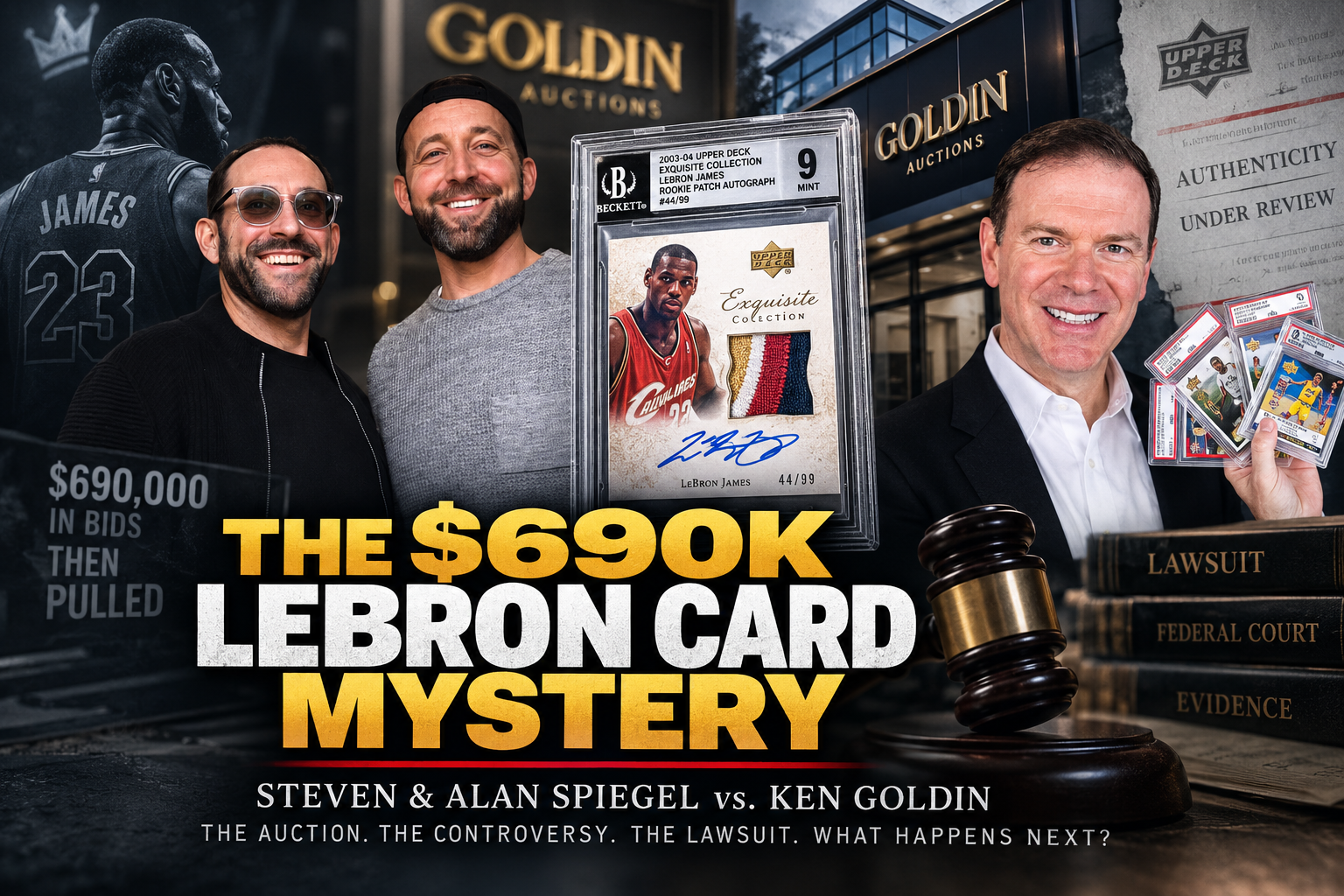
A high-value LeBron James rookie card that once attracted $690,000 in bids has become the centerpiece of a years-long legal battle involving collector Steven Spiegel, his brother Alan Spiegel, Goldin Auctions and its founder Ken Goldin. More than five years after Goldin abruptly pulled the card from auction, the dispute remains unresolved, with a federal judge finding that major questions about the card’s authenticity, the parties’ conduct and the events surrounding its withdrawal still require a factual determination.
The case centers on a 2003-04 Upper Deck Exquisite Collection LeBron James Rookie Jersey Patch Autograph card bearing serial number 44/99. Steven and Alan Spiegel purchased the card in January 2014 for approximately $35,000. Before they acquired it, the card had been graded a 9 by Beckett Grading Service. The Spiegels later obtained an Upper Deck letter concerning the card’s authenticity and had the card re-holdered by Beckett with a “Patch Authenticated” designation, according to court records.
The card became substantially more valuable as the market for high-end sports memorabilia exploded. By 2021, the Spiegels believed the LeBron rookie could command a price approaching or exceeding $1 million. Goldin Auctions agreed to sell it in June 2021, and the card was listed for auction on June 10. Within approximately 24 hours, bidding had reached $690,000. Then, on June 11, Goldin withdrew it from the auction. The abrupt decision transformed what had looked like a potentially record-setting sale into one of the most contentious disputes in the modern sports-card market.
The controversy had actually begun before the Goldin auction. Questions had been raised about the jersey patch embedded in the card. A photograph circulated showing what purported to be another version of the same serial-numbered card with a predominantly white patch rather than the multicolored patch visible in the Spiegels’ card. The implication was potentially explosive: if the photographs represented the same card at different points in time, the patch could have been changed.
The Spiegels disputed that interpretation and maintained that the photograph was unreliable and potentially manipulated. They sought confirmation from Upper Deck, the manufacturer of the Exquisite Collection, and received a letter in October 2019 stating that the card was authentic. That letter later became one of the most important pieces of evidence in the litigation.
Goldin subsequently contacted Upper Deck before putting the card on its 2021 auction block and verified the validity of the company’s letter. The card was then promoted for sale. But questions about the patch resurfaced, including scrutiny from an online sports-card account known as Cardporn, which the litigation describes as a participant in the hobby that frequently questioned the authenticity of cards and the practices of people and companies operating in the trading-card market.
According to the Spiegels’ lawsuit, Goldin’s decision to withdraw the card was inexplicable given that he had previously promoted the collectible and verified the Upper Deck letter. They alleged that Goldin’s actions effectively reinforced doubts about the card and damaged its market value. The Spiegels ultimately filed suit against Goldin Auctions and Ken Goldin in federal court in New Jersey on March 1, 2023.
The lawsuit accused the defendants of breach of fiduciary duty, tortious interference with prospective economic advantage, fraud in the inducement, breach of the implied covenant of good faith and fair dealing, and violations of the New Jersey Consumer Fraud Act. The defendants denied the allegations and maintained that Goldin Auctions had acted appropriately. The court allowed the core case to proceed after Goldin’s initial effort to have the lawsuit dismissed was denied.
The dispute subsequently became more complicated because Goldin’s side turned the allegations back on the Spiegels.
In May 2025, a federal magistrate judge granted Goldin Auctions and Ken Goldin permission to amend their answer and assert counterclaims against the brothers. The defendants alleged that the Spiegels had failed to disclose material information concerning questions about the card’s authenticity and that the alleged omissions were relevant to Goldin’s decision to accept the card for auction. The court allowed those counterclaims to proceed, but that decision was procedural and did not establish that the Spiegels had committed fraud.
The case also became embroiled in a discovery fight over communications involving Goldin, Cardporn and other members of the sports-card community. The Spiegels argued that certain communications and photographs relevant to the decision to withdraw the card had not been produced. They later sought sanctions for alleged spoliation of evidence.
In October 2025, the court denied that sanctions request. The ruling addressed whether the legal requirements for sanctions based on alleged destruction or loss of electronically stored information had been met; it did not resolve the underlying authenticity dispute or determine that either party’s broader version of events was true.
The most significant development came in May 2026, when U.S. District Judge Karen M. Williams considered competing motions for summary judgment in the case. Rather than ruling for either side, the court denied the motions, leaving the central factual disputes alive.
That decision is important because it means the litigation has not produced a judicial finding that the LeBron card is fake. It has also not produced a definitive ruling declaring the card authentic. Instead, the court found that the evidence presents factual disputes that cannot be resolved through summary judgment.
Among the disputed issues is the meaning and scope of the 2019 Upper Deck authentication. The Spiegels rely heavily on the manufacturer’s letter as evidence that the card was authenticated. Goldin’s side has challenged what the letter actually established, including whether it conclusively authenticated the specific jersey patch at issue. The competing interpretations have become central to the legal battle.
That distinction is crucial because the case is not simply about whether somebody believed the card was real. It is about what each participant knew, when they knew it, what was communicated to the other side and whether those communications were sufficient to establish liability under the parties’ contracts and applicable law.
The court’s refusal to grant summary judgment therefore leaves both sides facing unresolved factual questions. The Spiegels continue to argue that Goldin improperly withdrew a legitimate collectible after accepting it for auction and that the withdrawal damaged the card’s value. Goldin and his company maintain that they acted appropriately when authenticity concerns resurfaced and have alleged that the Spiegels themselves failed to disclose information that was material to the transaction.
The allegations against Steven Spiegel should therefore be treated carefully. Goldin’s counterclaims include fraud-related allegations, but Spiegel has not been found guilty of fraud, convicted of a crime or judicially determined to have knowingly sold a counterfeit card. The federal case is a civil dispute, and the court’s May 2026 ruling did not resolve those allegations in Goldin’s favor.
The same caution applies to the card itself. Despite years of scrutiny, social-media accusations, competing photographs, authentication documents and extensive litigation, the court has not declared the LeBron card counterfeit. The question of authenticity remains intertwined with disputed evidence about the patch, Upper Deck’s communications and what the various participants understood at the time.
For Steven Spiegel, the dispute has transformed what began as a potentially lucrative sports-card investment into a highly publicized federal lawsuit. Public reporting has described Spiegel as a longtime collector who also had interests in finance and real estate, while court filings identify him and his brother as collectors and secondary-market participants in the high-end sports-card industry.
The available public record does not establish a reliable picture of Spiegel’s current professional activities or exact whereabouts in 2026 beyond his continued involvement in the litigation. What is clear is that the legal battle over the LeBron card remains active and that the competing claims have not been finally adjudicated.
The saga also illustrates the unusual risks of the modern collectibles market. A sports card can carry an enormous financial value based not only on scarcity and the athlete depicted on it, but on a chain of authentication, grading, provenance and market confidence. Once confidence in any part of that chain is questioned, determining the truth can become extraordinarily difficult.
That is exactly what happened to LeBron James card No. 44/99.
It entered Goldin’s auction in June 2021 with expectations of a major sale. Within a day, buyers had pushed the bidding to $690,000. The auction was then terminated, the card became the subject of a bitter dispute and the owners eventually sued the auction house.
More than five years later, the central questions remain unresolved: whether the card’s patch is authentic, what Upper Deck actually intended to certify, what information the Spiegels and Goldin each possessed, and whether either side’s conduct crossed the legal line.
For now, the federal court has not concluded that Steven Spiegel committed fraud, and it has not concluded that the LeBron card is fake. What it has determined is that the evidence presents genuine disputes that cannot simply be resolved on paper.
The final answer to the mystery surrounding LeBron James rookie card No. 44/99 therefore remains to be determined in the continuing litigation.
————-
Disclaimer:
Some content on Reportingscams.com is published under our guest post program and is provided by third-party contributors. Reporting scams does not create, verify, or take responsibility for the views, accuracy, or claims expressed in such content.