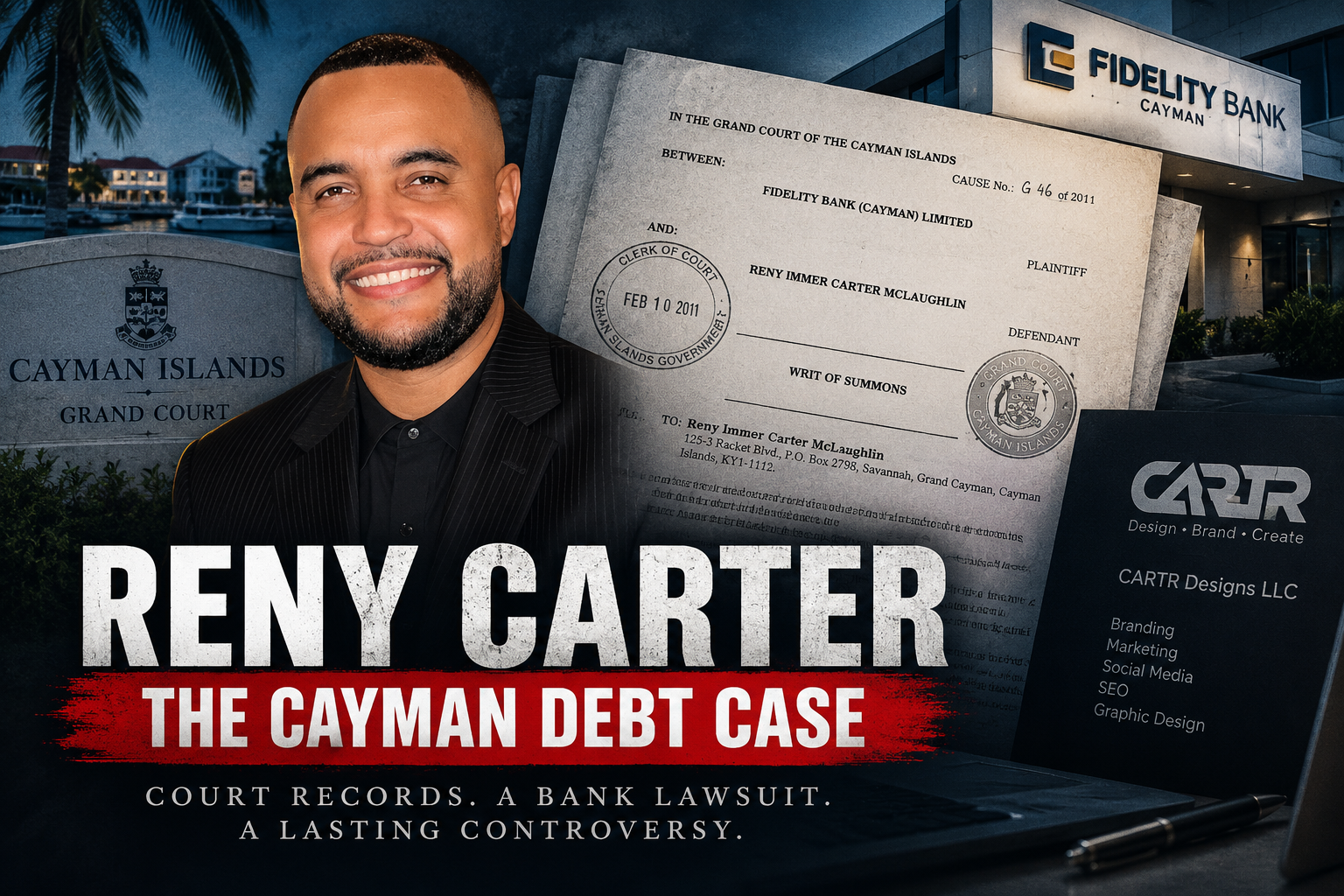
Reny Carter is not a figure who appears in the public record as a convicted fraudster, sanctioned businessman or criminal defendant. What the documents do show is more specific, and in some ways more revealing: a 2011 civil debt case in the Cayman Islands, a second court filing involving the same name in 2012, and a series of increasingly hostile public responses from Carter after those records were republished years later. The available evidence also shows that Carter remains professionally active in graphic design, branding, marketing and SEO, operating under the CARTR Designs name.
The legal name attached to the old Cayman proceedings is Reny Immer Carter McLaughlin. In his professional life he generally uses Reny Carter. A 2014 Cayman Compass report identifies a football player named Reny Immer Carter in Grand Cayman, while Florida corporate records identify the manager and registered agent of CARTR Designs LLC as “CARTER, RENY I, SR.” The overlap is strong enough to treat these records as referring to the same individual, although the public sources do not provide a formal biography establishing his date of birth.
What can be established about his background today is considerably clearer. Carter’s own CARTR Designs website describes him as the company’s founder and art director and says the business is based in the Cayman Islands. It describes him as a graphic designer and brand strategist with more than 15 years in the industry and says he works across branding, marketing, social media, SEO, logo design and visual identity. The site also says he is, or has been, art and marketing director for AA MEDIA Ltd, Kirk Motors, NAPA Auto Parts Cayman, AA RUBIS Gas Stations, National Concrete Cayman Ltd and Marksons Furniture. Those employment and client descriptions are self-published claims rather than independently verified employment records.
There is also evidence that the business remains active. Florida’s official Division of Corporations records show that CARTR Designs LLC was filed on February 20, 2023, remains active, and lists Reny I. Carter as its manager and registered agent. The company filed annual reports in 2024, 2025 and again on March 16, 2026. His Behance profile currently presents him as a CEO and art director specializing in logo design, brand identity and marketing, with CARTR Designs listed as his company and Tampa, Florida, as his location. The profile also contains work published as recently as 2025.
The controversy that follows Carter back to the public record begins in 2009. According to a writ of summons filed in the Grand Court of the Cayman Islands, Carter entered into a promissory note with Fidelity Bank (Cayman) Limited on August 21, 2009, for CI$59,200. The document says the loan carried interest at Prime plus 2%, stated at the time as 5.25%, and was supposed to be repaid in monthly installments of CI$399 beginning September 25, 2009.
The bank’s claim was straightforward: it said no repayments had been made under the note. By the time the statement of claim was filed on February 10, 2011, Fidelity said the outstanding balance had risen to CI$63,603, including accumulated interest. The bank sought that sum, continuing interest and costs. The writ was formally issued againstReny Immer Carter McLaughlin on February 10, 2011, and directed him to respond within 14 days after service.
The amount matters because this was not a complaint filed by a random creditor or an allegation circulating on social media. It was a formal civil proceeding filed in the Cayman Islands’ Grand Court. OffshoreAlert’s court-record archive independently identifies the February 10, 2011 filing as a Fidelity Bank action against Reny Immer Carter McLaughlin.
A second Fidelity Bank proceeding followed in 2012. OffshoreAlert’s records identify an Originating Summons in the same case, dated March 27, 2012. OffshoreAlert later described the two filings as writs concerning alleged indebtedness. The existence of that second proceeding is independently reflected in its court-record index, although the publicly searchable material available for this investigation does not establish the precise amount claimed in the 2012 filing.
That distinction is important. The 2011 documents establish a debt claim. They do not, by themselves, establish fraud, theft, money laundering, an investment scam or criminal misconduct. There is no evidence located in the sources reviewed here that Carter was criminally charged, pleaded guilty, convicted, fined by a regulator or ordered to pay a criminal penalty in connection with the Fidelity matter. The case was civil in nature.
Carter himself has disputed the continuing publication of the court records. In a January 2025 email to OffshoreAlert, he said the case had been “settled over a decade ago” and claimed that the records had been removed or “shredded.” He also said he intended to take legal action against websites continuing to publish his name. OffshoreAlert editor David Marchant rejected that account, responding that the writ had been published because it was a court record and saying that it could still be obtained from the Cayman court.
The public correspondence subsequently became part of the story itself. In January 2025, Carter sent further emails objecting to the reporting and at one point threatened physical violence against Marchant. The correspondence is preserved in the documents supplied for this investigation and was also published by OffshoreAlert. OffshoreAlert later published another Carter letter in May 2025 and two more letters in June 2026. Its current archive identifies five items connected to Carter, including the two original Fidelity Bank court filings.
One of Carter’s most significant claims deserves particular scrutiny. In his 2025 correspondence, he stated that Fidelity Bank no longer existed in Cayman because it had “closed down due to fraud.” The available institutional record does not support that explanation. Fidelity Bank continued operating for years after the 2011 lawsuit. Cayman Compass reported in February 2022 that Jamaica-based PROVEN Investments had completed its acquisition of 100% of Fidelity Bank Cayman, which had approximately US$354.1 million in assets at the end of the third quarter of 2021. Cayman Islands Monetary Authority records likewise listed Fidelity Bank as a Category A bank in 2022.
The bank was subsequently renamed PROVEN Bank (Cayman) Limited after the acquisition. Cayman Islands business records and the Cayman Islands Chamber of Commerce both identify PROVEN Bank as the former Fidelity Bank. A 2023 PROVEN annual report says the acquisition occurred in 2022 and that the banking business was restructured and rebranded under the PROVEN name. In other words, the evidence indicates a commercial acquisition and rebranding, not a bank disappearing because of a fraud shutdown.
There have nevertheless been controversies involving Fidelity Bank during its history, although they should not be confused with the Carter case. Cayman Compass reported in 2022 that evidence in a fraud trial involving Cayman football officials concerned a CI$1.6 million Cayman Islands Football Association loan with Fidelity and a US$500,000 CONCACAF deposit connected to a prepaid-card contract. The reporting concerned allegations against football figures, not a criminal finding that Fidelity itself committed fraud. The bank was also mentioned in reporting about the FIFA corruption investigation because accounts at Fidelity were used in transactions involving people investigated in that scandal. Again, that does not establish wrongdoing by Carter or by the bank itself.
The current picture is therefore more complicated than the labels often attached to online allegations. Carter is a working designer and marketer with an active Florida company and an active public-facing Cayman business identity. His professional portfolio continues to show branding projects, including work published during 2025. Public sources place his business footprint between Cayman and Tampa, but they do not reliably establish his precise physical whereabouts today.
The strongest adverse record found in this investigation is the historical civil debt litigation: a bank claimed that Carter borrowed CI$59,200, made no payments under the promissory note and owed CI$63,603 by February 2011, followed by another Fidelity proceeding in 2012. Carter says the matter was settled more than a decade ago, but the materials reviewed here do not include the settlement agreement or a final judgment confirming how the dispute ended.
That is where the record should end unless stronger evidence emerges. There is no responsible basis to transform a decades-old civil debt dispute into a claim of fraud or criminality. But there is also no reason to erase the court record simply because the person named in it objects to its continued publication. The larger lesson is about due diligence: a public record can survive long after a dispute has ended, while online claims about what happened to that dispute can be just as difficult to verify. In Carter’s case, the documents show a real lawsuit, a disputed account of its aftermath, an active business and a highly public confrontation over reputation. What they do not show is a criminal conviction or a proven fraud scheme. That distinction is not a technicality. It is the line between reporting what the evidence establishes and turning an old court file into something it never was.
Source:
OffshoreAlert
————-
Disclaimer:
Some content on Reportingscams.com is published under our guest post program and is provided by third-party contributors. Reporting scams does not create, verify, or take responsibility for the views, accuracy, or claims expressed in such content.