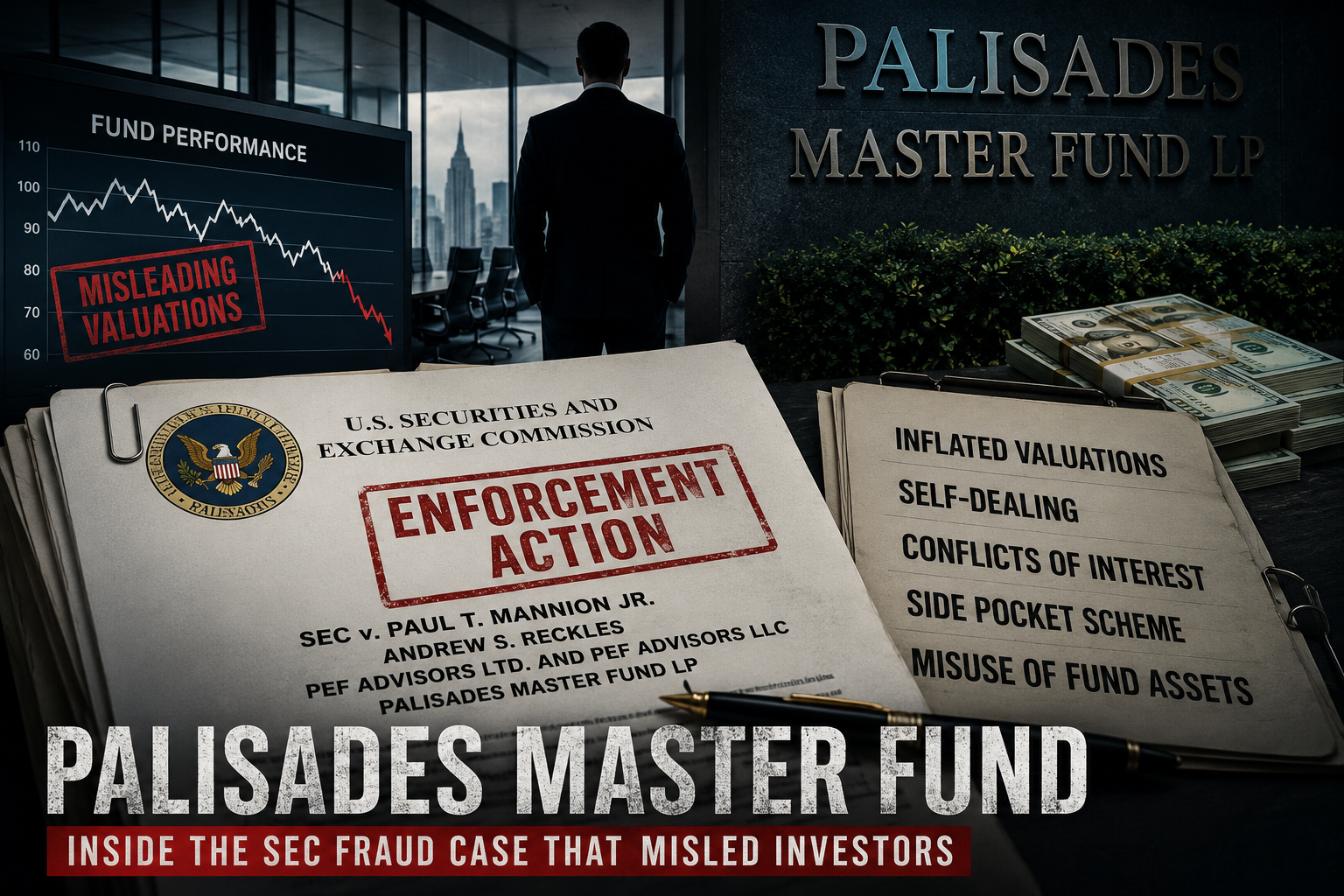
Investors trust hedge fund managers with one simple expectation. They believe the people running the fund will protect their money, report performance honestly, and avoid putting their own interests ahead of those of their clients. The SEC argued that those basic duties broke down inside Palisades Master Fund, where two investment advisers allegedly manipulated asset values, concealed conflicts of interest, and diverted fund assets for their own benefit. What began as a hedge fund promising sophisticated investment opportunities ultimately became a years-long enforcement case that exposed how difficult it can be for investors to detect misconduct occurring behind closed doors.
The SEC’s investigation centered on Paul T. Mannion Jr. and Andrew S. Reckles, principals of investment advisers PEF Advisors Ltd. and PEF Advisors LLC, which managed Palisades Master Fund LP. According to the Commission, the pair controlled investment decisions while also exercising substantial authority over how the fund’s holdings were valued and reported to investors. That combination of control, the SEC alleged, created opportunities for self-dealing and misleading financial reporting that continued over an extended period.
At the heart of the case was an investment in World Health Alternatives Inc. Rather than reporting the asset at what the SEC believed was a realistic value, regulators alleged that Mannion and Reckles dramatically overstated its worth in reports sent to investors. The difference was not insignificant. The SEC said the fund reported the position at more than $19 million even though the managers allegedly knew it was worth millions less. Inflated valuations can create a misleading picture of a fund’s health, making losses appear smaller than they really are and allowing managers to continue collecting fees based on asset values that may not reflect reality.
The SEC also focused on the managers’ use of a “side pocket,” an accounting tool sometimes used by hedge funds to isolate illiquid or difficult-to-value investments. Side pockets are not inherently improper. Many legitimate investment funds use them when assets cannot be easily priced. The problem, according to regulators, was not the existence of the side pocket itself but the way it was allegedly used. The SEC claimed the defendants placed troubled assets into the side pocket and continued assigning values that bore little resemblance to their actual market worth, creating a misleading impression of the fund’s financial condition.
Regulators further alleged that the misconduct extended beyond accounting judgments. According to the SEC’s complaint, Mannion and Reckles exercised warrants owned by the fund for their own benefit and failed to disclose private sales involving World Health Alternatives stock. Investors, the SEC argued, were entitled to know about these transactions because they involved fund assets and presented clear conflicts between the managers’ personal interests and those of the investors whose money they had been entrusted to manage.
Another part of the SEC’s case involved an investment in communications equipment company Radyne Corporation. Regulators alleged that while participating in a private investment in public equity, commonly known as a PIPE transaction, the defendants concealed that they were simultaneously holding a short position in the same company’s stock. Such information, according to the SEC, was material because investors evaluating the managers’ conduct would reasonably want to know whether the advisers had financial incentives that conflicted with the interests of the fund.
When the SEC filed its civil enforcement action in 2010, it accused Mannion and Reckles of violating multiple provisions of the federal securities laws, including the anti-fraud provisions governing investment advisers and securities transactions. The complaint sought permanent injunctions, disgorgement of allegedly ill-gotten gains, civil monetary penalties, and other equitable relief. Regulators described a pattern of misleading investors rather than isolated mistakes, arguing that the alleged misconduct affected both valuation practices and the use of fund assets.
The litigation continued for several years. Federal court filings show extensive motions and legal arguments as both sides contested the SEC’s allegations. The defendants denied wrongdoing during the litigation, challenging both the factual allegations and the Commission’s legal theories. Like many complex securities enforcement cases, the dispute involved large volumes of financial records, valuation evidence, and expert testimony before reaching a conclusion.
In 2014, the SEC announced that a federal court had entered final judgments against Mannion and Reckles. According to the Commission, the court permanently enjoined both defendants from future violations of the securities laws and ordered significant financial remedies, including disgorgement, prejudgment interest, and civil penalties. The judgments represented the culmination of years of litigation that began with the SEC’s investigation into Palisades Master Fund’s operations.
The case became notable because it illustrated several recurring themes that regulators continue to warn investors about. One is the danger of opaque asset valuations. Unlike publicly traded stocks, many hedge fund investments lack readily available market prices. Investors therefore depend heavily on managers to provide honest and supportable valuations. When those valuations are manipulated, investors may continue investing, leave money in a troubled fund, or pay management fees based on inflated numbers without realizing it.
Another lesson concerns conflicts of interest. Investment advisers owe fiduciary duties that require them to place clients’ interests ahead of their own. When fund managers personally benefit from transactions involving fund assets or fail to disclose conflicts, investors lose the ability to evaluate whether decisions are being made for the benefit of the fund or for the benefit of those controlling it. That principle sits at the core of many SEC enforcement actions involving private investment funds.
The Palisades matter also demonstrated why side pockets have attracted regulatory attention over the years. While they serve legitimate purposes for managing illiquid investments, they can become problematic if managers assign unrealistic values or use them to delay recognition of investment losses. Since the Palisades litigation, the SEC has repeatedly highlighted valuation practices and conflicts of interest as enforcement priorities across the private fund industry.
Publicly available records do not indicate that the Palisades matter resulted in criminal convictions arising from the SEC’s civil enforcement action. The case proceeded as a civil securities fraud matter, with the Commission seeking injunctive relief and financial penalties rather than criminal prosecution. Likewise, the available court records show that the defendants contested the allegations during the litigation instead of admitting liability. The final judgments resolved the SEC’s civil claims through the federal court process.
More than a decade after regulators first filed suit, the Palisades Master Fund case remains an example frequently cited in discussions about hedge fund governance and valuation oversight. It serves as a reminder that sophisticated investment structures do not eliminate the need for transparency or accountability. Investors often cannot independently verify complex portfolio valuations, making honest disclosure one of the most important protections they have. When regulators conclude that those disclosures have been compromised, the consequences can stretch far beyond one fund, reinforcing why oversight, independent valuation practices, and fiduciary responsibility remain central to maintaining trust in the investment industry.
————-
Disclaimer:
Some content on Reportingscams.com is published under our guest post program and is provided by third-party contributors. Reporting scams does not create, verify, or take responsibility for the views, accuracy, or claims expressed in such content.