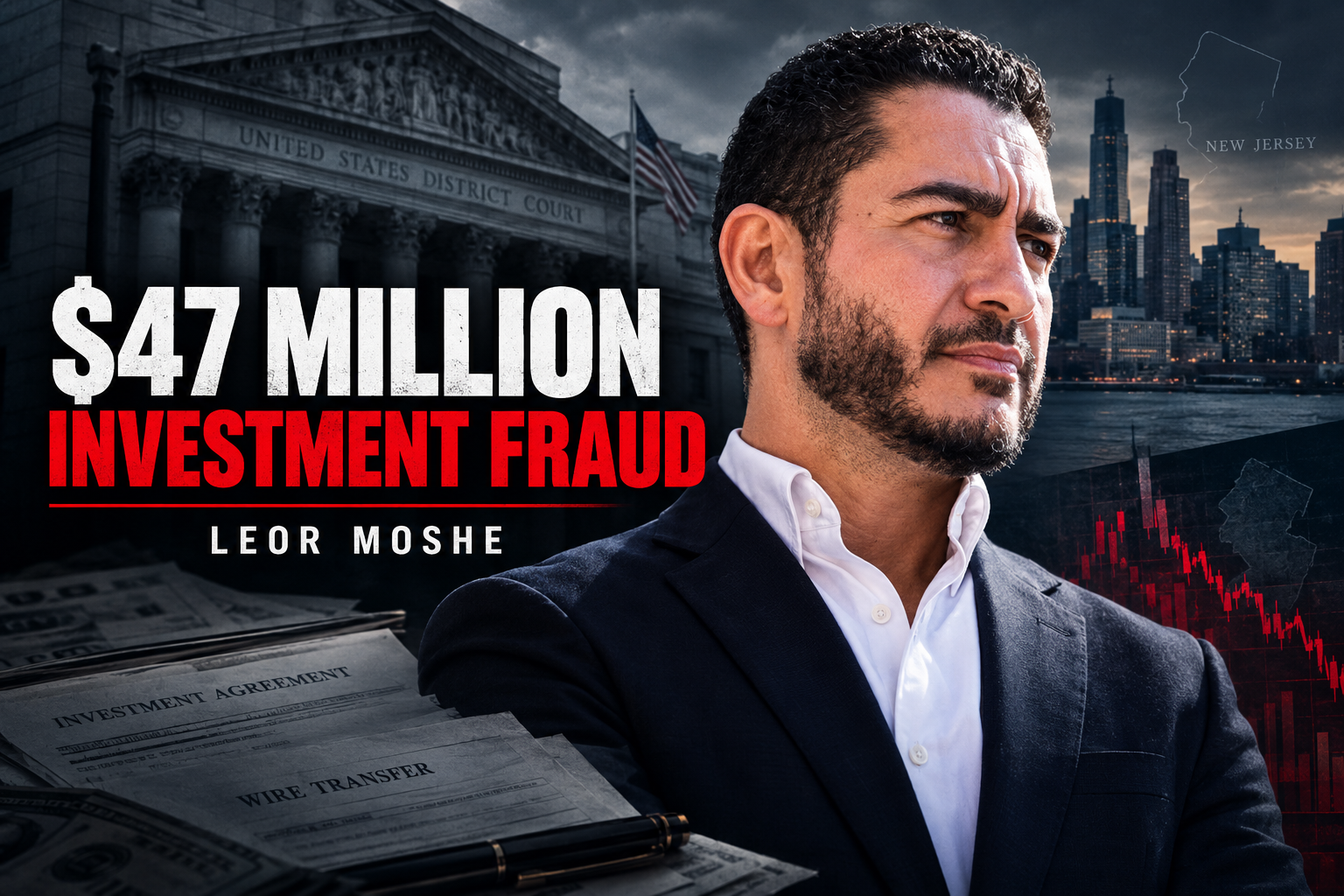
A New Jersey businessman who built an investment operation around promises of unusually high returns has admitted that more than $47 million flowed into his company from investors, many of whom came from the same close-knit Orthodox Jewish communities he belonged to. Leor Moshe, 43, of Toms River, pleaded guilty on August 13, 2026, to one count of wire fraud in federal court in Trenton. His sentencing is scheduled for December 16, 2026. The parallel civil case brought by the Securities and Exchange Commission names Moshe along with Jacob Goldman and Isaac Odes and remains unresolved.
The criminal case centers on Capital Funding ASAP LLC, a New Jersey company Moshe incorporated in 2018. Prosecutors say that beginning in 2019, Moshe presented Capital Funding as a short-term business lending operation. Investors were told their money would be used to finance loans to businesses and that they could receive fixed returns ranging from roughly 9% on shorter investments to as much as 53% on one-year investments. The SEC’s complaint says at least 87 investors put more than $47 million into the operation, while the Justice Department says more than 97 victims were affected. The difference appears to reflect the agencies’ different methods of counting investors and victims rather than a disagreement over the scale of the operation.
The central problem was where the money actually went. According to the SEC, Capital Funding generated little, if any, legitimate lending activity capable of producing the promised returns. At least $11 million was instead diverted for personal expenses, including gambling debts, credit-card payments, home renovations, mortgage payments, car payments and transfers to a personal cryptocurrency account. More than $850,000 was also used to make payments to earlier investors, allowing the operation to continue while new money was coming in.
One example in the federal records illustrates how the system worked. In February 2021, an investor sent approximately $380,000 into the Capital Funding account after being told the money would finance short-term loans and earn a return of about 9% to 10%. The account had contained only about $35,000 immediately before the deposit. Three days later, without another deposit during the interim, Moshe transferred approximately $88,000 to his personal cryptocurrency account. Prosecutors cited the transaction as part of the evidence supporting the wire-fraud charge.
The SEC complaint contains another example involving a $2 million investment made in February 2023. The account held about $349,000 before the money arrived. Within three days, approximately $820,000 was paid to five previous investors. The SEC says more than $471,000 of those payments came directly from the new $2 million investment. That is the basic mechanics of a Ponzi-like structure: money from later investors helps satisfy obligations to earlier investors rather than returns being generated by a productive underlying business.
The promises made to investors went beyond high returns. Some were told their principal was guaranteed or backed by collateral, including sports cards, real estate liens or Moshe’s ownership interest in a property-holding company called 120 Whitesville LLC. The SEC says some of that collateral either did not exist, had already been promised elsewhere or was later disposed of without investors being told. In one case, Moshe transferred ownership of a Jackson, New Jersey property to an investor after the scheme collapsed, but the SEC said the property’s value was significantly below the investor’s $2 million investment.
The regulatory complaint also describes a more elaborate effort to create the appearance of a functioning lending business. Moshe allegedly told one major investor that Capital Funding had a relationship with a legitimate New Jersey cash-advance company. The SEC says Moshe subsequently created Iruka Funding LLC, a separate company he incorporated in March 2023 and dissolved roughly seven weeks later. According to the complaint, he used the similar name while dealing with a bank, created a fabricated bank statement showing $26.1 million in deposits and $26.7 million in withdrawals, and sent the document to an investor. The SEC further alleges that Moshe created a letter purporting to come from the president of the legitimate cash-advance company and falsely stating that Capital Funding had $21.5 million invested in cash-advance deals. That investor ultimately put more than $3.5 million into Capital Funding between November 2022 and April 2023.
Moshe was not the only person drawn into the SEC case. Jacob Goldman, 44, and Isaac Odes, 40, both Toms River residents, are accused by the SEC of helping solicit investors without being registered as broker-dealers or associated with registered broker-dealers. The agency says the two men collectively brought in at least 25 investors who put more than $23 million into Capital Funding. Odes allegedly solicited at least 10 investors who invested more than $16 million, while Goldman allegedly solicited at least 15 investors who invested more than $7 million.
The SEC’s allegations describe a commission-driven sales structure. The agency says Odes received commissions ranging from 5% to 25% of investments and received more than $1.7 million from Capital Funding during the relevant period. Goldman, meanwhile, received more than $7 million from Capital Funding, including substantial amounts that the SEC says represented compensation for soliciting investors. The complaint says Goldman also discussed paying other people to bring in investors and described a system in which an intermediary could offer a prospective investor one return while keeping an additional percentage as compensation.
The operation began to unravel in 2023. The SEC says investors generally received promised payments through about May, although those payments were largely supported by new investor money rather than genuine lending profits. By June, most investors stopped receiving the promised returns, and no returns were paid after August 2023. The SEC estimates that investors ultimately lost more than $25 million. Capital Funding now appears to have ceased active operations, with the SEC reporting that it has no known assets or open bank accounts.
There was also a civil dispute involving Moshe before the federal enforcement action became public. In June 2023, Blueberry Funding LLC sued Moshe, 120 Whitesville LLC and a group of other defendants in New Jersey state court, alleging that the defendants had received $3.5 million under a financing arrangement, returned $1 million and failed to repay the remaining $2.5 million. The case also named Goldman, Odes and several members of the Moshe family and related entities. The state litigation was later the subject of additional proceedings and ultimately closed following settlement-related and dismissal proceedings. The existence of that lawsuit does not by itself establish the allegations made in it, but it shows that a significant financial dispute involving Moshe and some of the same people was already unfolding when the Capital Funding operation collapsed.
A separate 2025 federal case arising from that dispute provides another piece of the chronology. Blueberry Funding accused attorneys and others of attempting to steer alleged victims toward a religious arbitration process rather than conventional civil litigation. The federal judge dismissed several of the claims for inadequate pleading while allowing an unauthorized-practice-of-law claim to proceed at that stage. Those allegations concerned the handling of the earlier civil dispute, not a judicial finding that Moshe committed the later federal securities violations.
The federal criminal case against Moshe is now on a different footing. He did not merely face an allegation from prosecutors; he pleaded guilty to wire fraud. The charge carries a statutory maximum of 20 years in prison and substantial financial penalties, while the government’s criminal filing also contains a forfeiture provision covering property traceable to the offense. The Justice Department has credited the FBI and SEC investigation, and Moshe is represented by attorney Steven Yurowitz.
The SEC case is still pending against Moshe, Goldman and Odes. The agency is seeking permanent injunctions, disgorgement of allegedly ill-gotten gains plus prejudgment interest, civil monetary penalties and, in Moshe’s case, an injunction restricting participation in the offer or sale of securities. No final civil judgment or monetary award against the three defendants had been entered in the public record reviewed for this article as of September 17, 2026. Goldman and Moshe also invoked their Fifth Amendment privilege during the SEC investigation and declined to provide information about the business and investor funds. That is a documented procedural fact, not a finding of liability.
The record now paints a clear picture of the risk created when personal trust substitutes for independent verification. The investors were not simply approached through anonymous internet advertisements. According to the SEC, many came through community relationships, personal introductions, phone calls, meetings, texts and informal communications. The promised returns were unusually high, yet the investment was presented as a relatively straightforward way to participate in short-term business lending. Once the underlying business could not generate enough money to meet those promises, the structure depended on continued inflows.
That is what makes the Capital Funding case bigger than one failed New Jersey investment company. More than $47 million was raised, more than $25 million was lost, and at least $11 million was diverted to personal expenses according to federal authorities. Moshe has accepted criminal responsibility for wire fraud, while the SEC’s broader allegations against Moshe, Goldman and Odes remain to be resolved in court. For investors, the lasting lesson is not simply that spectacular returns can disappear. It is that trust, community reputation and apparently formal paperwork are not substitutes for checking where money is actually held, how an investment produces its returns, who is legally authorized to sell it and whether the underlying business can support the promises being made.
————-
Disclaimer:
Some content on Reportingscams.com is published under our guest post program and is provided by third-party contributors. Reporting scams does not create, verify, or take responsibility for the views, accuracy, or claims expressed in such content.