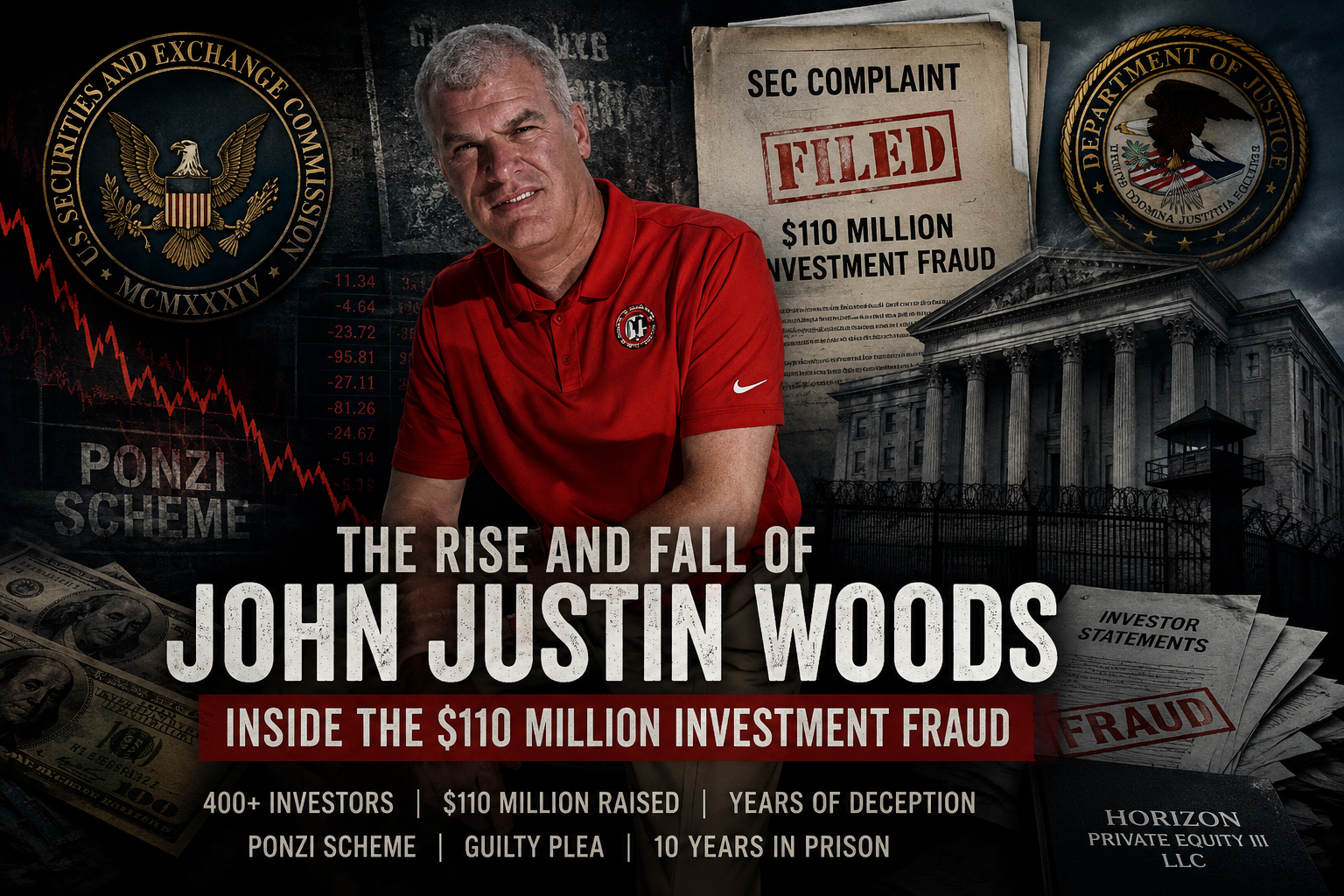
For years John Justin Woods built a reputation as a trusted investment adviser, portraying himself as a seasoned financial professional who could help clients grow and protect their wealth. He introduced clients to a private investment fund through his Georgia-based advisory firm, Southport Capital, that he called a conservative opportunity backed by commercial lending and other income-producing assets. Most of the people who invested with him weren’t looking for crazy bets or outsized returns. They were retirees, business owners, professionals and long-time clients who thought they were putting their life savings with a trusted adviser. That confidence eventually collapsed when federal investigators determined that the investment operation was not what it was presented to investors as being.
As of August 2021, the United States The Securities and Exchange Commission has filed emergency enforcement action against Woods, his registered investment advisory firm Livingston Group Asset Management LLC, doing business as Southport Capital, and Horizon Private Equity III LLC. Woods raised more than $110 million from about 400 investors by promoting Horizon as a diversified private investment fund while hiding the fact that much of the money was being used to pay back earlier investors and finance personal expenses, the SEC said. Regulators alleged that what looked like a successful investment business was actually a Ponzi scheme that lasted for years and was sustained by new investor money, not actual investment returns.
The SEC’s complaint painted a picture of a business built on confidence, but sustained through deception. Investors were promised their money would be loaned out short-term, and invested elsewhere, in ways that would provide steady income. Instead, regulators said, investors’ money was moved in large amounts for undisclosed purposes. Millions of dollars were allegedly shuffled from account to account to give the illusion of a thriving investment business, even as account statements revealed values and returns that prosecutors later argued did not reflect the true financial state of the fund.
Federal authorities also charged Woods with tightly controlling the information that investors received. Instead of signs of increasing financial difficulties, investors continued to receive reports indicating that Horizon was financially sound. That helped to give existing investors confidence their money was safe in the fund and to bring in new clients, whose investments were increasingly important in keeping the operation afloat. The SEC also claims that about $33 million of investor money was used to pay earlier investors, a classic Ponzi scheme pattern in which money from new investments is used to meet the obligations of earlier investments, rather than the profits earned by legitimate business activity.
Criminal charges soon followed the civil enforcement lawsuit. Federal prosecutors say Woods masterminded the fraud for almost 10 years, starting around 2012 and lasting until regulators intervened in 2021. The Department of Justice said Woods repeatedly lied about the financial condition of Horizon Private Equity III and how investor money was being used. Prosecutors said he was aware the fund did not have enough income to cover its liabilities, but he continued to raise more capital and feed investors false information about the state of the company.
One of the stranger aspects of the case was Woods’ dealings with his own firm’s compliance department. Court filings and regulatory records alleged he provided false and misleading information to Southport Capital’s chief compliance officer regarding the movement of investor funds and the fund’s financial position. A compliance officer helps the investment adviser understand and comply with securities laws and identify potential regulatory violations. “Woods ‘compromised one of the firm’s most important internal safeguards designed to protect investors by concealing important information from the individual responsible for oversight,’ prosecutors said.
Those allegations later played a big role in the criminal case when Woods admitted that he had intentionally misled his firm’s compliance officer. The admission underscored how internal compliance systems can fail when senior executives deliberately withhold or misrepresent material information, prosecution-focused industry publications noted. The case is now often cited by compliance professionals as an example of how even established advisory firms can fall down when the person at the helm overrides internal controls.
Investigators into Horizon’s finances found client money had been spent on things far outside the investment strategy clients thought they were buying. The SEC said Woods funneled millions of dollars to personal expenses, including luxury cars, expensive travel, country club memberships, jewelry and other personal expenses not related to investors’ interests. The purchases were made while clients still believed their money was being invested in opportunities in commercial lending that would provide steady returns, prosecutors said.
Authorities also alleged Woods used progressively complex transfers among accounts and related entities to sustain the illusion of a profitable investment business. Regulators said he kept touting the fund’s health and ability to deliver consistent returns instead of alerting investors to Horizon’s perilous financial condition. When the SEC sought emergency relief in 2021, investigators felt the difference between what investors had been told and the fund’s actual financial condition had become significant.
The SEC asked a federal court for an order freezing assets tied to Woods, Southport Capital and Horizon Private Equity III and for the appointment of an independent receiver to take control of the companies to stop further losses. In large investment fraud cases, receivers are often appointed to preserve any remaining assets, investigate financial records and maximize potential recoveries for the victims. The role of the receiver was key to tracing the investors’ money and finding out if there was any meaningful recovery to be had for the hundreds of people who were affected by the scheme.
The damage was already done for many investors. “Horizon attracted hundreds of clients who believed they were investing in a relatively conservative private fund managed by a licensed financial professional with years of experience in the industry,” federal authorities said. Rather, investigators found that the scheme relied more and more on bringing in new investors’ money to meet the obligations to existing investors. More than $110 million was invested in the program before regulators stepped in, making it one of Georgia’s largest investment fraud cases prosecuted in recent years.
As the investigation progressed, admissions in the criminal case bolstered the civil allegations. In November of 2021, John Justin Woods pleaded guilty to one count of wire fraud in federal court. His plea reflected his role in running the fraudulent investment scheme and misleading investors about how their money was being managed, prosecutors said. Woods’ criminal case was unlike many securities enforcement actions that resolve in settlements without an admission of wrongdoing. He formally admitted he had been involved in a scheme that defrauded clients. With the guilty plea, the government’s case became much stronger and much of the uncertainty about the facts alleged in the SEC’s civil complaint went away.
Federal prosecutors said Woods’ misconduct went beyond lying to investors. He is accused in court filings of knowingly hiding the fund’s financial decline while continuing to market Horizon Private Equity III as a stable, profitable investment. He also admitted to providing false information to the chief compliance officer of his firm which hampered the internal oversight mechanisms to uncover the problems that were brewing within the business. Management should give accurate information so that compliance officers can identify regulatory risks, and misleading them weakened one of the most important protections available to investors, prosecutors said.
As investigators tracked the movement of investor funds, the implications became clearer and clearer. Rather, the SEC said, the big piles of cash that clients thought were being put to work in commercial lending opportunities were instead used to pay off existing investors, cover operating expenses and bankroll Woods’ personal lifestyle. The money was used to pay for luxury vehicles, private travel, expensive jewelry, country club memberships and other personal expenses, investigators alleged. During this time, investors continued to receive account statements and updates indicating that their investments were safe and performing as expected.
The case also grabbed headlines because of Woods’ profession. Before founding Southport Capital, he spent many years in the securities industry and was associated with a number of brokerage firms including Oppenheimer & Co. Industry records show his securities licenses and work with clients seeking investment advice predates the founding of Horizon Private Equity III. That experience gave him credibility with investors, many of whom believed he understood financial markets and how regulations were supposed to work. Prosecutors said he betrayed that trust by promoting Horizon as a well-managed investment fund when its financial situation was worsening.
Additional customer complaints and arbitration claims were filed as the regulatory proceedings continued. Woods identifies several disclosure events on FINRA’s BrokerCheck and investment adviser records regarding the failure of Horizon. Arbitration and civil suits have been filed by a number of investors to recover losses, who say they were tricked into believing their investments were safe and could be held for the long term. While each claim involved different facts and individual circumstances, they together demonstrated the widespread financial harm investors suffered when the fund collapsed.
In its enforcement action, the SEC sought a variety of civil remedies beyond just shutting down the operation. Regulators want the court to permanently enjoin Woods from violating federal securities laws, order him to disgorge his ill-gotten gains, plus prejudgment interest, and impose civil monetary penalties. The agency also sought to bar him from serving as an officer or director of a public company, if appropriate, and pursued industry bars that would effectively end his ability to work as a registered investment adviser. The allegations indicated a long-term betrayal of the clients’ trust by Woods.
The criminal case had even worse consequences. A federal judge sentenced Woods in 2024 to 10 years in prison for operating what prosecutors called a decadelong Ponzi scheme. The Department of Justice said the sentence “reflects the seriousness of a fraud that caused substantial losses to hundreds of investors who entrusted him with their retirement savings and other investments.” The court also ordered Woods to pay restitution of more than $33 million but full recovery depends on whether assets exist and the outcome of receivership proceedings. And while the government is working to track down and recover remaining assets, many victims may never be made whole financially.
The investigation also exposed the wider problems facing regulators in trying to oversee private investment funds. Many private funds are not subject to the same public disclosure requirements as publicly traded companies, which means that investors often must rely heavily on representations made by fund managers and investment advisers. Regulators have repeatedly warned that honesty, transparency and strong internal controls are especially critical in such a structure. The Woods case has become an example enforcement officials cite to demonstrate how easily investor confidence can be exploited when those safeguards break down.
Woods was the star of both the civil and criminal proceedings, but the fallout went far beyond one person. The court-appointed receiver spent years reviewing financial records, locating assets, evaluating claims and trying to maximize the money recovered for the victims. Meanwhile, regulators continued administrative proceedings that resulted in Woods being barred from the investment advisory industry, effectively ending his ability to function as a registered adviser. In short, the SEC enforcement action, the DOJ criminal prosecution, and the receivership were a coordinated effort to hold the responsible parties accountable and to recover as much money as possible for investors who suffered significant financial losses.
The fall of Horizon Private Equity III also serves as a reminder that investment fraud is typically not a one-day event. The scheme was able to continue for nearly a decade because investors believed the consistent account statements, regular communications and promised returns were indicative of actual investment performance, investigators say. In fact, prosecutors said, new money from investors was increasingly being used to prop up obligations the fund could no longer meet by itself. As long as new money kept coming into the business the underlying financial problems were not apparent to many of those whose savings were at risk.
The case also exposed the need for independent oversight. Investment advisers have fiduciary duties to place the interests of their clients ahead of their own, disclose material risks and tell the truth about investment performance. Woods repeatedly failed to fulfill those duties, according to federal officials, by providing false information about Horizon’s finances and concealing how investor money was being used. His admission that he misled the compliance officer at his own firm was another example of how internal safeguards can be rendered impotent when the person charged with running the business actively conceals critical information.
The losses for the victims went far beyond financial losses. Many investors poured their retirement savings, college funds, business proceeds and other life savings into Horizon Private Equity III, believing they were investing in a relatively conservative private fund, according to court records and statements from federal prosecutors. In 2021, when regulators froze assets, many could not access money they’d expected to count on for future financial security. The receiver has sought to identify and recover assets that are available, but it has always been uncertain that every dollar lost would be recovered, which is a common reality in large-scale investment fraud cases.
The action against Woods also illustrates how multiple government agencies often work together when suspected securities fraud reaches the criminal level. The SEC focused on investor protection, asset freezes and civil penalties, while the U.S. The Department of Justice criminally charged the matter, which led to a guilty plea and sentence to federal prison for ten years. Those actions sent a clear message that investment advisers who misuse client funds and misrepresent investment products can be subject to both civil liability and criminal prosecution.
Today, John Justin Woods is back in the investment advisory business. His criminal conviction effectively ended a career that had once relied on earning clients’ confidence, while SEC administrative proceedings barred him from associating with investment advisers, permanently. Public regulatory records now contain more than a dozen disclosure events about his professional history, a sign of the extensive legal and regulatory fallout from the collapse of Horizon Private Equity III. What began as a business built on trust ended up as one of Georgia’s biggest investment fraud prosecutions in years.
In the end, John Justin Woods’ story is about more than one adviser or one failed investment fund. It shows how credibility, professional experience and long-standing client relationships can sometimes create a false sense of security when transparency and accountability disappear. The case is a reminder to investors of the importance of independently verifying investment opportunities, reading regulatory records carefully and questioning unusually steady returns or limited disclosures. It is a reminder to regulators and the financial industry that strong compliance systems are only as good as the people running an organization who elect honesty over deception. The financial losses in the Horizon case were in the tens of millions of dollars, but the erosion of trust among hundreds of investors may prove to be the lasting legacy of one of the biggest Ponzi scheme prosecutions to emerge from Georgia’s investment advisory industry.
————-
Disclaimer:
Some content on Reportingscams.com is published under our guest post program and is provided by third-party contributors. Reporting scams does not create, verify, or take responsibility for the views, accuracy, or claims expressed in such content.