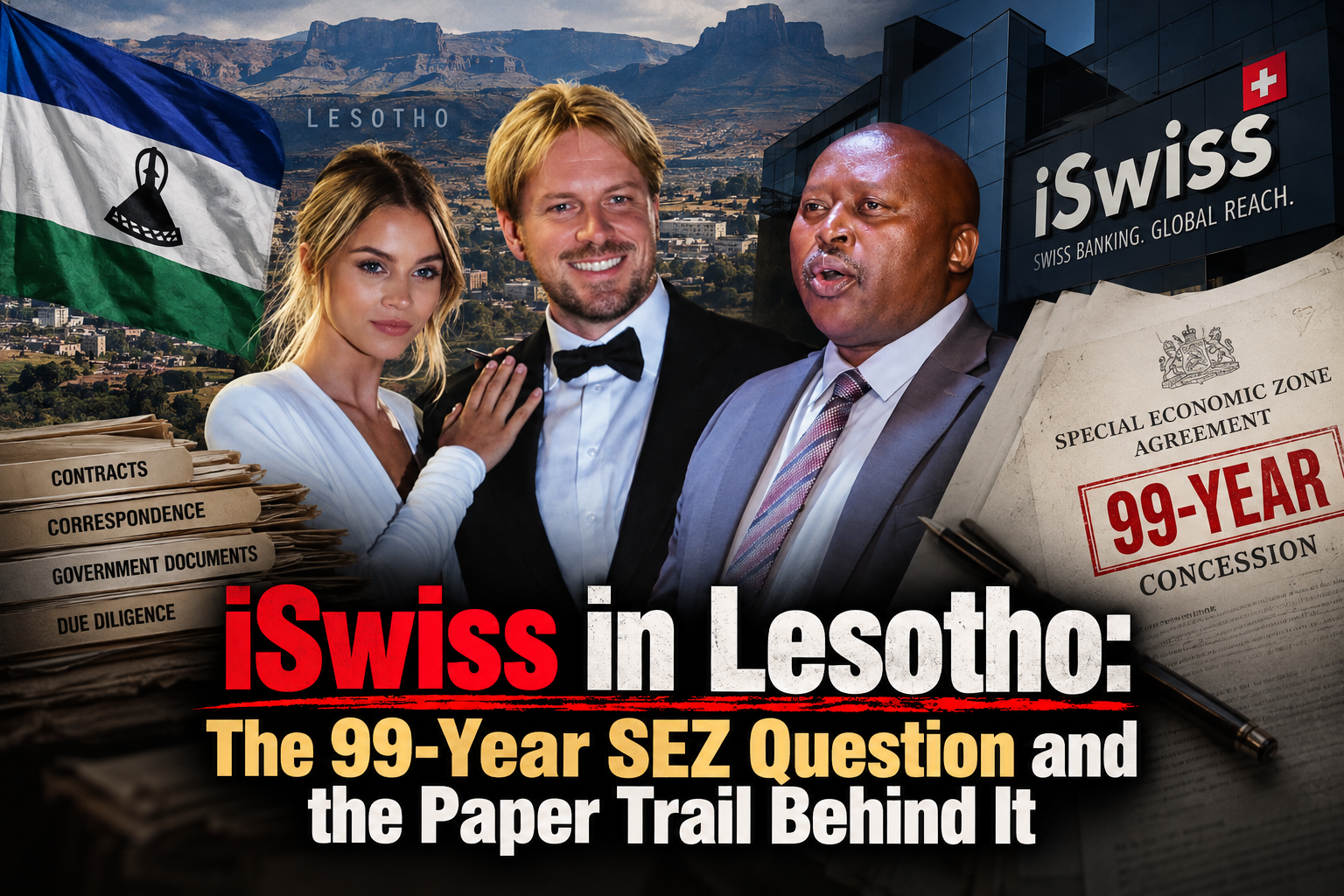
An examination of iSwiss, Christopher Aleo, Minister Mokhethi Shelile and Lesotho’s proposed Special Economic Zones partnership raises questions about how a relatively new corporate presence became central to a potentially 99-year economic project.
A potentially far reaching economic project in Lesotho has raised questions about transparency, due diligence and the government’s decision-making process after a company known as iSwiss emerged as the proposed private sector partner for the country’s Special Economic Zones.
The issue is not simply whether iSwiss is a legitimate company. The more important question is how the company came to occupy such an important position in Lesotho’s economic plans, particularly when the arrangement described in a draft policy would give iSwiss a 75 percent stake in a joint venture with the government and potentially place the partnership on a 99-year footing.
This reporting does not establish that iSwiss is a scam, nor does it prove that any government official acted improperly. What it does reveal is a sequence of events involving corporate registrations, meetings with a government minister, assistance from a former ministry employee, an unsolicited proposal and a draft policy that specifically identified iSwiss as an exclusive partner. Taken together, those events leave several questions that have not been fully answered.
How iSwiss Appeared in Lesotho
The story begins in 2024, when iSwiss established a corporate presence in Lesotho.
On May 30, 2024, iSwiss Lesotho (Pty) Ltd was incorporated. Its listed activities included accounting, bookkeeping, auditing, tax consultancy and management consultancy. The company’s sole director and shareholder was identified as Christopher Aleo, an Italian national.
Just days later, on June 5, iSwiss Bank Ltd was incorporated. Aleo reportedly held 999,999 shares, while Simona Jakstaite, a Lithuanian national, held one share.
Both companies were registered at the same address, 12 Orpen Road, Maseru Sun Hotel & Casino, in Maseru.
There is nothing inherently unusual about an international business establishing local entities before beginning operations in a new country. Nor does the use of a hotel address, by itself, demonstrate anything improper. What makes these registrations relevant is what happened around them and what role iSwiss would soon be given in the country’s proposed SEZ strategy.
The Link to Minister Mokhethi Shelile
One of the more significant parts of the story concerns Mokhethi Shelile, Lesotho’s Minister of Trade and Industry, Business Development and Tourism.
A former ministry employee, Lesole Maleke, told Newsday that iSwiss was introduced to him by Shelile and that he was asked to help the company with its registration. Maleke had spent nearly 37 years working in the ministry and said his experience with business registration made him suitable to assist the company.
Shelile confirmed that he had referred iSwiss to Maleke.
The minister said he had met representatives of the company in Dubai, where they discussed Special Economic Zones. When the representatives subsequently arrived in Lesotho, they came to his office, after which he referred them to ministry personnel who could assist with their registration.
Shelile characterized this as ordinary practice, explaining that investors frequently approach his office before being directed to the relevant government department.
That explanation accounts for how iSwiss came into contact with Maleke. But it does not answer the larger question surrounding the company’s subsequent role in the SEZ project.
Lesole Maleke and the Corporate Trail
Maleke’s involvement did not end with the initial registration assistance.
According to the reporting, corporate records show that on August 20, 2024, Maleke was appointed as an agent of Swiss Capital F.Z.E Pty Ltd, a company incorporated in the United Arab Emirates. Its registered physical address was in Ajman Free Zone, while its main business address in Lesotho was again listed at the Maseru Sun Hotel & Casino.
Christopher Aleo was listed as the company’s director.
Maleke explained that the company required someone based in Lesotho with a physical address in the country to satisfy registration requirements. He therefore became its local agent.
None of these facts, standing alone, establishes wrongdoing. They do, however, provide an unusually detailed picture of the company’s early corporate footprint in Lesotho and the people who assisted it in establishing that presence.
That becomes more significant when viewed alongside the government’s emerging SEZ plans.
The SEZ Proposal
Lesotho has been considering Special Economic Zones as a means of attracting investment and diversifying its economy. A feasibility study was completed in November 2019 as part of cooperation between the Ministry of Trade and Industry and the African Development Bank.
The issue involving iSwiss arose several years later, when a draft SEZ policy for 2024–2029 reportedly identified iSwiss as the government’s exclusive partner for establishing and managing the zones.
According to the draft described in the reporting, the Government of Lesotho and iSwiss would establish a joint venture in which the government would own 25 percent while iSwiss would hold the remaining 75 percent. The joint venture would have exclusive rights to create and manage the SEZs, subject to local law.
The proposed arrangement was also reported as potentially involving a 99-year commitment.
That figure is what gives the controversy much of its significance. A commercial arrangement lasting nearly a century raises obvious questions about the financial strength of the private partner, the protections available to the government and the process through which that partner was selected.
Was There Actually a 99-Year Deal?
The government has been clear on one point: it said no 99-year agreement had been signed with iSwiss.
After Newsday reported on the proposed arrangement, the Ministry of Trade and Industry disputed the claim that the government had already entered into such a deal.
The ministry also disputed the description of an October 17, 2024 meeting as a meeting to validate the SEZ policy. According to the ministry’s public relations officer, the meeting was instead held to discuss the feasibility study with business associations and other stakeholders. The ministry also stated that no SEZ policy had yet been adopted.
That distinction is important. A draft policy is not the same thing as a signed contract. The existence of a draft document does not establish that the government had legally committed itself to a 99-year agreement.
But it raises another question: why did a draft policy circulating within the ministry identify iSwiss specifically as the government’s exclusive partner?
The Ministry’s Changing Explanation
The controversy became more complicated when Minister Shelile addressed the issue publicly.
Shelile maintained that the October 17 meeting was not intended to validate the document. However, when questioned by reporters, he acknowledged that the meeting had indeed been called to validate the document and attributed the discrepancy to an error by the ministry.
At the same time, he argued that the document could not be considered an official ministry document because the ministry had not formally adopted it.
Shelile described it as a document circulating within the ministry.
That leaves an obvious gap in the public explanation. If the document was merely an internal draft, who prepared it? Who authorized its circulation? And, most importantly, who decided that iSwiss should be identified as the government’s exclusive partner?
The available reporting does not provide a definitive answer.
The Unsolicited Proposal
Perhaps the most important admission from Shelile concerns how iSwiss first came into consideration for the SEZ project.
When asked whether the company had been selected through a competitive bidding process, Shelile confirmed that iSwiss had submitted an unsolicited proposal.
He also acknowledged that the ministry had been in discussions with the company. The minister referred to other companies but did not identify them publicly.
An unsolicited proposal is not, by itself, evidence of anything improper. Private companies regularly approach governments with investment ideas, and governments may evaluate such proposals.
The unanswered issue is what happened after iSwiss made its proposal.
The public account reviewed for this article does not explain in detail what evaluation process followed, what criteria were applied to iSwiss, whether other companies were formally considered or what due diligence was performed before the company appeared as the proposed exclusive partner in the draft policy.
That is particularly relevant given the size and proposed duration of the project.
Who Are Christopher Aleo and Simona Jakstaite?
The reporting also examined the people at the center of iSwiss.
Christopher Aleo is presented as the key figure behind the company and was identified in the Lesotho corporate records as the dominant shareholder and director of the entities discussed in the report.
Simona Jakstaite, who held one share in iSwiss Bank Ltd, has also been publicly associated with Aleo.
Newsday reported finding limited publicly available information about the company and its leadership. Its investigation noted that Aleo’s online presence included significant references to fashion and film, while Jakstaite also appeared prominently in social-media and lifestyle coverage.
Those observations should be treated cautiously.
A person’s social-media presence is not evidence of financial misconduct, and the absence of extensive information online does not prove that a company is illegitimate. A serious assessment of a financial group requires examination of corporate structures, regulatory licenses, financial statements, ownership information and previous business activities.
For that reason, the more useful question is not what Aleo or Jakstaite post online. It is what documentation exists behind the companies they represent.
The Due Diligence Question
If iSwiss was being considered for a 75 percent interest in a joint venture responsible for Lesotho’s Special Economic Zones, the government’s due-diligence process becomes highly relevant.
The public record described in the reporting does not provide a complete picture of that process.
It remains unclear what financial information iSwiss provided to the government, what evidence of previous large-scale projects was examined, whether independent financial or legal assessments were commissioned, and whether regulators or other authorities were consulted before the company was positioned as the proposed private-sector partner.
It is also unclear whether the government formally compared iSwiss with competing companies or whether the unsolicited proposal became the basis for the company’s preferred position.
These questions do not mean the answers would necessarily be damaging to iSwiss or the government. Proper due diligence may have been performed behind the scenes.
The problem is that the public cannot determine that from the information currently available.
Why the 75/25 Structure Matters
The proposed ownership structure deserves particular attention. Under the draft arrangement described in the reporting, the government would own 25 percent of the joint venture while iSwiss would own 75 percent.
That would place the private company in the majority position. The proposed joint venture would also receive exclusive rights to establish and manage the SEZs.
In other words, the issue is not simply that a private company was being considered as a contractor or consultant. The proposed arrangement would potentially give iSwiss a controlling financial interest and an exclusive operational role in a major national development initiative.
When combined with the reported 99-year term, the scale of the proposal becomes difficult to ignore.
What the Paper Trail Shows
The available record paints a fairly clear timeline, even though important details remain unresolved.
iSwiss established its first reported Lesotho company in May 2024 and another financial entity shortly afterward. Christopher Aleo was central to the ownership and management of those companies. Minister Mokhethi Shelile confirmed meeting iSwiss representatives and referring them for assistance with registration. Former ministry employee Lesole Maleke subsequently became involved in the companies’ local registration arrangements.
Around the same period, iSwiss was pursuing discussions with the government concerning Special Economic Zones. The company ultimately submitted an unsolicited proposal.
A draft SEZ policy then identified iSwiss as the proposed exclusive partner, with a reported 75 percent share in the joint venture compared with 25 percent for the government.
The government subsequently denied that any 99-year agreement had been signed and maintained that the policy had not been adopted. That sequence is not proof of a scam.
But it is enough to justify questions about the process.
The Questions That Remain
The central issue surrounding iSwiss in Lesotho is therefore not whether the company can be branded a scam based on the information currently available.
There is not enough evidence in the material reviewed to make that conclusion responsibly.
The more important issue is transparency.
Why was iSwiss selected as the proposed exclusive partner after submitting an unsolicited proposal? Was there a formal assessment of the company’s financial and operational capacity? Were other potential partners considered? What due diligence was carried out? Who drafted the policy language giving iSwiss the exclusive role? And what safeguards would protect Lesotho if the proposed partnership were eventually structured to last for 99 years?
The government may have straightforward answers to these questions.
If it does, publishing the relevant documentation would go a long way toward resolving the controversy.
For iSwiss, the same principle applies. If the company has the financial resources, regulatory standing, corporate history and operational experience necessary for a project of this scale, independently verifiable documentation could help establish that record.
Until that information is made clearer, the iSwiss story remains an unresolved investigation not a proven fraud case.
What makes it noteworthy is the combination of a newly established corporate presence, a direct connection with a senior government minister, an unsolicited proposal and a draft policy that placed the company at the center of a potentially 99 year national economic project.
For a country deciding how to shape its economic future, those are questions worth answering before the paperwork becomes irreversible.
————-
Disclaimer:
Some content on Reportingscams.com is published under our guest post program and is provided by third-party contributors. Reporting scams does not create, verify, or take responsibility for the views, accuracy, or claims expressed in such content.