Online finance programs appear every year promising freedom from traditional work. Some are legitimate digital businesses. Others sit in a much more controversial space where financial claims start raising questions. One name that has recently drawn attention across financial forums and investigative blogs is Simon Goldberg aka The Spaniard. He is often connected with a group called Empower the People and a system that claims people can receive large refunds from the United States government.
Supporters see Goldberg as someone exposing financial systems that ordinary people never learn about. Critics believe the program is built on questionable interpretations of tax law that could place participants at risk.
The debate around his program has spread across online communities, investigative websites, and social media discussions.
To understand the controversy it helps to look at how Goldberg built his online presence and what exactly his program claims to do.
Who is Simon Goldberg?
Simon Goldberg appears online as a self proclaimed financial mentor. His visibility comes almost entirely from the internet. Most people encounter him through webinars, recorded presentations, private groups, or social media content.
The message promoted in many of these presentations focuses on financial independence. The story usually speaks directly to people struggling with debt, rising living costs, or frustration with traditional employment.
The Spaniard presents the idea that hidden systems exist within finance and taxation that can help ordinary people recover money or eliminate financial pressure. For viewers dealing with financial stress the message can feel powerful and personal. It often sounds less like a sales pitch and more like a discovery someone wants to share. This style of presentation has helped attract followers from many countries.
What is Empower the People
Empower the People is the name commonly linked to Goldberg’s program. It is described by supporters as a financial education community that teaches people how to reclaim money through government systems.
Within the community members often share stories about discovering financial loopholes or learning strategies that banks and institutions supposedly do not want people to know.
Critics argue that the program goes beyond financial education and promotes a controversial method of claiming tax refunds from the United States government. The central claim suggests that everyday personal expenses may create financial credits that can be reclaimed through tax filings.
This idea has attracted attention from tax experts who strongly dispute the interpretation.
What is the tax refund claim people are being told about
At the center of the controversy is a theory involving a tax document called Form 1099 OID. This form normally exists for a specific reason. It is used by financial institutions to report interest income earned from certain debt instruments such as bonds.
Investigations into the program say participants are told that ordinary spending may somehow generate financial credits that can be reclaimed through this form. People are encouraged to calculate the amount they spend each year on things like housing, bills, or personal costs. That spending is then used to support refund claims submitted through tax filings.
Tax professionals say this interpretation has no connection to how the form actually works. Authorities in the United States have warned for years about schemes that misuse this document in an attempt to generate artificial tax refunds. This disagreement between the official purpose of the form and the claims promoted inside the program sits at the heart of the controversy.
How the Simon Goldberg tax refund scheme is said to work
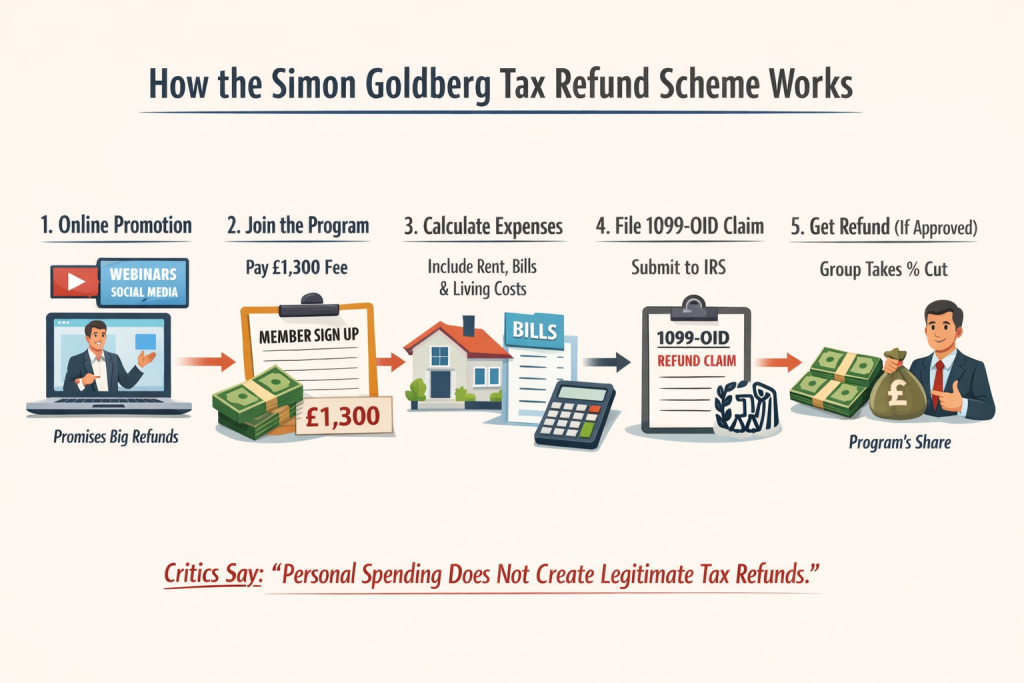
People usually discover the program through social media posts, private groups, or online presentations. The message often focuses on the idea that governments and financial institutions hide certain financial rights from ordinary citizens. Viewers are told that by learning these systems they may be able to recover large amounts of money.
Once someone joins the community they are introduced to a process that revolves around a tax document known as Form 1099 OID. Members are told that everyday personal spending may create financial credits that can be reclaimed from the United States government. This spending can include housing payments, bills, and other living expenses.
Participants are guided through calculating how much money they spent during the year. That amount is then used in tax filings that request refunds from the Internal Revenue Service. Critics say the filings rely on an interpretation of tax law that does not match how the form is actually meant to be used.
To participate people may be asked to submit identification documents and sign paperwork related to the tax submission process. Reports say some participants sign documents before seeing the final information that is later filed with tax authorities.
The program reportedly requires an upfront payment of around thirteen hundred pounds. If a refund is issued a portion of that payment may also be taken by the organization behind the program.
Tax experts warn that personal spending does not generate refundable tax credits in this way. Because of that authorities have previously treated similar filings as incorrect or fraudulent tax claims.
How people become involved in the program
People usually discover the program through online presentations or recommendations from someone already involved. After joining the community participants are guided through a process that involves calculating personal spending and submitting identification documents.
Some reports suggest that passports may be used to obtain taxpayer identification numbers needed for the tax filings. Participants may sign paperwork that is later submitted to authorities as part of refund claims.
The program reportedly requires an entry payment of around thirteen hundred pounds. If a refund is issued a portion of that payment may also be taken by the organization. Supporters describe the process as a way to reclaim money from a hidden financial system. Critics say the structure raises serious questions about legality and risk.
Why financial experts warn people about this system
Tax professionals focus on a simple point. Personal spending does not create refundable tax credits under United States law. Because of that experts believe refund claims based on everyday living expenses may be classified as incorrect filings.
Authorities have previously prosecuted promoters of similar refund systems. People who submit those filings can face penalties if tax authorities determine the claims are false.
Even individuals who believed they were following legitimate advice can find themselves dealing with investigations or repayment demands. For this reason many tax specialists say any system promising government refunds linked to normal household spending should be examined very carefully.
Why critics connect the program to unusual financial theories
Some investigators have also noticed similarities between the ideas promoted in the program and financial theories that have circulated online for many years. These theories often claim that governments hold secret financial accounts connected to individuals or that certain legal documents can cancel debts.
Courts across several countries have repeatedly rejected these arguments. Judges have ruled that these claims have no legal foundation.
Despite this history such ideas continue to attract attention online. People who feel trapped by financial pressure may be drawn to any concept that promises a path out. Programs built around these beliefs often spread quickly through digital communities.
What supporters say about Simon Goldberg
Supporters of Goldberg describe him very differently from critics.
Inside the community he is often seen as someone challenging traditional financial systems. Followers believe he is exposing information that banks and governments prefer to keep quiet. Members frequently share motivational stories about discovering new financial possibilities or learning ideas that changed their perspective about money.
For many participants the sense of belonging inside the community becomes an important part of the experience.
This positive environment can make criticism from outsiders feel unfair or hostile.
Why critics believe the system is dangerous
Critics see the situation from a completely different angle. They argue the program relies heavily on hope and financial desperation. When people believe they have discovered a hidden financial loophole they may stop questioning whether the idea actually works.
Investigators worry that individuals may unknowingly submit tax filings that authorities later classify as fraudulent.
The real risk is not only financial loss. Legal consequences can follow when incorrect tax claims are filed with government agencies.
For critics the biggest concern is that many participants may not fully understand the risks involved.
Why legal disputes have become part of the story
The controversy around Simon Goldberg has not remained limited to financial debates. Some critics who publicly examined the program say they received legal threats after publishing their findings. One online content creator who analyzed the claims reportedly faced legal action after releasing videos about the system.
Supporters of Goldberg say such responses are necessary to stop misinformation. Critics believe legal pressure may discourage people from asking questions. These conflicts have helped push the controversy into wider public discussion.
Questions people search online about Simon Goldberg
Many people who encounter the program start searching for information online before making any decisions.
A common question people ask is whether Simon Goldberg’s tax refund system is legitimate. Tax professionals who have examined the claims say the theory behind the refunds does not match how the tax system works.
Another question people often ask is whether participants could face legal trouble. Experts warn that submitting incorrect tax filings can lead to penalties and investigations even if someone believed they were acting in good faith.
Some people also ask whether the program has actually paid refunds. Supporters share stories of success while critics argue these examples do not prove the system is lawful.
These questions continue to appear in search engines as the debate grows.
Why programs like this continue to spread online
Financial pressure plays a major role in the growth of programs like this. When people struggle with debt or rising costs they naturally look for solutions that promise relief. The idea that hidden financial systems exist can feel incredibly attractive.
Online marketing strengthens that belief. Testimonials, screenshots of earnings, and personal stories create an image of opportunity that feels real and immediate.
Once a community forms around those ideas the message spreads quickly. Members share the opportunity with friends and family because they genuinely believe they have discovered something valuable.
This cycle helps programs gain momentum even when experts raise warnings.
The bigger question people should ask before joining any financial program
The story around Simon Goldberg raises a larger issue that appears repeatedly in the digital finance world.
Whenever a program promises large amounts of money through secret loopholes the most important step is simple verification.
Understanding exactly how money flows through the system matters far more than motivational presentations or inspiring success stories.
Looking at official laws, financial regulations, and independent expert analysis can often reveal whether a claim is realistic.
Financial freedom is a powerful idea. The internet makes that promise travel faster than ever before.
Separating genuine opportunity from optimistic marketing has quietly become one of the most important financial skills people can develop today.
Source:
https://www.youtube.com/watch?v=eKL2wKqxC58
https://taxpolicy.org.uk/2026/02/25/simon-goldberg-empower-the-people-tax-fraud/
————-
Disclaimer:
Some content on Reportingscams.com is published under our guest post program and is provided by third-party contributors. Reporting scams does not create, verify, or take responsibility for the views, accuracy, or claims expressed in such content.