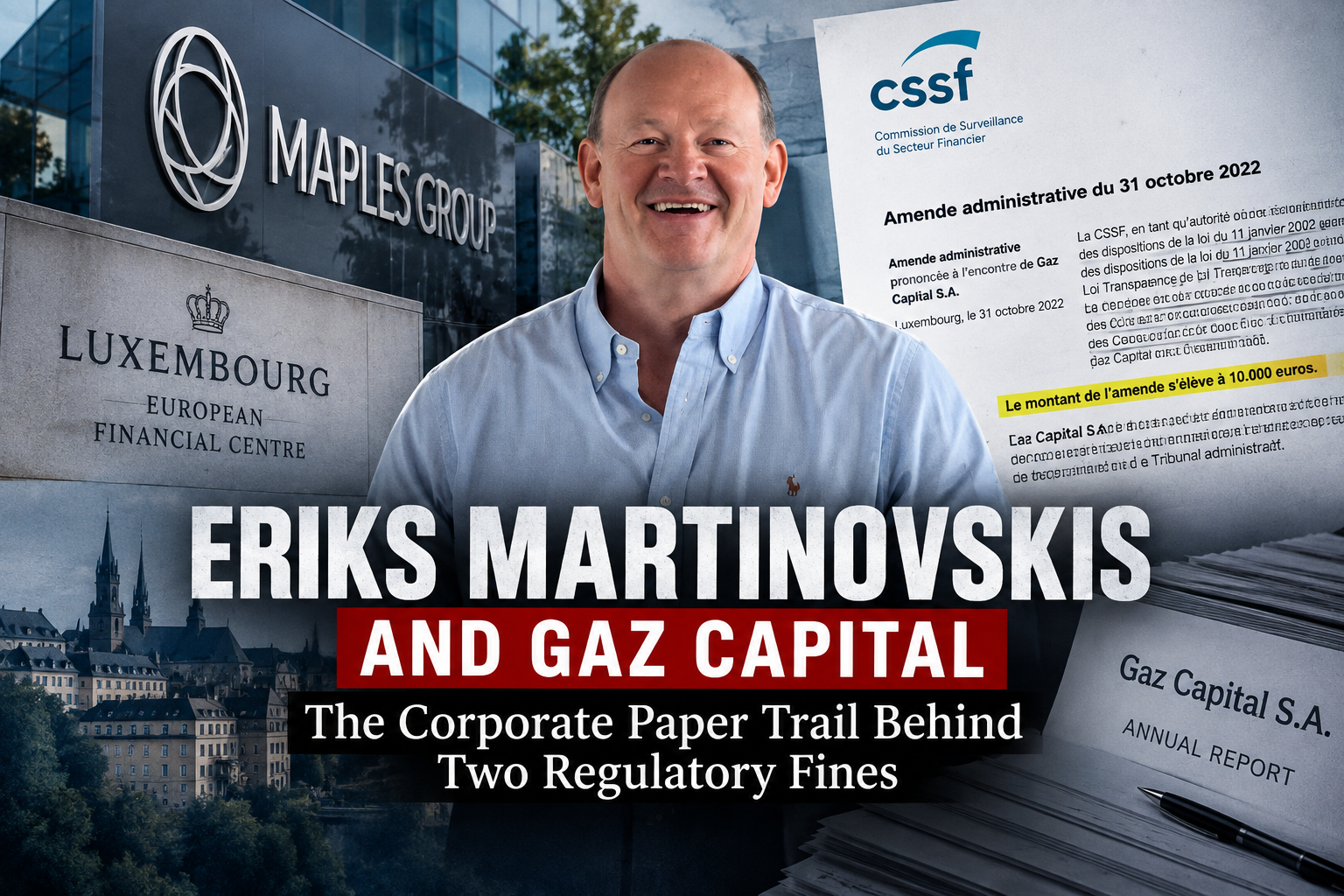
Eriks Martinovskis has spent much of his professional life operating in the quiet world of Luxembourg corporate structures, where directors, holding companies, investment vehicles and fiduciary service providers can sit several layers away from the businesses and assets they ultimately support. His name does not appear in the public record as someone convicted of fraud or personally fined for the Gaz Capital violations that have attracted attention. But his documented corporate connections, his role at Gaz Capital and the company’s repeated regulatory failures make the paper trail worth examining closely.
Martinovskis was born in Ventspils, Latvia, on September 12, 1980, according to Luxembourg’s official corporate records. That makes him 46 in September 2026. The same records identify him as a company director and show that he has held management positions in Luxembourg structures going back at least to 2012. Public records reviewed for this article do not establish a credible alternative name or alias for him. Professionally, he is based in Luxembourg, where he is identified as director of Loyal Wallet Partners S.à r.l., a business-consulting company. The company’s own website lists Martinovskis as its director.
That company is more than a name appearing on a website. Luxembourg’s official gazette records show Loyal Wallet Partners acting through Martinovskis in corporate structures, including a 2016 transaction in which the company was represented by him as its sole manager. His professional footprint also extends into Switzerland. Corporate records identify him as president of Loyal Wallet Swiss SA, whose stated activities include accounting, legal and tax consulting, multi-family-office services and other consulting work.
The Gaz Capital connection is where the story becomes more consequential.
Gaz Capital S.A. is a Luxembourg financing company associated with Gazprom and used in international debt markets. Its securities have been held by institutional investment funds, including U.S.-registered investment funds, demonstrating that its financial obligations have had exposure beyond Russia and Luxembourg.
Martinovskis became a director of Gaz Capital in August 2022. Luxembourg Stock Exchange documentation identifies him as a director from August 19, 2022, and names Loyal Wallet Partners as Gaz Capital’s corporate administrator from the same date.
Just weeks later, however, the Luxembourg financial regulator was dealing with a reporting failure that had occurred before Martinovskis took the job.
On October 31, 2022, Luxembourg’s Commission de Surveillance du Secteur Financier, known as the CSSF, imposed a €10,000 administrative fine on Gaz Capital. The regulator said the company had published its annual financial report for the year ended December 31, 2021 late. The sanction was imposed against Gaz Capital S.A. under Luxembourg’s Transparency Law.
The chronology matters. According to a letter sent by Luxembourg attorney Joram Moyal to OffshoreAlert on October 12, 2023, Martinovskis was appointed to Gaz Capital after the relevant filing deadline had already passed. Moyal stated that the accounts were due by June 30, 2022 but were not filed until July 27, 2022. Martinovskis, according to the letter, was not appointed until August 24, 2022. Moyal therefore argued that his client could not have been responsible for the missed deadline.
The CSSF document itself supports an important part of that distinction: it names Gaz Capital as the sanctioned entity. It does not name Martinovskis as the person fined or accused of causing the late filing. The penalty was €10,000, and the regulator stated that Gaz Capital had the right to challenge the decision before Luxembourg’s Administrative Court.
Martinovskis’ lawyer subsequently contacted OffshoreAlert because, according to the letter, the publication of the Gaz Capital sanction had generated questions from clients concerned about Martinovskis’ reputation. The lawyer described him as an independent company director working for a number of companies and asked that the alert be cancelled or amended. OffshoreAlert published the letter, making Martinovskis’ position part of the public record.
But the regulatory story did not stop with the 2022 fine.
On August 21, 2026, the CSSF imposed another €10,000 administrative sanction on Gaz Capital. This time the problem concerned the company’s annual financial report for the year ended December 31, 2025. The CSSF’s current information page lists Gaz Capital among issuers that failed to publish their annual financial report by the applicable deadline of April 30, 2026.
That second action is significant because it demonstrates that the company’s reporting problems were not confined to the 2021 financial year. The two sanctions are separated by nearly four years, yet both involve the same fundamental regulatory obligation: timely disclosure of annual financial information.
The latest sanction does not, however, establish personal wrongdoing by Martinovskis. The CSSF’s published material concerns Gaz Capital. It does not state that Martinovskis personally committed fraud, concealed information, misappropriated money or caused the company’s reporting failure. Nor does the material reviewed establish an investor-loss figure, restitution order, disgorgement award or illicit personal gain arising from either regulatory case.
That distinction is particularly important because Martinovskis’ broader corporate network has attracted scrutiny for reasons extending beyond Gaz Capital.
A 2025 investigation by financial-intelligence firm Kharon examined Luxembourg-based Altair Holding S.A. and its connections to Russian business interests. Kharon reported that Martinovskis was listed as Altair Holding’s sole shareholder in October 2014. But the firm also reported that a lawyer for Martinovskis said he had transferred 100% of his ownership interest in 2014 and had not retained an ownership stake. Kharon said later corporate records connected Altair to other ownership, while Martinovskis went on to hold management roles in European affiliates of Russian companies, including a Gazprom subsidiary.
Kharon also traced Martinovskis to companies associated with Azimut Hotels, a Russian hospitality group. The Luxembourg corporate record independently shows Martinovskis holding management positions in companies linked to that business network.
There is another layer to the story: his work for Pharmstandard International S.A. U.S. securities filings identify Martinovskis as a director of the Luxembourg company and show him signing filings on its behalf. One SEC filing identifies him as the person signing a Form 13F report for Joint Stock Company Pharmstandard, while another securities document records his signature as director of Pharmstandard International. Pharmstandard International’s own website continues to identify Martinovskis as its director.
The pattern visible in these records is therefore not a simple criminal case. It is a corporate network spanning Luxembourg, Switzerland, Russia-linked businesses, investment structures and international securities markets. Martinovskis repeatedly appears in the paperwork as a director, manager or corporate-services professional.
That is precisely why separating documented facts from assumptions matters.
There is no finding in the sources reviewed that Martinovskis personally committed fraud in connection with Gaz Capital. There is no identified criminal conviction, guilty plea or personal restitution order arising from the two CSSF sanctions. There is also no evidence in the reviewed records that the €20,000 in combined Gaz Capital fines represented money stolen from investors. They were administrative penalties imposed on the company for failures involving financial-report publication.
What the record does establish is more specific. Gaz Capital was fined €10,000 in 2022 for late publication of its 2021 annual financial report. Martinovskis became its director only afterward, according to his lawyer’s account and corporate documentation. Gaz Capital was then hit with another €10,000 CSSF sanction in August 2026 over the publication of its 2025 annual financial report. The company remains subject to Luxembourg’s transparency regime, which requires issuers to provide timely regulated financial information to investors and regulators.
And Martinovskis remains active in the corporate world. His professional presence identifies him with Loyal Wallet Partners, while public corporate records continue to connect him to international companies and financial structures.
That is the part investors and counterparties should pay attention to: not an unsupported accusation against an individual, but the documented trail of companies, directorships and regulatory events surrounding him. Gaz Capital’s two fines do not prove personal misconduct by Martinovskis. They do show that a major Luxembourg issuer connected to his directorship has twice faced regulatory penalties for financial-reporting failures. In a financial system built on disclosure, deadlines and investor access to reliable information, repeated compliance failures are not merely paperwork issues. They are precisely the kind of events that regulators record publicly so that markets can see where disclosure obligations were not met.
The paper trail is therefore still open. The latest CSSF sanction places Gaz Capital’s reporting practices back under scrutiny in 2026, while Martinovskis continues to operate within the international corporate-services ecosystem. The facts do not justify turning him into a criminal defendant who does not exist in the record. They do justify asking a harder and more useful question: when the same issuer is sanctioned again for failing to meet transparency obligations, who was responsible for ensuring that investors received the information they were legally entitled to receive, and what safeguards are now in place to prevent the failure from happening again?
Source:
OffshoreAlert
————-
Disclaimer:
Some content on Reportingscams.com is published under our guest post program and is provided by third-party contributors. Reporting scams does not create, verify, or take responsibility for the views, accuracy, or claims expressed in such content.