For years, Andreas Maria Maximilian Freiherr von Mauchenheim genannt Bechtolsheim, better known as Andy Bechtolsheim, stayed out of the chaos that often surrounds Silicon Valley’s biggest names. While others chased headlines, he built quietly in the background, helping shape the infrastructure that powers the internet. That silence broke in 2024 when U.S. regulators accused him of insider trading, pulling one of tech’s most low profile billionaires into a legal spotlight he had managed to avoid for decades.
Bechtolsheim’s rise in the industry reads like classic Silicon Valley folklore. After studying at Stanford University, he co founded Sun Microsystems, a company that became central to early internet computing. His engineering work on high performance workstations helped lay the foundation for networked computing at scale. People who were around in those early days often recall him as someone who cared more about how systems worked than how companies were perceived. That mindset carried through his career.
After Sun’s rise and eventual acquisition by Oracle, Bechtolsheim did not fade out. Instead, he continued to invest and build. He later co founded Arista Networks, which grew into a serious competitor to Cisco Systems in the cloud networking space. Arista became known for high speed switching technology used by data centers and large scale cloud providers. Through all of this, Bechtolsheim maintained a reputation that was almost unusual for Silicon Valley. He stayed quiet, rarely gave interviews, and avoided the kind of public persona that many founders cultivate.
That is part of what made the events of 2024 stand out so sharply.
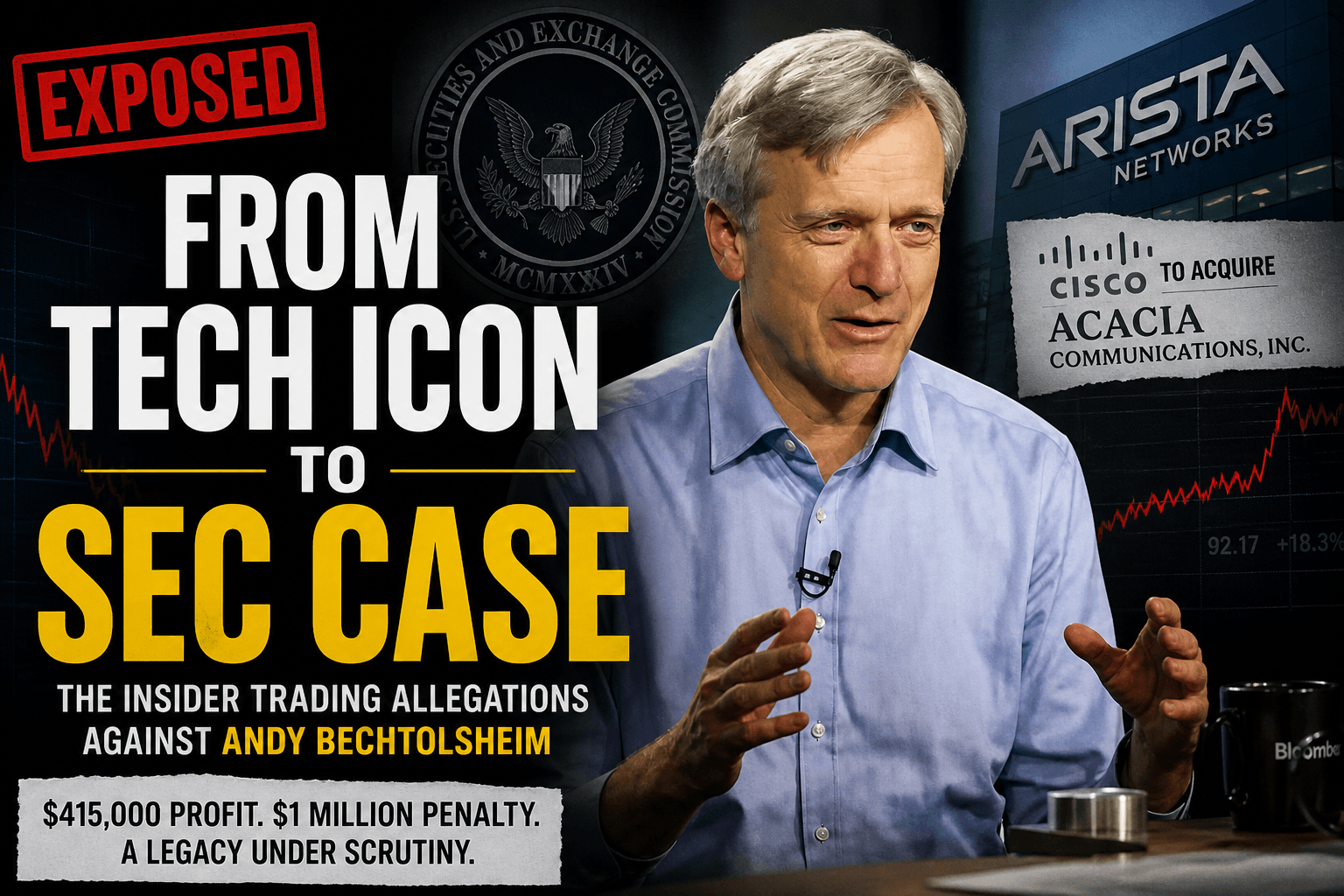
In March that year, the U.S. Securities and Exchange Commission filed charges accusing Bechtolsheim of insider trading tied to Cisco’s planned acquisition of Acacia Communications. According to the SEC, he obtained nonpublic information about the deal through his role and connections within Arista. These are the kinds of conversations that happen behind closed doors in corporate environments, where timing and confidentiality are everything.
Regulators allege that instead of keeping that information confidential, Bechtolsheim used it to purchase shares of Acacia before the acquisition was publicly announced. When Cisco revealed the deal, Acacia’s stock price jumped significantly. The trade resulted in a profit of around $415,000.
On paper, that figure is not especially large for someone of his wealth. But that is exactly what made the case feel unusual to many observers. It raised a simple but uncomfortable question. Why take that kind of risk for that kind of gain. For regulators, the answer was straightforward. The act itself was enough. It did not matter whether the profit was small or massive. What mattered was the use of inside information.
The case did not drag on. Bechtolsheim chose to settle with the SEC without admitting or denying the allegations. He agreed to pay nearly $1 million in total penalties, including disgorgement of profits and additional fines. Legally, this kind of resolution is common. It allows cases to close without prolonged court battles. But outside the courtroom, settlements like this tend to leave a mark that is harder to quantify.
Shortly after the charges became public, Bechtolsheim stepped down as chairman of Arista Networks. The company continued its operations without visible disruption, but the leadership change carried meaning. In Silicon Valley, exits at that level are rarely random. They usually signal pressure, even if it is not openly discussed.
The situation also exposed something deeper about how power works in the tech industry. Executives like Bechtolsheim operate in environments where sensitive information flows constantly. Deals, acquisitions, partnerships. These are not isolated events. They are part of the daily rhythm of large technology companies. Being early to that information is valuable. Acting on it is where the line gets drawn.
There is no public evidence suggesting that Bechtolsheim had a history of similar violations. Still, the case highlights how thin the boundary can be between access and misuse. It does not always take a pattern. Sometimes a single decision is enough to trigger regulatory action and reshape a career narrative.
People who have followed his career for years often describe him as disciplined, technical, and focused. Not someone driven by short term gains. That contrast is part of what makes the case linger. It does not fit neatly into the usual storyline of aggressive trading or repeated misconduct. Instead, it feels like a break from character, which in some ways makes it more difficult to explain.
For the SEC, the message is broader than one individual. Enforcement in insider trading cases has become more aggressive, especially in sectors like technology where market moving information is concentrated among a small group of insiders. The Bechtolsheim case shows that regulators are willing to act even when the individual involved does not fit the typical profile of a repeat offender.
For Silicon Valley, it serves as a reminder that reputation alone does not provide insulation. Decades of credibility can be complicated by a single incident. Not erased, but changed.
Bechtolsheim’s contributions to computing remain significant. His work at Sun Microsystems helped shape early internet infrastructure. His role at Arista Networks pushed forward the capabilities of modern data centers. Those achievements are still part of his story. But they now sit alongside a regulatory case that cannot be ignored.
The case may be closed from a legal standpoint, but its impact continues in quieter ways. In boardrooms, in investor circles, in the way people talk about risk and judgment. For someone who spent most of his career operating away from public scrutiny, the shift is noticeable.
And in an industry where trust often matters as much as technology, even a single moment of questionable judgment can echo long after the numbers are settled.
————-
Disclaimer:
Some content on Reportingscams.com is published under our guest post program and is provided by third-party contributors. Reporting scams does not create, verify, or take responsibility for the views, accuracy, or claims expressed in such content.