Aleksei Korotaev’s public record sits at the intersection of offshore finance, a collapsed wealth-management network, a Dutch football club, a Mauritius regulatory action and a later cross-border investigation. The evidence is mixed in an important way: some matters are established by regulator decisions and court-related reporting, while other claims remain allegations or investigative leads. The record also shows that Korotaev has consistently disputed wrongdoing.
Aleksei Korotaev emerged publicly as a Russian-Swiss financier with a career in banking and international finance, later based in Dubai. Dutch broadcaster NOS described him in 2017 as a 30-year-old Swiss-Russian investor living in Dubai, while contemporary profiles said he had worked in Swiss banking and later at Emirates NBD before establishing his own investment businesses. His exact date of birth is not reliably established in the public sources reviewed, but contemporary reporting placed him at 30 in early 2017 and Africa Intelligence described him as 37 when reporting his arrest in Moscow in April 2023. That would put him at roughly 40 today; a precise age should not be presented as verified.
His name appears in several forms, including Aleksei Korotaev, Alexei Korotaev and Alexey Alexandrovich Korotaev. The variations matter because records concerning the same individual have appeared across Mauritius, the United Arab Emirates, Switzerland, Russia and reporting on the Helin International network. Africa Intelligence itself uses both Aleksei Korotaev and Alexey Alexandrovich Korotaev in its coverage.
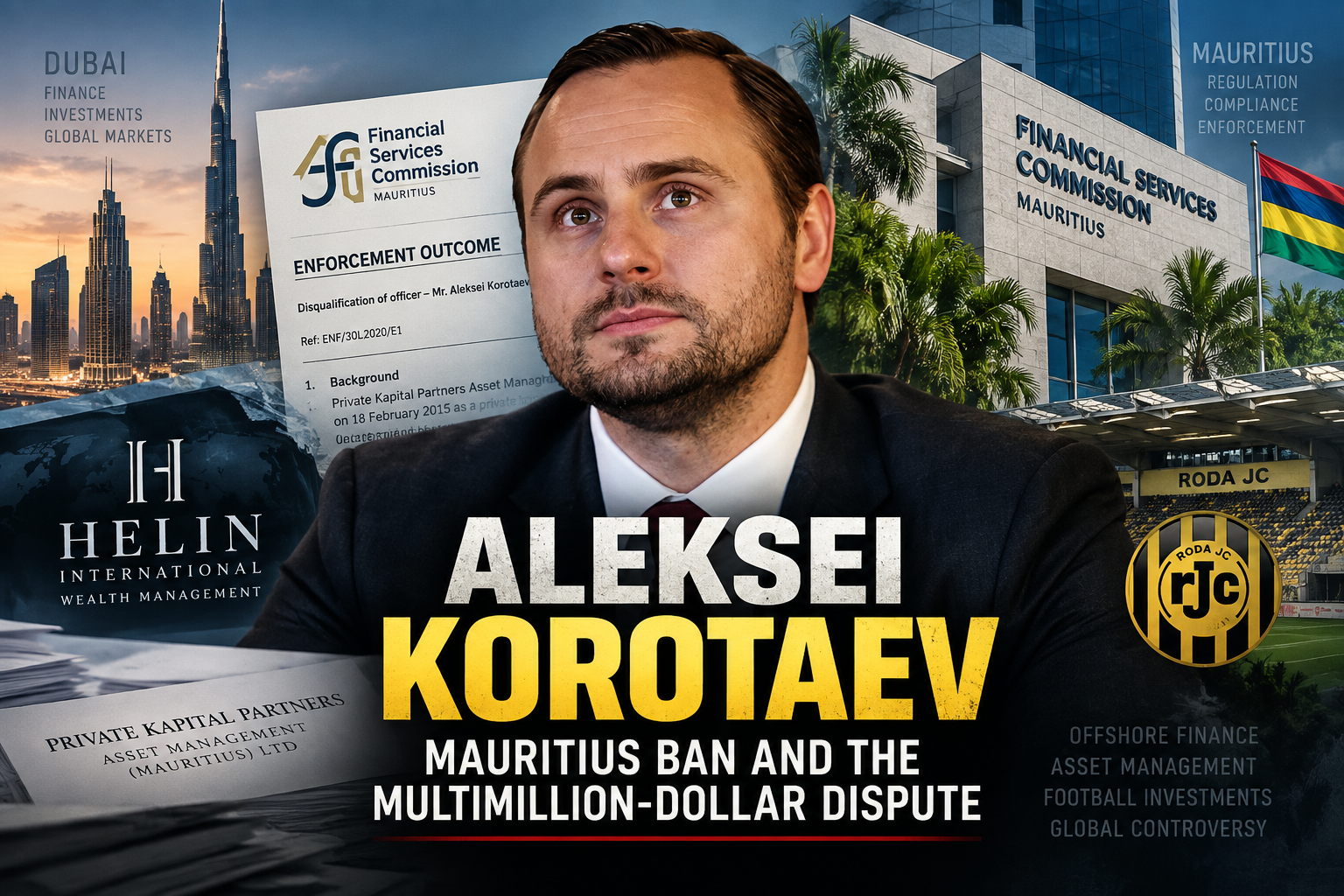
The first major piece of the story is Private Kapital Partners Asset Management (Mauritius) Limited, or PKP. Mauritius incorporated the company in February 2015, and the Financial Services Commission granted it a Category 1 Global Business Licence, a Collective Investment Scheme Manager Licence and an unrestricted Investment Adviser Licence. The FSC identified Korotaev as the company’s director and ultimate beneficial owner from inception.
The company later became the subject of a serious regulatory enforcement action. The FSC said an onsite inspection took place on October 12, 2018 and that it remained in contact with PKP and Korotaev through December 2019 over remedial measures that, according to the regulator, were never resolved to its satisfaction.
The findings went considerably beyond an administrative filing problem. The FSC said PKP failed to file annual reports for 2016 and 2017, lost its required management company and Mauritius-resident directors after March 2017, failed to pay its annual licence fee, and consequently allowed its Category 1 licence to lapse on July 1, 2018. The regulator also said PKP failed to submit several interim financial statements on time.
The most serious findings concerned anti-money-laundering and counter-terrorist-financing controls. The FSC said PKP failed to maintain appropriate customer-due-diligence records for six entities with which it had consultancy agreements, failed to establish the source of funds received from three entities, opened an omnibus account without the required prior board approval and lacked documented policies and procedures designed to manage money-laundering and terrorism-financing risks.
The regulator also concluded that PKP had breached its licensing conditions because, based on its review of bank statements, the company was receiving income from activities other than investment advisory services. It further found that the company had failed to commence business within six months under its Collective Investment Scheme Manager Licence.
Korotaev did not admit those violations. The FSC’s own decision records his position in detail. He denied the allegations and argued that the compliance failures stemmed from the FSC’s failure to approve the transfer to a new management company. He said that without that approval, PKP could not properly pay fees or resolve outstanding compliance matters. On the AML issues, he denied responsibility and argued that the relevant systems and controls were the responsibility of the board and local directors.
The FSC Enforcement Committee rejected that explanation. On December 30, 2020, it concluded that Korotaev no longer met the statutory “fit and proper” standard and disqualified him from holding an officer position in any FSC licensee for five years. The decision was subject to a right of review before the Financial Services Review Panel. The separate FSC decision concerning PKP revoked its Collective Investment Scheme Manager and Investment Adviser licences, again after the company denied the allegations and offered substantially the same explanation involving the management company and local directors.
That regulatory record is important because it is not simply adverse media reporting. It is an official enforcement decision. At the same time, it does not establish that Korotaev committed fraud, stole investor money or engaged in money laundering. The FSC findings concern regulatory compliance, governance, licensing and AML controls, not a criminal conviction for those offences.
The other major thread leads to Helin International, a wealth-management network operating through the UAE and connected to a number of wealthy international clients. Reporting by Le Temps said Swiss prosecutors were investigating Helin after French heirs complained that roughly 88 million Swiss francs they had entrusted to the network could not be recovered. The Geneva prosecutor said the investigation concerned possible breach of trust and disloyal management and sought to determine how the assets had been managed, transferred and ultimately blocked.
Korotaev became entangled in that dispute after Helin accused him of issuing an unpaid cheque worth more than €18 million. He was arrested at Dubai airport in February 2017 and spent months in detention. Contemporary Dutch reporting described the dispute as a legal battle between Korotaev and Helin, while Korotaev countered that Helin had improperly emptied or transferred money from accounts he controlled.
The financial stakes were substantial. Le Temps reported that funds connected to Helin clients were transferred into a structure involving PKP and an omnibus account at ADS Securities in the UAE. It reported that, of the roughly CHF88 million at issue in the Swiss investigation, approximately €18 million was alleged to have been used by Korotaev, including about €4 million for shares in Dutch football club Roda JC. Those figures came from sources close to the investigation and should not be confused with a judicial finding that Korotaev stole CHF88 million.
Roda JC became one of the most visible consequences of the dispute. Korotaev acquired a minority stake in the Dutch club in January 2017 and promised an ambitious transformation, including a long-term goal of reaching the Champions League. He also brought former French international Nicolas Anelka into the club as a consultant. The investment quickly became controversial after Korotaev’s arrest. In 2019, 80% of Roda was sold to Mexican businessman Mauricio García de la Vega while Korotaev retained 20%. By 2020, Roda had agreed to a new regional ownership structure and ended its relationship with Korotaev.
The Helin dispute did not end with the Dubai proceedings. Swiss authorities later became involved, and Africa Intelligence reported that Korotaev was arrested in Moscow on April 27, 2023 after being sought through Interpol over suspected diversion of tens of millions of dollars from Helin. The report described the allegations as suspected embezzlement rather than an established conviction. Africa Intelligence subsequently reported that US, Swiss and French investigators were continuing to examine the broader Helin network and financial flows involving the UAE, Africa and other jurisdictions.
The broader Helin investigation is itself a complicated story involving allegations of tax evasion, offshore structures and suspected diversion of client funds. It would be legally wrong, however, to treat every allegation made against Helin or its associates as a proven finding against Korotaev personally. His connection to the network and to PKP is documented; the extent of his responsibility for the wider alleged misconduct remains a matter for investigators and courts.
The most recent public development is unusually revealing. In February 2026, Dubai lawyer Mohamed Al Kheyaili wrote to OffshoreAlert on behalf of Korotaev and PKP, asking the publication to remove or de-index its articles concerning the 2020 Mauritius enforcement action. The lawyer argued that the five-year FSC sanction had expired, that the regulator had removed the underlying public enforcement notice, and that continuing publication now created an outdated impression of Korotaev’s regulatory status. The letter explicitly acknowledged that OffshoreAlert’s original reporting had relied on the public FSC records available when the articles were published.
The letter asked either for removal of the articles or for search-engine de-indexing accompanied by a notice explaining that the sanctions had expired and the underlying enforcement notice had been removed. OffshoreAlert published the letter rather than simply disappearing the material. The documents reviewed here do not independently establish the current physical whereabouts of Korotaev. The strongest recent public connection is Dubai, where his lawyer is based and where the 2026 representation was issued. Nor did this investigation find reliable evidence of a current regulated financial-services position held by him.
What remains is a record that is neither as simple as “convicted fraudster” nor as clean as an old regulatory misunderstanding. A Mauritius regulator formally found serious governance, licensing and AML-control failures and barred Korotaev from serving as an officer of an FSC licensee for five years. A company he owned had two of its licences revoked. Separately, he became embroiled in a major international dispute involving Helin International and tens of millions of dollars in client assets, was arrested in Dubai and later reported arrested in Moscow in connection with a Swiss-led investigation. He has denied the Mauritius allegations and has also disputed the accusations arising from the Helin dispute.
That distinction matters. Financial scandals often become distorted when regulatory breaches, civil disputes and criminal allegations are compressed into one accusation. In Korotaev’s case, the verified regulatory record is already serious enough without adding claims that the available evidence does not prove. The wider lesson is more uncomfortable: sophisticated investment structures can move money across jurisdictions faster than regulators, courts and investors can reconstruct who controlled it. For investors and financial institutions, the Korotaev story is therefore not simply about one financier. It is a case study in why ownership, source-of-funds checks, board oversight, licensing status and AML controls matter long before a dispute turns into a cross-border investigation.
Source:
OffshoreAlert
————-
Disclaimer:
Some content on Reportingscams.com is published under our guest post program and is provided by third-party contributors. Reporting scams does not create, verify, or take responsibility for the views, accuracy, or claims expressed in such content.