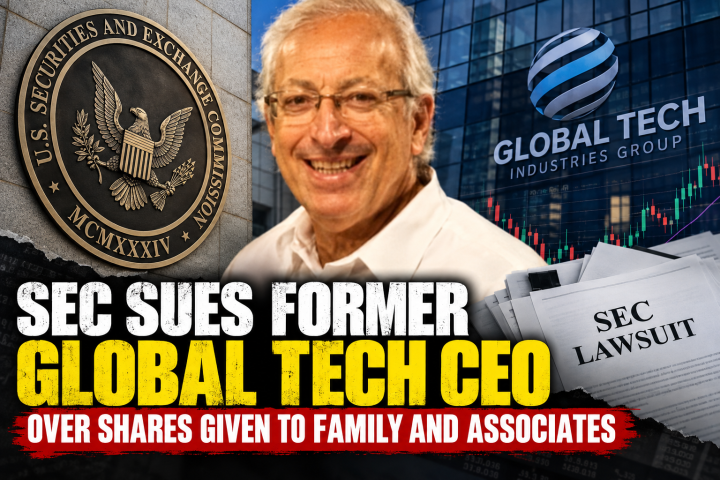
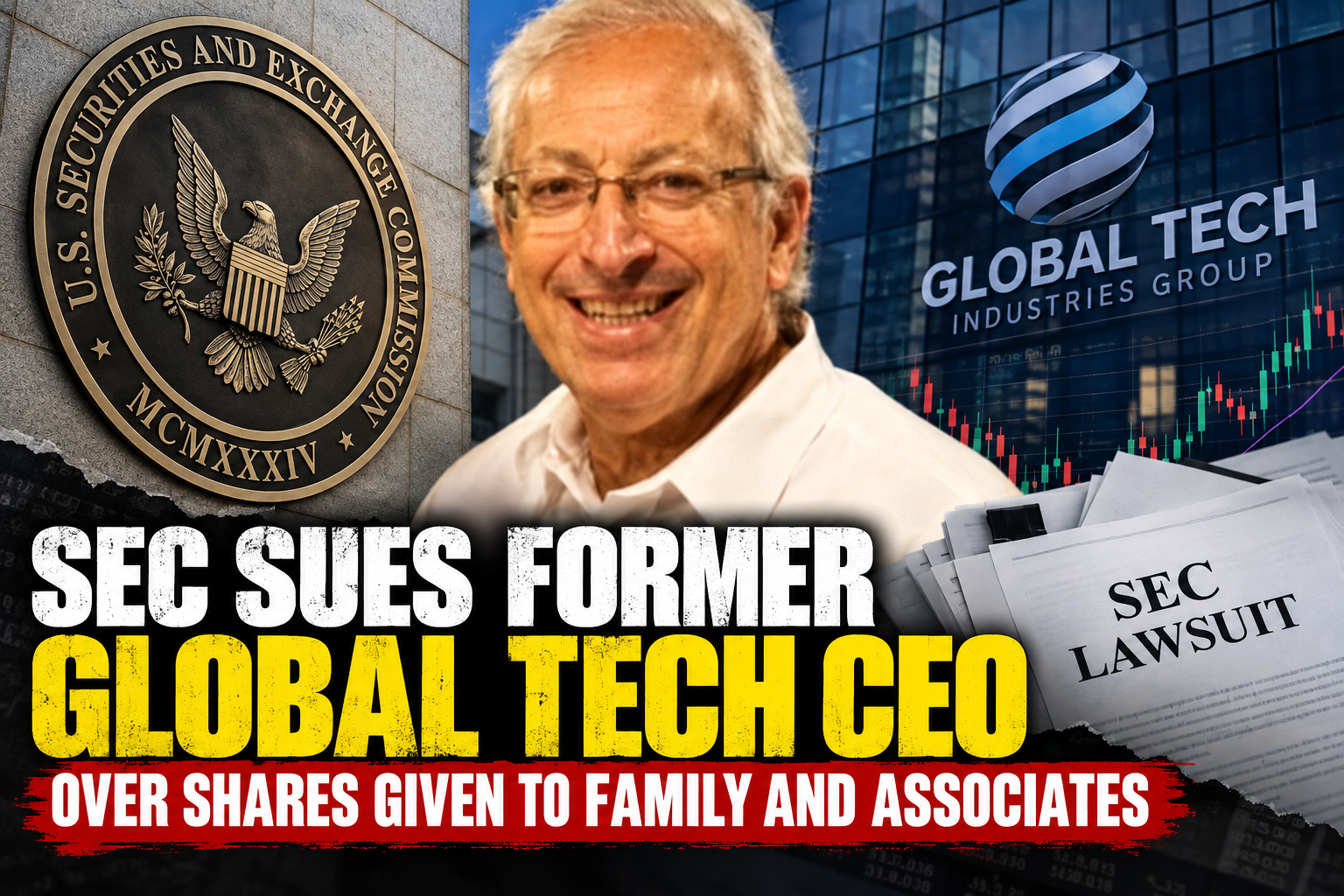
David Reichman spent more than two decades at the center of Global Tech Industries Group, a lightly operated public company whose shares traded over the counter. On October 2, 2026, that long tenure became the focus of a federal securities-fraud case after the U.S. Securities and Exchange Commission accused the 82-year-old former chairman and CEO of using company stock to benefit family members, friends and associates while misleading investors and regulators.
The SEC’s complaint, filed in the U.S. District Court for the Southern District of New York, describes a scheme that stretched from at least 2016 through June 2024. According to the agency, Reichman caused Global Tech to issue more than 32 million shares to people close to him under the stated justification that the recipients had provided services to the company. The SEC says they had not. The alleged purpose was not simply to move stock around the company. It was to enrich Reichman and people around him while diluting existing shareholders.
Reichman, according to the SEC filing, served as Global Tech’s CEO, chairman, chief financial adviser and principal accounting officer from May 2001 until September 18, 2024. He controlled a majority of the company’s voting rights and, in practice, exercised substantial control over its operations. The SEC says he now resides in Los Angeles, California. His daughter, Justine Reichman, 54, is named as a relief defendant and is also named in her capacity as trustee of the Justine Reichman 2021 Trust.
The company itself was hardly a conventional operating business. Global Tech was incorporated in Nevada in 1980 under another name and became Global Tech Industries Group in 2017 after previously operating as Tree Top Industries. Its shares were quoted on OTC Link ATS rather than a major national exchange. The SEC says the company had little revenue, no significant operations and only two employees during the relevant period: Reichman and its former president. Its 2023 filing showed an accumulated deficit of $346 million.
Against that backdrop, the stock issuances alleged by the SEC take on particular significance. The agency says Justine Reichman received nine million Global Tech shares in two transactions, including one million shares in 2016 and another eight million in 2019. Company filings described those shares as compensation for services, but the SEC says Justine provided no such services. The agency further alleges that the eight-million-share transaction was presented in board minutes as repayment for loans made by Justine, even though those minutes did not accurately reflect how the transaction came about.
Another six million shares went to DOT8 Inc., a Wyoming corporation that had connections to the Reichman family. The SEC says Reichman initially served as DOT8’s sole director and that Justine later became its president and director. Global Tech reported DOT8 as a subsidiary on tax returns but, according to the SEC, did not disclose it as a subsidiary or related party in its securities filings. The regulator says DOT8 received three million shares in 2016 and another three million in 2018 despite providing no services in return.
The alleged paperwork surrounding DOT8 is particularly damaging. The SEC says that nearly a year after the 2016 share issuance, Global Tech’s former president sent Reichman an engagement letter backdated to July 1, 2016, purporting to establish a legitimate business reason for the stock transfer. The document was reportedly prepared on Global Tech letterhead even though the company was still called Tree Top Industries when the shares were issued. In the email accompanying the document, the former president wrote that she was “Trying to get creative here,” according to the SEC complaint.
The alleged recipients extended beyond Reichman’s daughter. The SEC says three million shares were issued to Reichman’s former wife and Justine’s mother in 2019, supposedly for consulting work that she never performed. It also alleges that 10.5 million shares were issued to Reichman’s girlfriend, another 2.75 million to her son and 150,000 to her friend. The SEC says Reichman described some of these transactions privately as gifts while publicly representing that the shares were compensation for services.
The regulator also alleges a separate arrangement involving another associate. Global Tech issued 940,000 shares to the unidentified individual in 2016. When those shares were later sold, approximately 90% of the proceeds about $1.4 million was transferred to an entity controlled by Reichman. The individual kept roughly 10%. The SEC says the same associate later sold another approximately 860,000 Global Tech shares for about $2 million and transferred approximately $1.7 million of those proceeds to Reichman.
The value of the stock became much more consequential as Global Tech’s share price rose. According to the SEC, the stock traded for pennies before 2021, climbed above $2 at points during 2021 and reached as high as $8 in 2022. The agency says Justine Reichman and DOT8 sold substantial quantities during the rise, generating approximately $8 million for Justine and about $1 million for Reichman from the allegedly fraudulent issuances.
The SEC also accuses Reichman of concealing Justine’s ownership stake. As of March 31, 2021, the agency says she beneficially owned nearly 16 million shares, representing about 6.9% of Global Tech’s common stock through shares held directly and through DOT8. That information was significant because the company was preparing a registration statement connected to an August 2021 warrant offering.
According to the complaint, Reichman directed Global Tech’s former president to remove Justine’s name from a list of beneficial owners used to prepare the filing. The SEC further alleges that Reichman used Justine’s electronic signature to move eight million shares into book-entry form, temporarily removing her name from the shareholder list. The shares were later returned to her name. The agency says Justine was unaware of those transfers.
The resulting S-1 registration statement became another major part of the SEC’s case. The agency says the filing failed to disclose Justine’s beneficial ownership despite her being one of the company’s largest shareholders. Global Tech’s offering ultimately raised approximately $3.3 million, and the SEC alleges that Reichman personally transferred approximately $2.5 million from the company’s bank account to his own account.
The complaint contains another allegation involving an employee profit-sharing trust. Global Tech established the trust in 2009 and transferred millions of shares into it for the benefit of employees. By the end of 2019, the trust reportedly held 23.5 million shares. The SEC alleges that in May 2022 Reichman authorized the sale of 10 million of those shares for $2 million, with $1.8 million ultimately wired to him. Yet, according to the regulator, subsequent company filings continued to state that the trust held all 23.5 million shares and that none had been committed for release.
There was also a separate reporting problem. The SEC says Reichman was required to disclose his own stock transactions through Form 4 filings but repeatedly filed them late. The complaint identifies a series of transactions between October 2022 and February 2024 for which required reports were allegedly submitted after the statutory deadline.
The federal case is not the first legal crisis surrounding Global Tech. In July 2024, shareholders including White Rocks (BVI) Holdings sued Reichman and other members of the company’s management in Nevada, alleging, among other things, breach of fiduciary duty, fraud and fraudulent concealment. A Nevada court appointed Paul L. Strickland as receiver on September 18, 2024, and Reichman, along with other members of management, was removed from the company. Receiver reports continued into 2026, including a comprehensive status report addressing the company’s finances, alleged misappropriated funds, property and pending litigation.
The SEC’s October case remains a civil enforcement action, not a criminal prosecution. There has been no reported guilty plea or criminal conviction against Reichman arising from these allegations. The SEC has accused him of violating federal securities antifraud and reporting provisions and of aiding and abetting Global Tech’s reporting violations. The agency is seeking disgorgement of ill-gotten gains, prejudgment interest, civil penalties, permanent injunctions and a bar preventing Reichman from serving as an officer or director of certain public companies. It is also seeking disgorgement from the relief defendants.
As of the filing of the complaint, there had been no judgment establishing the SEC’s allegations as proven facts. Reichman therefore remains entitled to contest the claims in court. The case was filed as Securities and Exchange Commission v. David Reichman et al., No. 26-cv-08713, in the Southern District of New York, and the public docket shows the complaint was filed on October 2, 2026.
What makes the case important extends beyond one former executive or one obscure OTC company. The allegations describe the kind of conduct that can be difficult for ordinary investors to see while it is happening: related-party transactions hidden inside routine corporate filings, shares described as compensation, ownership interests obscured from the market and corporate assets allegedly diverted for personal benefit. Investors buying or holding a thinly traded public company’s stock depend heavily on the accuracy of the disclosures made by the people controlling that company. When those disclosures are incomplete or false, the damage can reach far beyond the individuals receiving the shares.
Global Tech is now under court-appointed receivership, while the SEC’s federal case moves forward. The central questions whether Reichman knowingly orchestrated the transactions described by the SEC, how much investors ultimately lost and what financial recovery can be obtained—will be determined through the legal process. But the record already illustrates why transparency in small public companies matters: when insiders control both the information and the stock, misleading paperwork can become a mechanism for transferring value at the expense of shareholders who never had the information needed to protect themselves.
————-
Disclaimer:
Some content on Reportingscams.com is published under our guest post program and is provided by third-party contributors. Reporting scams does not create, verify, or take responsibility for the views, accuracy, or claims expressed in such content.