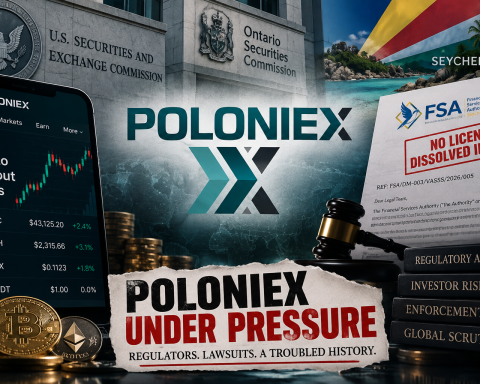
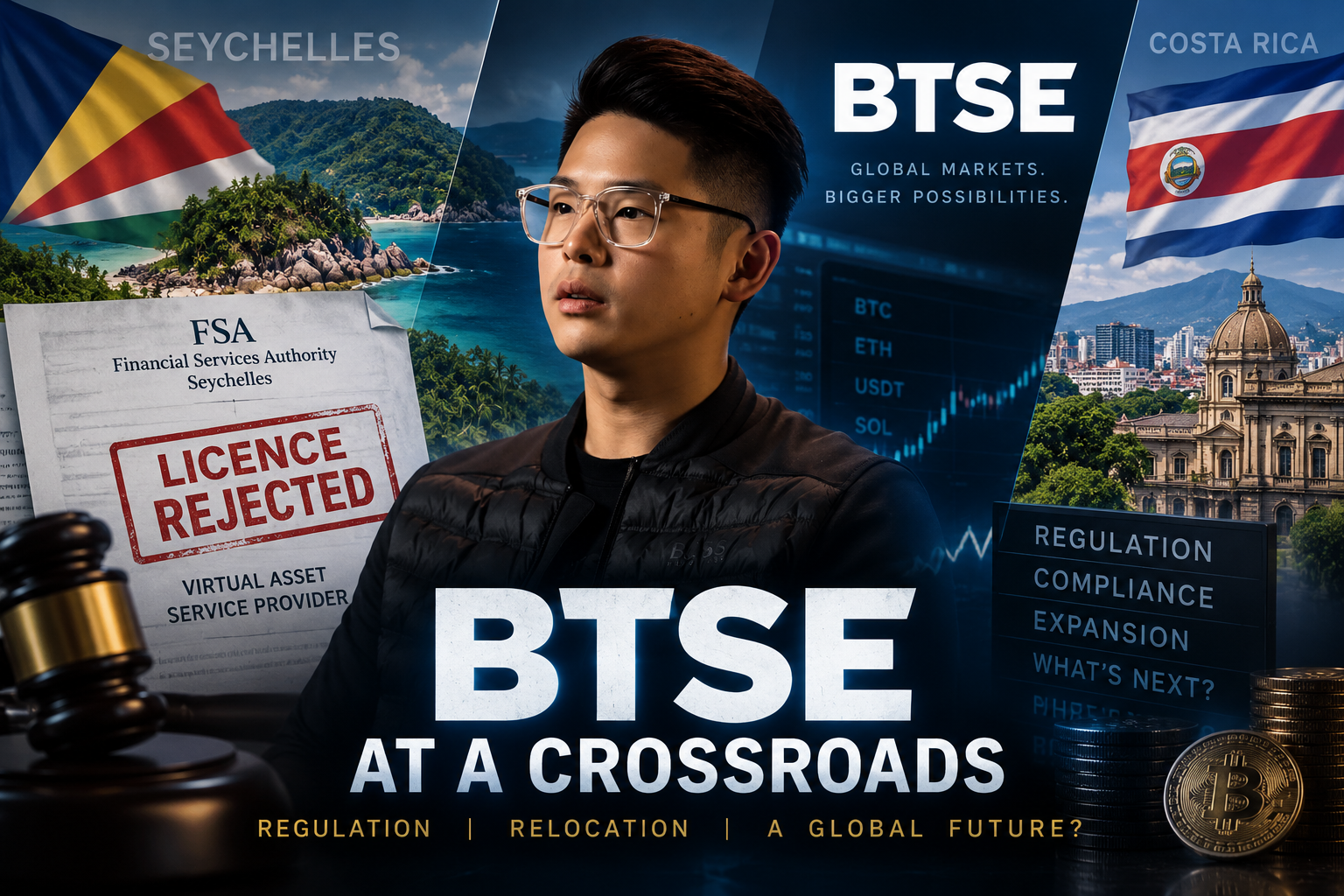
BTSE’s Seychelles exit has become a dispute over what happened, where the crypto exchange now operates and how much regulatory scrutiny should follow it. The documentary record is more complicated than either side’s preferred version. Seychelles’ Financial Services Authority says BTSE Holding Limited’s application for a licence under the country’s new Virtual Asset Service Providers Act was rejected on July 24, 2025, and that the company was instructed to stop operating or move its services outside the jurisdiction. BTSE, however, disputes the description of the episode as a shutdown and says the Seychelles entity had already migrated its users before the regulator issued its public statement.
The distinction matters. BTSE Holdings Limited sent a cease-and-desist letter to KYC News, the publisher of OffshoreAlert, on January 28, 2026, accusing the publication of making “false, misleading and defamatory statements.” The letter specifically rejected the claim that BTSE had been “shut down” in Seychelles, denied that it moved to avoid regulation and objected to being presented alongside KuCoin, whose founders and corporate parent had separately faced a major U.S. criminal case. BTSE demanded that the article and associated images be removed and threatened defamation and tortious-interference proceedings if its demands were not met.
The underlying regulatory event, though, is not in dispute. The Seychelles FSA’s own statement says BTSE Holding Limited submitted a VASP application on December 31, 2024, and that the application was rejected effective July 24, 2025. The regulator says BTSE was formally instructed to cease operations immediately or migrate its services out of Seychelles. It also says BTSE had informed the authority that it had been acquired by BTSE Global Limited Sociedad de Responsabilidad Limitada, a Costa Rican company, and that all existing users serviced by BTSE Holding Limited had been migrated to that entity effective July 2, 2025.
That July 2 date is one of the more important details in the story. It means the customer migration to Costa Rica occurred 22 days before the Seychelles FSA formally recorded its rejection of the licence application. The public record does not establish why the migration occurred before the rejection, whether BTSE knew what the regulator would decide, or whether the move was part of a contingency plan. It would be unsafe to turn that timing alone into an accusation of regulatory evasion. What can be established is that the operating structure changed before the formal rejection became public. The Costa Rican company itself was incorporated in January 2025, according to the country’s official gazette.
Costa Rica is also a materially different regulatory environment. Earlier FATF/GAFILAT assessments found that Costa Rica had not implemented licensing or registration requirements for VASPs. The country has since moved toward an AML-focused registration system rather than a conventional crypto operating licence. Legislative changes published in 2026 require VASPs falling within the new framework to register with SUGEF, while making clear that registration is not itself an operating licence. The new framework therefore should not be described simply as “unregulated” without qualification as of September 2026.
BTSE’s corporate structure adds another layer to the story. Public records and company material identify BTSE Holdings Limited in the British Virgin Islands, BTSE Global Limited SRL in Costa Rica and BTSE-related entities in other jurisdictions. BTSE has also historically maintained a Liechtenstein entity, BTSE AG, which the company said received registration under Liechtenstein’s Token and Trustworthy Technology Service Provider Act, subject to a condition precedent, in 2023.
The exchange itself was founded in 2018 by Jonathan Leong and Brian Wong. Today it is led by Henry Liu, who has described his earlier career as being in merchant banking before moving into blockchain technology. Public professional biographies place him in Hong Kong and identify education at the University of British Columbia and MIT Sloan. No credible source located in this review establishes his age, and there is no reliable public evidence that he has been charged with a crime or convicted of wrongdoing.
Liu remains publicly active as BTSE’s chief executive. BTSE has continued publishing trading, futures, KYC and product material in September 2026, and the company recently announced a regulated Indonesian joint venture. BTSE Indonesia operates through PT Aset Kripto Internasional and is licensed by Indonesia’s Financial Services Authority, OJK. The Indonesian crypto exchange association CFX lists PT Aset Kripto Internasional among licensed digital-asset traders.
That is significant because it complicates any suggestion that BTSE has simply abandoned regulation. The group is simultaneously operating through a Costa Rican structure while expanding through a separately regulated Indonesian vehicle. BTSE has also said that its European operations include a regulated Liechtenstein entity. The question for users is therefore less whether “BTSE is regulated” in the abstract and more precisely which BTSE legal entity holds which authorisation, in which jurisdiction, and for which products.
There is another controversy that deserves attention, although it remains an allegation rather than a finding of misconduct. In October 2025, The Block reported that Stable, a USDT-focused blockchain project backed by major investors including BTSE, reached an $825 million pre-deposit cap. X-based crypto researchers claimed that hundreds of millions of dollars had entered the deposit contract before Stable publicly announced that the campaign was live. One researcher, Emmett Gallic, claimed an address linked to BTSE had transferred roughly $500 million in USDT, more than 60% of the total cap. The Block reported the allegation and said it contacted Stable for comment.
The timing raised obvious questions because BTSE had participated in Stable’s $28 million seed round alongside Bitfinex, Hack VC, Franklin Templeton and other investors. Stable itself confirms BTSE was among the participants. But the available evidence does not establish that BTSE knew the campaign would open early, that the wallet was controlled by BTSE itself, or that anyone at BTSE deliberately front-ran retail participants. No regulator or court has publicly determined that such misconduct occurred.
The relationship became more visible later in the year. In December 2025, BTSE promoted Stable staking with headline annualised rates of up to 500% for a limited seven-day campaign. The offer was not an undisclosed yield: BTSE publicly described the terms, including the number of users eligible for each tier and the requirement to stake STABLE tokens. The Block labelled its coverage of the promotion as sponsored content.
Consumers have also posted complaints about BTSE on review platforms, including reports involving withdrawal delays, account restrictions and customer-support problems. Such complaints are not equivalent to regulatory findings, and some complaints surrounding the BTSE name relate to impersonation websites. BTSE itself has warned customers about fake domains designed to steal credentials and crypto assets. Those impersonation scams should not be attributed to the genuine BTSE exchange without independent evidence.
One fact that should be kept firmly separate is the criminal case involving KuCoin. The U.S. prosecution concerned Peken Global Limited and its executives, not BTSE. A federal judgment shows Peken Global pleaded guilty to operating an unlicensed money-transmitting business and was ordered to pay $113.314 million in criminal monetary penalties, with a $400 assessment and no restitution ordered in that judgment. The judgment names Chun Gan, also known as Michael, and Ke Tang, also known as Eric, in the broader KuCoin prosecution, but nothing in the records reviewed establishes that Henry Liu, BTSE or BTSE executives participated in KuCoin’s criminal conduct.
BTSE’s legal response to OffshoreAlert is therefore an important part of the story, but it is not itself proof of wrongdoing. The company expressly denied regulatory sanctions, denied AML/CFT violations and said the Seychelles article damaged its banking and regulatory standing. It demanded removal of BTSE references and images by February 6, 2026 and threatened claims for injunctions, damages and costs. No court judgment establishing defamation against OffshoreAlert was identified in the sources reviewed.
The strongest conclusion is therefore narrower than the most aggressive descriptions circulating online. BTSE was not convicted of fraud, money laundering or sanctions violations in the material reviewed. No criminal conviction against BTSE itself was identified, and no regulator has publicly announced a fraud finding against the exchange. But BTSE did have a VASP application rejected in Seychelles and was formally told to cease operations there or migrate. Its corporate structure subsequently placed substantial operations in Costa Rica, where the regulatory framework has historically been lighter and is now evolving toward AML registration. At the same time, the exchange remains active, has expanded into a regulated Indonesian market and continues to market leveraged trading, staking and other crypto products.
That combination is precisely why the story matters. A regulatory rejection is not the same thing as fraud, and a corporate relocation is not automatically regulatory evasion. But crypto users are often asked to make decisions based on a brand rather than a legal entity, and that is where risk can become difficult to see. BTSE’s case shows why investors should look past logos, executive interviews and headline claims of “global regulation” and ask a much more basic question: which company actually holds your assets, which regulator supervises that company, and what protection exists if something goes wrong? In an industry where jurisdiction can change faster than the platform’s branding, those details are not fine print. They are the story.
Source:
OffshoreAlert
————-
Disclaimer:
Some content on Reportingscams.com is published under our guest post program and is provided by third-party contributors. Reporting scams does not create, verify, or take responsibility for the views, accuracy, or claims expressed in such content.