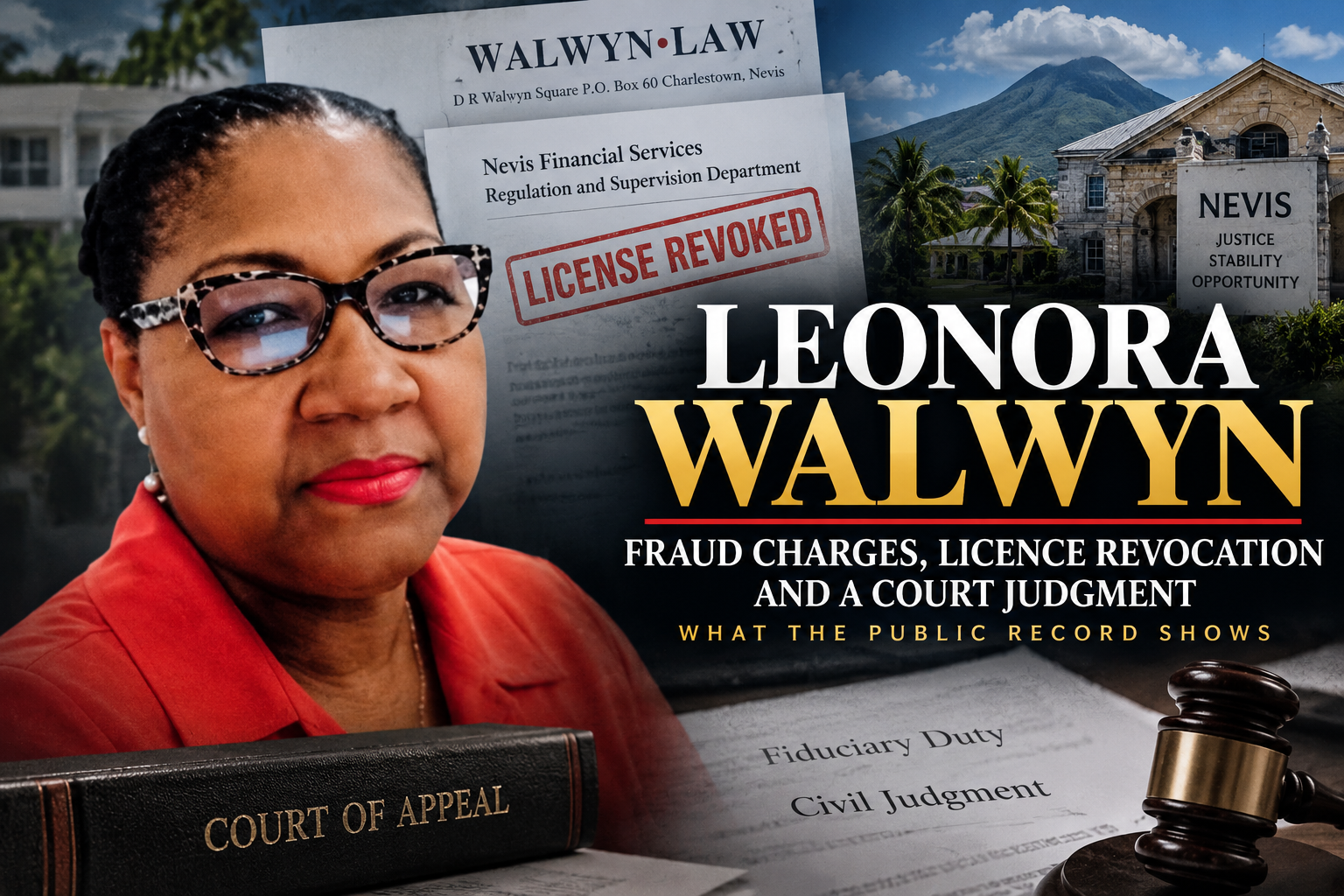
The public record surrounding Nevis lawyer Leonora Louisa Walwyn is more complicated than the old headlines suggest. There was a criminal arrest, a regulatory licence revocation and a separate civil case in which an appellate court found that she breached fiduciary duties to a client. But there is also a significant qualification that should not be buried: Walwyn now says the criminal charges were withdrawn and that she was never prosecuted, and she has publicly challenged the continued publication of reports about the episode.
Walwyn, who is also identified in public records as Leonora L. Walwyn-Bowrin, is a long-established attorney in St. Kitts and Nevis. A biographical directory lists her birth year as 1959, which would put her at 67 in 2026, although I could not find an official government source confirming her date of birth. Her professional education is better documented: York University in Toronto, where she earned a B.A. in 1984, followed by an LL.B. from the University of the West Indies in 1989 and the Legal Education Certificate from Norman Manley Law School in 1991. She was admitted to practice in St. Christopher and Nevis in 1991.
Walwyn founded WalwynLaw, a Nevis-based legal practice that describes itself as a boutique firm serving individuals, businesses and international institutions. The firm’s current website identifies her as its principal and says the practice was founded in 1991. It lists commercial law, financial-sector work and multi-jurisdictional transactions among her experience. A 2024 government-published list of lawyers with active practising certificates also includes her full name, Leonora Louisa Walwyn, indicating that she remained professionally active.
The episode that put Walwyn into the public spotlight began in December 2015. According to a contemporary report in The St. Kitts-Nevis Observer, she was arrested on December 28 and charged with two counts of forgery and one count of fraudulent conversion. The report said she was granted EC$350,000 bail with two sureties, surrendered her travel documents and was required to report to police weekly. The article did not establish that she committed the offences; at that point they were charges, not convictions.
Ten days after the arrest, on January 7, 2016, the Nevis Financial Services Regulation and Supervision Department announced that WalwynLaw’s licences to act as a registered agent had been revoked. The regulator’s notice expressly cited the Nevis Business Corporation Ordinance, the Nevis International Exempt Trust Ordinance and the Nevis Limited Liability Company Ordinance. The notice itself did not state that WalwynLaw had been convicted of an offence or that the licence revocation was a criminal penalty. A contemporaneous OffshoreAlert report said the firm’s registered-agent licence had already been suspended around May 22, 2015, months before the December arrest.
That distinction matters. The regulatory action and the criminal charges occurred close together, but the public documents reviewed do not establish that the licence was revoked because Walwyn was convicted, nor do they establish that the regulator made a finding of criminal fraud against her. The official revocation notice simply records the revocation.
There is, however, another piece of the record that predates the arrest and is considerably more detailed. In litigation involving client Eustace Archibald and RBTT Bank (SKN) Limited, the Eastern Caribbean Supreme Court’s Court of Appeal upheld a judgment against Walwyn arising from her handling of a property transaction.
The dispute began with a 1994 loan of EC$187,488 that Archibald obtained from RBTT to purchase land in Nevis. Walwyn was acting for the bank but also told Archibald that she could act for him in the purchase. The appellate judgment found that she authorised payment of the purchase price to the realtor without first obtaining the vendor’s Certificate of Title, even though the document was necessary both to transfer the property and to secure the bank’s mortgage.
The problem persisted for years. When the bank later pursued Walwyn for failing to protect its security interest, she borrowed $326,268.62 from the bank and used the money to resolve the bank’s claim. The court record says neither the bank nor Walwyn properly informed Archibald about what had happened to his loan.
In November 2001, Walwyn arranged the sale of part of Archibald’s property for EC$75,000. The court found that approximately EC$64,200 of the proceeds was directed toward her own loan account rather than Archibald’s already-closed loan account. The appellate judgment said this was done without full disclosure to Archibald.
The dispute eventually reached court. Archibald sued Walwyn and the bank, seeking, among other remedies, delivery of his title and damages. Walwyn counterclaimed for more than $244,000, asserting that she had effectively acquired the bank’s rights after paying off the loan. The High Court rejected her counterclaim, ordered her to deliver the title and awarded Archibald $3,500 in damages for conversion. The Court of Appeal later dismissed Walwyn’s appeal and awarded Archibald another $1,500 in agreed costs.
The appellate court’s reasoning is unusually direct. It found that Walwyn had breached her duty to the bank by releasing the purchase money without securing the title documents, while simultaneously owing fiduciary duties to Archibald as his solicitor. The court concluded that she had failed to make full and frank disclosure about the transactions and said that the payment of the property-sale proceeds toward her own loan, without full disclosure, constituted a breach of fiduciary duty.
The judgment also criticized her 2004 decision to file a claim in the bank’s name seeking EC$244,605.22 from Archibald even though, according to the court, he no longer owed that money to the bank. The appellate court described the filing as disturbing and said it reflected a determination to recover the loan proceeds “by hook or by crook.”
That civil judgment should not be conflated with a criminal conviction. Archibald had advanced allegations including constructive fraud, but the appellate court’s operative findings were centered on fiduciary breach, conversion and the failure to make proper disclosure. There is no evidence in the material reviewed that Walwyn was criminally convicted over the Archibald matter.
There is also no reliable evidence in the sources reviewed establishing that Walwyn personally profited from the criminal allegations that led to her 2015 arrest, or that investors lost a particular amount of money because of those charges. The documented financial figures belong primarily to the earlier property dispute and should not be presented as illicit gains.
Walwyn herself has now put her version of the criminal episode back into the public record. In a January 12, 2026 letter to OffshoreAlert, written on WalwynLaw letterhead and signed by her, she asked the publication to remove material concerning her arrest and the firm’s licence revocation. She stated that the actions against her were politically motivated by the then-government administration and said that “all charges were withdrawn” and that no prosecution was ever attempted. OffshoreAlert published the existence of that letter and characterized her position in the same terms.
I was not able to locate an independent court judgment, prosecutorial announcement or official police record in the publicly accessible sources reviewed that conclusively confirms the withdrawal of those criminal charges. Accordingly, the responsible formulation is that Walwyn says the charges were withdrawn and that she was never prosecuted, rather than stating that as an independently verified fact.
Her professional career nevertheless continued. WalwynLaw’s current website remains active, and a government list confirms Walwyn as an active practising attorney in 2024. The firm’s current public profile therefore places her in Nevis and still practising law, rather than retired, imprisoned or barred from legal practice.
The wider corporate-services record adds another layer, but requires caution. The International Consortium of Investigative Journalists’ Paradise Papers database identifies WalwynLaw as an intermediary connected to historical Nevis corporate entities, including 338844 Inc., Palm Corp., Ride Inc., Softech International LLC and Sherlock’s LLC. Those records show a corporate-services relationship; they do not, by themselves, establish that Walwyn, WalwynLaw or the entities engaged in illegal conduct. ICIJ expressly warns that inclusion in its database is not intended to imply wrongdoing.
The record that emerges is therefore neither a simple story of a convicted fraudster nor a clean slate. Walwyn was arrested and charged with serious offences in 2015; her firm’s registered-agent licences were revoked in January 2016; and a separate appellate court judgment found substantial professional misconduct in a civil property dispute, including breach of fiduciary duty and conversion. At the same time, the criminal charges did not result in a conviction in the sources located, and Walwyn now maintains that they were withdrawn for political reasons.
That distinction is important for anyone assessing professional risk in offshore and cross-border legal services. A charge is not a conviction, a regulatory revocation is not automatically a finding of criminal guilt, and a civil judgment does not establish a criminal offence. But neither should adverse court findings disappear simply because criminal proceedings later ended without prosecution. For clients, banks and international businesses operating through small financial centres, the lesson is straightforward: reputational claims should be tested against primary records, licences should be checked independently, and a firm’s present-day professional status should be considered alongside its historical record. In Walwyn’s case, the public record contains both a defence from the lawyer and court findings that deserve to be read together rather than selectively.|
Source:
OffshoreAlert
————-
Disclaimer:
Some content on Reportingscams.com is published under our guest post program and is provided by third-party contributors. Reporting scams does not create, verify, or take responsibility for the views, accuracy, or claims expressed in such content.