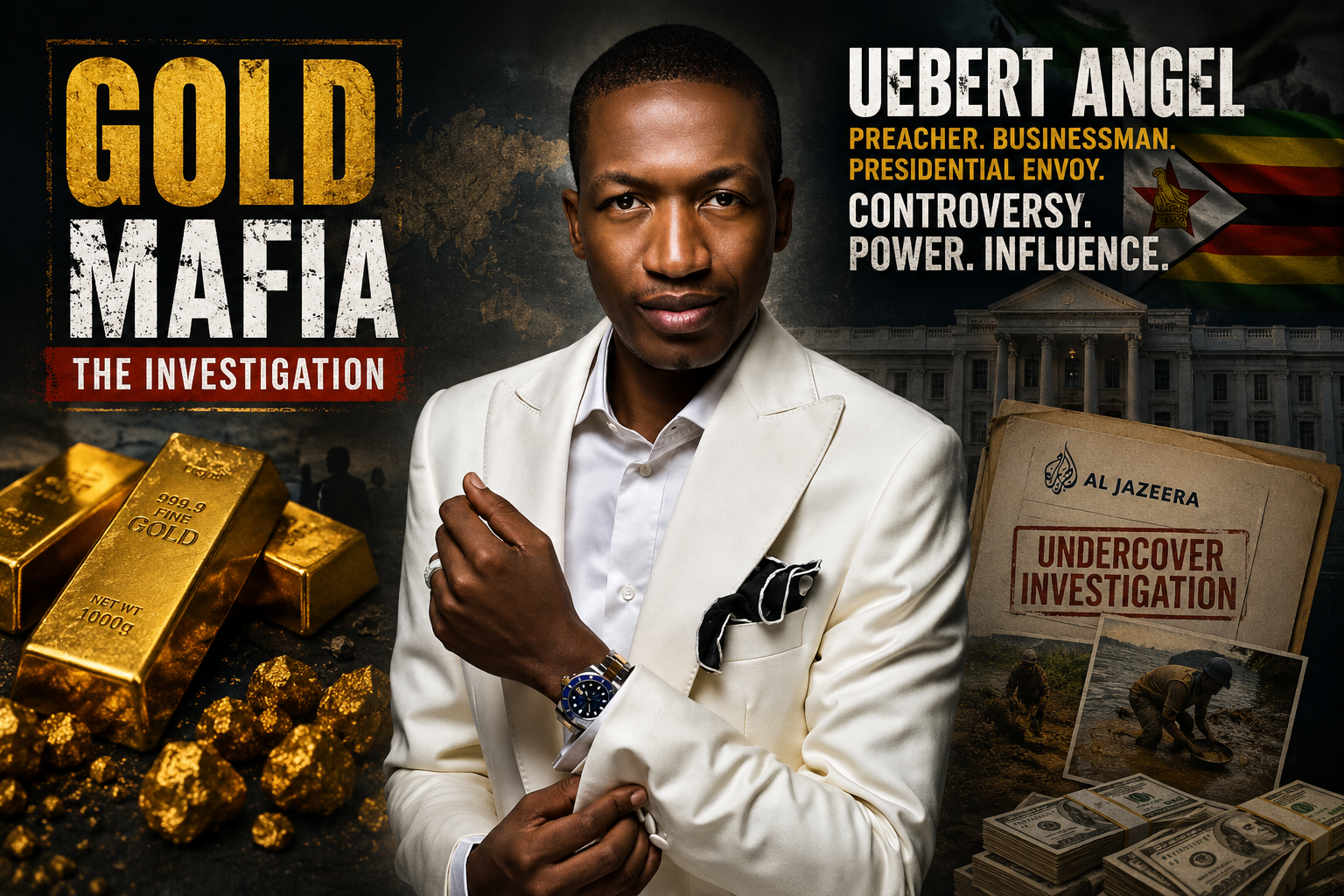
Few religious figures from Zimbabwe have built an international profile as quickly as Uebert Angel. To millions of followers, he is a prophet whose message of faith and financial success has inspired churches across Africa, Europe, North America, and Australia. To critics, he represents the commercialization of religion, where prosperity theology, luxury lifestyles, and political influence have become increasingly difficult to separate. In recent years, however, Angel’s reputation has become defined as much by controversy as by his ministry, particularly after an undercover investigation by Al Jazeera linked him to discussions about alleged money laundering and Zimbabwe’s gold trade.
Understanding how Angel became one of the country’s most recognizable public figures requires looking beyond the headlines. His story is one of rapid religious growth, business ambition, political access, and a series of controversies that have drawn scrutiny from journalists, former followers, and anti-corruption investigators.
Born Uebert Mudzanire in Zimbabwe, Angel spent part of his early adulthood in the United Kingdom before emerging as a Pentecostal preacher during the mid-2000s. Like many Zimbabweans who left during years of economic instability, he established himself abroad while maintaining close connections to his home country. During this period he often described himself as an entrepreneur involved in property and financial ventures, claiming that his business success predated his full-time ministry.
Those claims became central to the message he later preached.
Unlike traditional Pentecostal pastors who focused primarily on spiritual teachings, Angel presented himself as living proof that faith and financial success could exist together. His sermons revolved around prosperity theology, a movement that teaches that God rewards believers with material blessings, business opportunities, and financial breakthrough. The message resonated in Zimbabwe, where years of inflation, unemployment, and economic decline had left many people searching for hope beyond conventional economic opportunities.
In 2007, Angel founded Spirit Embassy, a church that quickly expanded beyond Zimbabwe into South Africa, the United Kingdom, the United States, Canada, Australia, and several European countries. Services were professionally produced, livestreamed, and heavily promoted through television and social media. Testimonies from church members frequently described miraculous healings, unexpected business success, debt cancellation, and supernatural financial breakthroughs after receiving prayer.
As the ministry expanded, Angel also invested heavily in media. His organization launched television broadcasts, publishing ventures, online platforms, and international conferences, turning the church into a global religious brand rather than a traditional local congregation. Spirit Embassy was later rebranded as GoodNews Church, reflecting its international ambitions.
Angel’s own image became inseparable from the ministry’s identity. Luxury cars, designer clothing, expensive watches, private aviation, and international travel featured prominently across church publications and social media. Supporters viewed these displays as evidence that his teachings worked in practice. Critics argued they reinforced the idea that wealth itself had become a measure of spiritual authority.
Angel has consistently rejected that criticism. He has argued that Christianity should not glorify poverty and has frequently cited biblical figures such as Abraham and Solomon to support his belief that financial prosperity is compatible with faith. In interviews and sermons, he has maintained that successful Christian leaders should not apologize for their wealth, particularly if it has been earned through legitimate business.
Alongside his ministry, Angel developed an extensive portfolio of commercial interests. Public records in the United Kingdom show that he and members of his family have been connected with multiple companies over the years, including businesses involved in publishing, media, consultancy, property investment, and financial services. Some remained active while others were dissolved after relatively short periods, a common occurrence for entrepreneurs operating across several industries.
The overlap between ministry and business nevertheless attracted attention. Angel frequently described himself as both a preacher and an entrepreneur, often encouraging church members to pursue investment opportunities and financial independence. Conferences organized by his ministry regularly combined religious services with business seminars and leadership events, reinforcing the message that commercial success formed part of Christian living.
That approach distinguished Angel from many traditional church leaders but also generated criticism from theologians who questioned whether prosperity theology placed excessive emphasis on wealth. Former members of his ministry also began speaking publicly about their experiences. Some claimed they had been encouraged to give generously during fundraising campaigns while expecting miraculous financial returns. Others alleged that success stories received greater attention than those whose expectations were never fulfilled.
Angel has consistently denied exploiting followers and has maintained that all giving within the church is voluntary. He argues that critics misunderstand biblical teachings on generosity and prosperity, while supporters continue to describe GoodNews Church as a community that has transformed lives through both spiritual guidance and charitable work.
Although theological criticism followed Angel for years, it was not the only controversy surrounding him.
One dispute that received considerable media attention involved a luxury Bentley purchased in the United Kingdom. Court proceedings arose from a disagreement over financing arrangements connected to the vehicle, resulting in civil judgments relating to unpaid obligations. Angel disputed aspects of the reporting and argued that the matter had been presented in a misleading way because of his public profile. The case did not involve criminal charges, but it contributed to wider public debate about the contrast between the image of extraordinary wealth projected through his ministry and legal disputes concerning personal finances.
Despite these controversies, Angel’s influence continued to grow. By the end of the 2010s he had become one of Zimbabwe’s best-known religious figures, with a substantial international following and increasing access to political leaders.
That relationship became official in March 2021 when President Emmerson Mnangagwa appointed Angel as Zimbabwe’s Ambassador-at-Large and Presidential Envoy. The appointment placed him in a diplomatic role intended to promote investment and strengthen Zimbabwe’s international business relationships.
Supporters welcomed the decision, arguing that Angel’s international network could attract investors during a period when Zimbabwe was seeking foreign capital. Critics questioned whether a religious leader with extensive private business interests should simultaneously hold a government position carrying diplomatic privileges.
Angel defended the appointment by describing it as an opportunity to serve his country. His public appearances increasingly included meetings with government officials, foreign investors, and business delegations alongside his religious activities. The diplomatic role significantly expanded his influence beyond the church and brought him into closer contact with political and commercial elites.
For nearly two years, Angel balanced his ministry with his diplomatic responsibilities while continuing to promote Zimbabwe as an investment destination. Few outside investigative journalism circles knew that during the same period, reporters from Al Jazeera’s Investigative Unit were conducting an undercover operation that would dramatically alter the public conversation about both Angel and Zimbabwe’s gold industry.
The investigation, later released under the title Gold Mafia, focused on allegations that politically connected individuals were willing to assist wealthy clients seeking to move illicit money through Zimbabwe using gold exports and international financial networks. Reporters posed as representatives of a fictional Chinese criminal organization looking for ways to launder millions of dollars outside conventional banking systems.
Over many months, undercover journalists met businessmen, gold dealers, intermediaries, and individuals claiming close access to senior government officials. Hidden cameras recorded discussions about financial structures, international transactions, and methods that participants claimed could be used to avoid scrutiny from regulators.
Angel entered the investigation through businessman Rikki Doolan, who introduced the undercover reporters to several influential figures. Unlike many others featured in the documentary, Angel was not presented solely as a businessman. He appeared as a serving ambassador representing the Zimbabwean government while also leading one of Africa’s largest prosperity gospel ministries.
The significance of that distinction became clear during the recorded meetings.
According to Al Jazeera, Angel described his close relationship with President Mnangagwa and portrayed himself as someone capable of arranging access to senior political leaders. He discussed Zimbabwe as an attractive destination for investment and spoke about his ability to facilitate introductions at the highest levels of government.
As conversations developed, investigators alleged that Angel discussed mechanisms through which large sums of money could be moved using gold transactions. The documentary also included discussions about diplomatic status and international travel, which investigators argued suggested that political influence could be used to facilitate sensitive financial transactions.
The documentary did not claim that the proposed transactions were completed. Instead, its central allegation was that politically connected individuals appeared willing to offer services that could assist in laundering illicit funds if suitable clients were available.
When Gold Mafia was released in March 2023, it generated headlines around the world and transformed Angel from a controversial televangelist into one of the most prominent figures in an international investigation into Zimbabwe’s financial system.
For Angel, the documentary marked the beginning of the most serious challenge to his public reputation. For Zimbabwe, it raised uncomfortable questions about governance, political influence, and whether individuals with close ties to the country’s leadership were willing to exploit those relationships for private financial gain.
When Gold Mafia was released in March 2023, the documentary immediately became one of the most discussed investigations ever produced about Zimbabwe. Over four episodes, Al Jazeera’s Investigative Unit alleged that politically connected businessmen, gold traders and government insiders were prepared to help wealthy clients move illicit money through Zimbabwe’s gold sector. The reporters posed as representatives of a fictional Chinese criminal syndicate seeking to launder millions of dollars, using hidden cameras to record meetings over several months.
One of the documentary’s most recognizable figures was Uebert Angel. Unlike several others featured in the investigation, Angel was not only a businessman or religious leader. He was also serving as Zimbabwe’s Ambassador-at-Large, giving the allegations a diplomatic dimension that attracted international attention.
In footage broadcast by Al Jazeera, Angel spoke about his access to President Emmerson Mnangagwa and described himself as someone capable of opening doors at the highest levels of government. During conversations with undercover reporters, discussions moved beyond investment opportunities to proposals involving gold exports and the movement of large sums of money. The documentary alleged that politically connected individuals appeared willing to explain how illicit funds could be converted into gold and transferred through international markets with reduced scrutiny.
The programme also included conversations about diplomatic status and international travel. Al Jazeera argued that these discussions suggested official influence could potentially be used to facilitate sensitive financial transactions. While the documentary presented recorded conversations and proposals, it did not claim that every transaction discussed had actually taken place. Instead, it argued that the undercover meetings revealed a willingness among influential figures to offer services that could assist money laundering if suitable clients were available.
The documentary received extensive international coverage and renewed attention on Zimbabwe’s long-standing problem with gold smuggling. For years, independent researchers, anti-corruption organisations and international financial watchdogs have warned that illegal gold exports deprive Zimbabwe of significant revenue while creating opportunities for organised crime and corruption. Estimates of the value of gold leaving the country through informal channels have varied widely, but most studies agree that illicit trading has become a persistent challenge.
Angel rejected the allegations almost immediately after the documentary aired. He denied participating in money laundering, denied facilitating gold smuggling and argued that the recordings had been taken out of context. He maintained that he never intended to assist criminals and claimed he had become suspicious of the individuals he met during the undercover operation. According to Angel, the documentary presented edited conversations that failed to reflect what actually happened during the meetings.
Al Jazeera stood by its reporting and rejected suggestions that the investigation had been misleading. The broadcaster said the documentary was based on months of undercover work, extensive recordings and a thorough editorial review. It maintained that the evidence accurately reflected the conversations captured during the operation.
The release of Gold Mafia prompted calls for investigations inside and outside Zimbabwe. Opposition politicians demanded explanations from the government, while civil society organisations argued that the allegations warranted an independent inquiry. The documentary also attracted attention in the United Kingdom, where members of Parliament raised questions about the issues it highlighted and the broader concerns surrounding Zimbabwe’s gold trade.
Zimbabwean authorities responded through the Financial Intelligence Unit (FIU), which reviewed the allegations contained in the documentary. After examining the available information, the FIU announced that it had found no evidence that the alleged money laundering transactions discussed in the programme had actually taken place. Officials stated that the investigation had not identified completed financial crimes involving Angel based on the evidence available to them.
That conclusion remains one of the most debated aspects of the case. Angel and his supporters frequently point to the FIU’s findings as evidence that the allegations were never substantiated by Zimbabwe’s own financial authorities. Critics, however, argue that the absence of criminal charges does not necessarily resolve the ethical and governance questions raised by the undercover recordings. Legal experts have also noted that proving money laundering offences requires evidence of completed transactions and criminal intent, a significantly higher threshold than demonstrating that discussions or proposals occurred.
Although Gold Mafia dominated headlines, it was not the first time Angel had faced public criticism.
For years, his ministry attracted debate over prosperity theology, fundraising practices and highly publicised miracle claims. One of the most controversial themes associated with his church involved testimonies of “miracle money,” in which followers claimed unexplained deposits had appeared in their bank accounts after receiving prayer. While supporters described these accounts as evidence of divine intervention, critics questioned the lack of independent verification and argued that such claims encouraged unrealistic expectations among financially vulnerable believers.
Former members of GoodNews Church also publicly criticised aspects of the ministry, alleging pressure to contribute financially during fundraising campaigns and questioning the emphasis placed on wealth. Angel has consistently denied exploiting followers and has maintained that giving is entirely voluntary. He argues that prosperity has a biblical foundation and that financial success should not be viewed as incompatible with Christian faith.
His business interests have also attracted scrutiny. Public records show that Angel and members of his family have been associated with a number of companies in the United Kingdom over the years. The businesses operated across sectors including property, media, publishing and consultancy. While company formations and dissolutions are common in commercial life, the scale of Angel’s business activities has often fuelled questions about the relationship between his ministry and private commercial ventures.
Another widely reported episode involved a civil dispute over a luxury Bentley purchased in the United Kingdom. The matter resulted in court proceedings concerning finance payments, although it did not involve criminal allegations. Angel disputed aspects of the reporting at the time, arguing that the case had been exaggerated because of his public profile.
Despite repeated controversies, Angel’s ministry has continued to attract a substantial international audience. GoodNews Church remains active in several countries, while Angel continues to preach, publish religious content and maintain a significant online following. His supporters regard him as one of Africa’s leading Pentecostal figures and believe the criticism directed at him reflects hostility towards his success and influence rather than evidence of misconduct.
For critics, however, Gold Mafia changed the discussion. Before the documentary, debates about Angel largely centred on prosperity theology and the commercialisation of religion. Afterwards, they increasingly focused on political access, financial transparency and the responsibilities that come with holding diplomatic office.
The case also illustrates the challenges investigators face when examining alleged financial crime involving politically connected individuals. Undercover journalism can reveal conversations that raise serious public interest questions, but those conversations do not automatically translate into criminal prosecutions. Prosecutors require admissible evidence that legal offences were committed, while journalists are tasked with exposing conduct that deserves public scrutiny even if it ultimately falls short of criminal liability.
That distinction is important when assessing Angel’s case. To date, no court has convicted him of money laundering or gold smuggling in connection with the allegations made in Gold Mafia. He continues to deny wrongdoing, and Zimbabwe’s Financial Intelligence Unit concluded that it had not found evidence of completed money laundering transactions involving him. At the same time, the documentary remains one of the most significant investigations into Zimbabwe’s gold sector and continues to be cited by anti-corruption organisations and researchers examining illicit financial flows in southern Africa.
Angel’s career reflects a rare combination of religious influence, commercial ambition and political access. Over nearly two decades, he built an international ministry, developed business interests across several jurisdictions and became a representative of the Zimbabwean government. Those overlapping roles helped elevate his profile but also intensified scrutiny when allegations emerged.
Whether history remembers Uebert Angel as a successful preacher unfairly drawn into an undercover investigation or as a symbol of broader governance concerns will depend on future developments. What is beyond dispute is that Gold Mafia permanently altered the conversation around his public career. It transformed a debate once dominated by prosperity theology into one focused on transparency, accountability and the relationship between political influence and international finance.
For Zimbabwe, the investigation highlighted persistent concerns about gold smuggling, regulatory oversight and the country’s efforts to strengthen its financial system. For Angel, it marked the point at which his name became associated not only with one of Africa’s largest Pentecostal ministries but also with one of the continent’s most consequential undercover investigations into alleged corruption and illicit financial networks.
————-
Disclaimer:
Some content on Reportingscams.com is published under our guest post program and is provided by third-party contributors. Reporting scams does not create, verify, or take responsibility for the views, accuracy, or claims expressed in such content.