For years, Ozan Özerk cultivated the image of a fintech entrepreneur who had cracked one of the toughest problems in modern banking. His companies promised to simplify cross-border payments, provide banking infrastructure for financial technology firms, and help businesses move money around the world faster than traditional banks. Investors, startups, and financial institutions viewed his ventures as part of Europe’s rapidly expanding embedded finance industry. OpenPayd, the company most closely associated with him, grew into a major Banking-as-a-Service platform, serving clients across multiple jurisdictions and processing billions of euros in transactions.
But behind that success story, another narrative slowly began to emerge.
International investigative journalists, Turkish prosecutors, and financial crime investigators started asking uncomfortable questions about companies linked to Özerk’s wider business network. Reports alleged that payment infrastructure connected to some of his businesses had been used by criminal organizations operating large-scale online investment scams. Later, authorities in Turkey launched an investigation into separate companies controlled by Özerk over allegations that electronic money and insurance businesses had been used to move proceeds generated from illegal betting operations. Court-appointed trustees were installed to oversee some of those companies, executives were detained, and millions of dollars’ worth of assets were reportedly frozen as investigators examined financial records.
These developments transformed Özerk from one of Europe’s lesser-known fintech success stories into a figure attracting scrutiny across multiple jurisdictions. While there has been no public criminal conviction against Özerk himself and many legal proceedings remain ongoing, the investigations have raised broader questions about governance, anti-money laundering controls, and the challenges regulators face when supervising financial businesses operating across borders.
Understanding how those questions emerged requires going back long before the investigations began.
Unlike many fintech founders who came from investment banking or software engineering, Özerk’s career started in medicine. Born in Nicosia, Cyprus, in 1979, he later moved to Norway, where he studied medicine at the University of Oslo. During his early years in Norway, he also completed military service with the Norwegian Armed Forces before shifting his focus toward technology and entrepreneurship.
His first major commercial success came through Biip.no, a Norwegian social networking platform that gained popularity during the early wave of social media before eventually being acquired. The experience provided both capital and confidence to pursue larger ambitions beyond consumer technology. Instead of remaining in software alone, Özerk turned his attention to one of the most tightly regulated industries in the world, financial services.
The timing proved advantageous.
Following the global financial crisis, Europe experienced a wave of regulatory reform designed to increase competition within banking. New licensing frameworks allowed non-traditional financial companies to provide services that had previously been reserved for banks. Electronic money institutions, payment institutions, and Banking-as-a-Service providers began reshaping how financial technology companies entered the market.
Rather than building another consumer application, Özerk focused on creating infrastructure.
That distinction became central to his business strategy.
Companies like OpenPayd were not designed primarily for individual consumers. Instead, they built the underlying systems that allowed fintech firms, cryptocurrency exchanges, marketplaces, payroll providers, and digital businesses to offer banking products without developing those capabilities from scratch. Clients could access international payment rails, virtual accounts, foreign exchange services, and embedded banking solutions through a single platform.
As demand for fintech infrastructure accelerated across Europe, OpenPayd expanded rapidly. The company established regulated entities across several jurisdictions, positioning itself as a technology-driven financial infrastructure provider serving hundreds of corporate clients. Industry conferences frequently featured executives discussing embedded finance, open banking, and the future of digital payments. The company’s growth reflected wider trends transforming European financial services, where technology firms increasingly partnered with regulated institutions instead of becoming banks themselves.
Behind that expansion sat a much broader corporate network.
Özerk accumulated interests in electronic money companies, banking institutions, insurance businesses, and financial technology firms spread across Europe and Turkey. Public records and corporate disclosures linked him to businesses operating under different regulatory regimes, including Malta, Lithuania, Norway, Cyprus, and Turkey. On paper, each company served different commercial purposes, yet together they formed an interconnected financial ecosystem capable of supporting payment processing, banking infrastructure, foreign exchange, and insurance services.
Cross-border corporate structures are common within international finance. Companies often establish subsidiaries in different countries to obtain regulatory licences, serve regional customers, or comply with local legal requirements. In itself, operating through multiple jurisdictions is neither unusual nor improper. Many of Europe’s largest fintech firms have adopted similar models.
However, these structures also create supervisory challenges.
Different regulators oversee different parts of a corporate group. Information sharing between authorities can be slow, particularly when transactions move through several countries within seconds. As payment technology becomes more sophisticated, regulators increasingly rely on anti-money laundering controls, transaction monitoring systems, customer due diligence, and suspicious activity reporting to identify criminal misuse.
Those safeguards have become particularly important because payment processors occupy a critical position within the financial system. They rarely interact directly with the public in the way retail banks do, yet they facilitate enormous volumes of transactions every day. If weaknesses develop within compliance systems, criminal organizations may attempt to exploit legitimate payment infrastructure to move illicit funds alongside ordinary commercial activity.
For years, OpenPayd promoted its commitment to compliance and regulation. Company materials described investments in financial crime prevention, risk management, and regulatory oversight. Like other licensed financial institutions operating in Europe, it was required to comply with anti-money laundering legislation, know-your-customer obligations, sanctions screening, and ongoing transaction monitoring. These controls are designed to prevent licensed financial businesses from becoming conduits for fraud, organized crime, or money laundering.
There was little public indication that Özerk’s companies would later become connected to high-profile investigative reporting.
That began to change as journalists from several international media organizations collaborated on one of the largest investigations into online investment fraud ever undertaken.
The project, later known as the “Scam Empire” investigation, involved the Organized Crime and Corruption Reporting Project (OCCRP), Swedish broadcaster SVT, Norwegian newspaper VG, and other media partners. Their reporting examined an international network of fraudulent investment platforms that allegedly deceived tens of thousands of victims across dozens of countries through sophisticated online scams. According to the investigation, victims were persuaded to transfer money after being promised extraordinary returns from cryptocurrency, foreign exchange trading, and other investment opportunities that investigators concluded were fictitious.
The reporting did not focus solely on the fraud itself. It also examined how money flowed through the global financial system after victims made payments.
Investigative journalists traced complex payment routes involving numerous financial institutions, payment processors, shell companies, and intermediary businesses operating across several countries. Among the companies referenced during that reporting were businesses connected to Özerk’s wider corporate network, including OpenPayd and European Merchant Bank.
The reporting did not allege that those companies created the scams themselves. Instead, journalists examined whether payment infrastructure associated with those institutions had processed transactions linked to the alleged fraud network. Such questions are significant because payment providers occupy a gatekeeping role within modern finance. Regulators expect licensed institutions to identify unusual transaction patterns, conduct enhanced due diligence where appropriate, and report suspicious activity to relevant authorities.
The publication of those findings marked the beginning of much closer scrutiny of businesses associated with Özerk. What initially appeared to be isolated reporting on payment flows would soon be followed by a separate investigation in Turkey involving entirely different companies within his business empire. That investigation would bring prosecutors, financial crime units, court-appointed trustees, and asset seizure orders into the picture, expanding the controversy far beyond questions raised by investigative journalists alone.
The next phase of the story would prove even more consequential than the first.
The Turkish investigation unfolded against a backdrop of increasing scrutiny of digital payment providers. Across Europe and the Middle East, regulators had been warning that electronic money institutions were becoming attractive targets for criminal organizations seeking to move funds quickly through legitimate financial channels. Unlike traditional banks, many fintech companies had grown at remarkable speed, serving thousands of businesses across multiple jurisdictions. That rapid expansion brought commercial success, but it also placed extraordinary pressure on compliance systems designed to detect suspicious activity before money entered the financial system.
By late 2025, Turkish authorities had turned their attention to companies within Ozan Özerk’s business network.
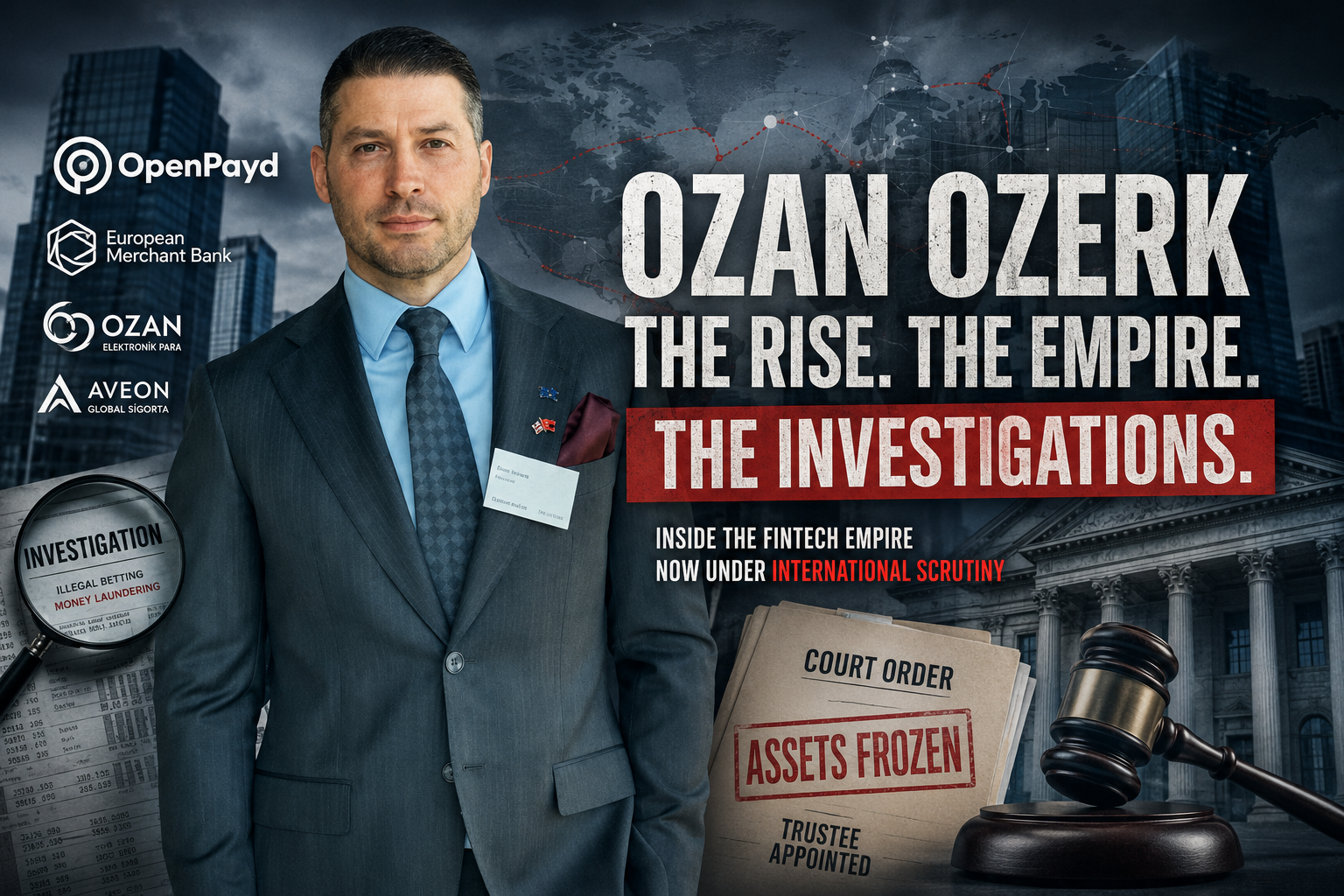
According to public reporting, the Istanbul Chief Public Prosecutor’s Office launched a criminal investigation into allegations that proceeds from illegal betting operations had been laundered through financial businesses connected to Özerk. The investigation focused on Ozan Elektronik Para A.Ş., an electronic money institution, and Aveon Global Sigorta A.Ş., an insurance company in which Özerk was the majority shareholder. Prosecutors alleged that funds generated from unauthorized online betting activities were introduced into the legitimate financial system through electronic payment services and insurance-related transactions. At the time of writing, these allegations remain part of ongoing legal proceedings and have not resulted in a public criminal conviction against Özerk.
The investigation quickly escalated beyond document reviews and financial analysis.
Turkish authorities carried out searches, detained company executives, and sought court orders to preserve assets while investigators examined financial records. Public reports stated that several senior executives associated with the businesses were taken into custody as part of the operation. These actions reflected a common strategy in financial crime investigations, where prosecutors seek to prevent the transfer or dissipation of assets before inquiries are complete.
One of the most significant legal developments followed shortly afterward.
A Turkish court reportedly appointed trustees to oversee the management of Ozan Elektronik Para A.Ş. during the investigation. Trustee appointments are an extraordinary legal measure. Rather than shutting down a company immediately, courts transfer operational control to independent administrators who manage the business while criminal proceedings continue. The objective is to preserve assets, protect customers and creditors, and prevent interference with evidence or ongoing investigations.
For any regulated financial institution, the appointment of trustees is a serious event. Customers, business partners, payment networks, and counterparties often view such orders as a sign that authorities believe there are sufficient grounds to justify judicial intervention, even though the appointment itself does not determine criminal liability. It is ultimately a protective measure rather than a finding of guilt.
Alongside the trustee appointment, investigators reportedly froze assets worth approximately 350 million Turkish lira, equivalent to around 11 million U.S. dollars at the time. Public reporting described the seizure as covering financial assets connected to the investigation, although the precise composition of those assets has not been fully disclosed through public court documents. Asset freezing orders are widely used in financial crime cases to ensure that property remains available should future confiscation proceedings become necessary.
While the investigation in Turkey attracted widespread domestic attention, it also resonated internationally because of Özerk’s profile within European fintech.
Unlike a local business owner whose activities are confined to one jurisdiction, Özerk had spent years building companies serving customers across several countries. OpenPayd had become a recognized provider of Banking-as-a-Service infrastructure, while European Merchant Bank operated under a Lithuanian banking licence. His businesses interacted with payment providers, financial technology firms, digital asset companies, and institutional clients throughout Europe.
As news of the Turkish investigation spread, questions inevitably arose about whether regulators elsewhere would examine businesses linked to the same ownership network.
At the time of writing, there is no publicly available evidence that European regulators have announced enforcement action directly against Özerk personally in connection with the Turkish proceedings. Likewise, there has been no public criminal conviction against him arising from those investigations. Nevertheless, financial institutions operating internationally often experience heightened regulatory attention when significant criminal investigations emerge within related corporate groups. Supervisory authorities may review governance arrangements, anti-money laundering controls, ownership structures, and internal compliance procedures to determine whether additional regulatory action is necessary.
The Turkish investigation also highlighted the increasingly blurred boundaries between different sectors of financial services.
Electronic money companies, banks, insurance firms, and payment processors no longer operate in isolation. A customer may deposit money through one licensed institution, transfer it through another, exchange currencies using a third provider, and purchase insurance products through a fourth, all within the same corporate ecosystem. While this integration creates efficiency for legitimate commerce, investigators argue that it can also make financial crime more difficult to detect if criminals exploit weaknesses across multiple services simultaneously.
The allegations involving illegal betting illustrate why prosecutors pay close attention to electronic money institutions.
Illegal betting operations frequently rely on digital payment systems because traditional banking channels may be unwilling to process their transactions. Electronic wallets, prepaid payment instruments, and fast settlement systems can allow funds to move rapidly between numerous accounts before investigators have an opportunity to intervene. Anti-money laundering legislation therefore requires licensed payment providers to identify unusual transaction patterns, verify customer identities, monitor account activity, and report suspicious transactions to financial intelligence authorities.
Whether those obligations were adequately fulfilled remains one of the central questions investigators appear to be examining.
Public reporting has not disclosed the full evidentiary record supporting the Turkish investigation, nor have prosecutors publicly detailed every transaction or customer relationship under scrutiny. As a result, many aspects of the case remain unknown outside official investigative files. That uncertainty has contributed to intense public interest while also underscoring the importance of distinguishing verified court actions from allegations that have yet to be tested in court.
Throughout the controversy, Özerk has maintained that he was not involved in the day-to-day management of the companies under investigation. According to statements reported by multiple outlets, he described himself primarily as an investor and shareholder rather than an operational executive responsible for the businesses’ daily activities. He has also indicated that the companies maintain compliance systems designed to meet applicable regulatory requirements. Those statements form an important part of the public record because they present the position of the individual whose business interests have become the subject of scrutiny.
His response also reflects a broader reality within modern corporate governance.
Large financial groups are often structured so that founders and principal shareholders are separated from operational management. Boards of directors, executive officers, compliance departments, and independent risk committees typically oversee daily decision-making. Determining where legal responsibility ultimately lies can become one of the most complex aspects of any financial crime investigation, particularly when ownership spans multiple jurisdictions and numerous regulated entities.
The Turkish proceedings were not the only factor shaping public perceptions of Özerk’s business empire.
They emerged after international investigative journalists had already examined payment flows involving companies associated with his wider network during the OCCRP-led Scam Empire investigation. Although the Turkish case and the Scam Empire reporting concern different alleged criminal activity, together they placed unprecedented attention on businesses connected to one of Europe’s most prominent fintech entrepreneurs.
That combination of investigative journalism and prosecutorial action created a narrative far more significant than either development alone. One questioned whether licensed payment infrastructure had processed transactions linked to alleged international investment scams. The other alleged that separate companies within the same ownership network had been used to launder proceeds from illegal betting operations. Neither development established Özerk’s personal criminal liability, but together they intensified scrutiny of his business empire and raised difficult questions about governance, oversight, and financial crime controls within rapidly expanding fintech groups.
By the beginning of 2026, what had once been celebrated as a cross-border fintech success story had become the subject of growing debate among regulators, compliance professionals, journalists, and financial crime specialists. The focus was no longer simply on innovation or technological growth. It had shifted toward a more fundamental question that regulators across Europe continue to confront: how can authorities ensure that the infrastructure powering modern digital finance is not exploited by those seeking to disguise the proceeds of fraud, illegal betting, or other organized criminal activity?
That question extends well beyond any single entrepreneur. It strikes at the heart of the regulatory challenges facing the global fintech industry itself.
If the Turkish investigation raised questions about governance inside companies connected to Ozan Özerk, the international reporting that preceded it raised equally important questions about the role payment infrastructure can play in global financial crime.
The Organized Crime and Corruption Reporting Project (OCCRP), working with media partners including Sweden’s SVT and Norway’s VG, spent months examining what became known as the “Scam Empire” investigation. Their reporting centered on an alleged network of fraudulent online investment platforms that prosecutors and investigators believe targeted victims across Europe, North America, Australia, and other regions. According to the investigation, the schemes persuaded individuals to invest in cryptocurrencies, foreign exchange products, and other financial instruments that either did not exist or were manipulated to create the illusion of profitable trading.
The human cost was significant.
Many victims believed they were investing their life savings with legitimate financial firms. Some reportedly mortgaged their homes or emptied retirement accounts after being convinced by sophisticated sales operations that promised exceptional returns. Instead of generating profits, investigators alleged that much of the money disappeared into a complex network of shell companies, payment intermediaries, and bank accounts spread across several jurisdictions.
Following money through that network became one of the defining challenges of the investigation.
Unlike traditional financial crimes that often involve a single bank or jurisdiction, modern online fraud frequently depends on multiple licensed institutions operating in different countries. Payments may pass through electronic money institutions, correspondent banks, foreign exchange providers, and payment processors before reaching their final destination. Every additional layer makes tracing funds more difficult and creates opportunities for criminals to disguise the origin and movement of money.
It was within that broader examination of financial infrastructure that companies linked to Özerk’s business interests entered the picture.
According to the OCCRP-led reporting, payment infrastructure associated with OpenPayd and European Merchant Bank appeared in transaction flows connected to businesses that investigators associated with the alleged scam network. The reporting did not accuse either institution of creating or operating the fraudulent investment platforms. Instead, it examined whether regulated financial institutions had processed transactions connected to businesses that investigators later concluded formed part of a wider fraud ecosystem.
That distinction is critical.
Payment providers process millions of legitimate transactions every day. The fact that criminal proceeds pass through a licensed institution does not automatically establish wrongdoing by the institution or its owners. Anti-money laundering laws generally require prosecutors to prove far more than the existence of suspicious transactions before establishing criminal liability. Investigators must examine what compliance systems existed, what information was available to employees, whether suspicious activity was identified, and how institutions responded once risks became apparent.
Those questions remain central to any fair assessment of Özerk’s wider business empire.
Publicly available information does not establish that Özerk personally directed illegal transactions or knowingly facilitated criminal activity. Nor has any court publicly convicted him of fraud or money laundering. Instead, the public record consists of investigative reporting, ongoing legal proceedings involving companies in which he holds ownership interests, and court actions designed to preserve assets and maintain operational control while investigations continue.
Even so, the convergence of multiple independent developments is difficult to ignore.
First came investigative reporting examining payment flows connected to an alleged international fraud network. Then came a criminal investigation in Turkey involving separate companies within Özerk’s broader corporate structure. The allegations differed, the jurisdictions were different, and the legal theories were not the same. Yet both developments focused on financial institutions operating within a business empire built around moving money across borders.
For regulators, that convergence presents an uncomfortable reminder of how rapidly financial services have evolved.
Over the past decade, Banking-as-a-Service providers, electronic money institutions, payment processors, and embedded finance platforms have become essential infrastructure for the digital economy. Their technology enables everything from online marketplaces and payroll providers to cryptocurrency exchanges and international remittance companies. The same speed and efficiency that make these services commercially valuable also create attractive opportunities for sophisticated criminal organizations seeking to move funds before authorities can intervene.
This is precisely why regulators across Europe have devoted increasing attention to anti-money laundering compliance within the fintech sector. Supervisory authorities have repeatedly warned that rapid commercial growth must not come at the expense of customer due diligence, transaction monitoring, sanctions screening, and governance. Institutions are expected not only to comply with regulatory requirements but also to demonstrate that compliance functions remain effective as transaction volumes increase.
Whether investigators ultimately conclude that those standards were met within companies connected to Özerk remains a matter for the relevant legal and regulatory authorities.
Another issue that has attracted attention is the complexity of Özerk’s corporate structure itself.
Public records indicate business interests spanning payment institutions, insurance companies, banking entities, technology firms, and financial service providers operating across several countries. Such international structures are common among multinational financial businesses, particularly those serving clients throughout Europe. However, they can also complicate regulatory oversight because different entities fall under different supervisory authorities, each applying its own legal framework and reporting requirements.
For investigative journalists, mapping those relationships is essential. Ownership does not necessarily imply operational control, and corporate affiliation alone does not establish legal responsibility for another company’s conduct. Nevertheless, understanding how entities are connected allows readers to follow both commercial relationships and regulatory oversight in a way that isolated reporting often cannot.
Özerk has consistently maintained that he is an entrepreneur and investor whose role should not be confused with the operational management of every company in which he has an ownership interest. Public statements attributed to him emphasize that licensed institutions within his business network maintain compliance departments and operate under regulatory supervision. Those responses deserve to be reported alongside the allegations because they represent the principal defense advanced in the public domain.
As legal proceedings continue, several important questions remain unanswered.
Will Turkish prosecutors ultimately file formal indictments against additional individuals or entities? Will courts uphold or lift the trustee appointments imposed during the investigation? Will frozen assets remain subject to confiscation proceedings, or will they eventually be released? Will European regulators conduct further reviews of institutions connected to Özerk’s business interests? And perhaps most importantly, will ongoing investigations produce evidence sufficient to support criminal prosecutions, or will some allegations ultimately remain unproven?
At present, those questions do not have definitive public answers.
That uncertainty illustrates an important principle of investigative journalism. Responsible reporting is not measured by the severity of allegations but by the accuracy with which evidence is presented. Investigations often begin long before courts reach conclusions. Journalists have an obligation to distinguish allegations from established facts, explain what official records actually show, and give readers enough context to understand where legal proceedings currently stand.
In Özerk’s case, the verified public record establishes several key facts. He built one of Europe’s more prominent fintech infrastructure businesses after beginning his career in medicine and entrepreneurship. Companies within his wider corporate network have become the subject of significant investigative reporting concerning alleged fraud payment flows. Turkish prosecutors have opened a criminal investigation involving separate companies in which he holds ownership interests. Courts have reportedly appointed trustees over one of those companies and approved asset preservation measures during the investigation. At the same time, Özerk has not been publicly convicted of any criminal offence, and he has denied operational involvement in the conduct under investigation.
Those facts alone make the story significant.
It is not simply the story of one entrepreneur. It reflects the growing tension between financial innovation and financial oversight. As fintech companies continue replacing traditional banking infrastructure, regulators face increasing pressure to ensure that technological progress is matched by equally sophisticated safeguards against money laundering, organized crime, fraud, and illegal gambling.
Whether Ozan Özerk’s business empire ultimately becomes an example of regulatory failure, corporate resilience, or a cautionary tale about the risks of operating complex financial networks across multiple jurisdictions will depend on investigations that are still unfolding. Courtrooms, regulators, and supervisory authorities, rather than headlines alone, will determine many of those answers.
Until then, the story remains unfinished.
What is already beyond dispute, however, is that Özerk’s rise from medical student to fintech founder has become intertwined with one of the most closely watched cross-border financial investigations involving a European technology entrepreneur in recent years. The outcome will matter not only to the companies involved but also to regulators, investors, compliance professionals, and customers who increasingly rely on digital financial infrastructure every day.
In an industry built on trust, confidence can take years to establish and only moments to lose. The investigations surrounding companies connected to Ozan Özerk demonstrate how quickly success in the fintech world can be overshadowed by questions about governance, compliance, and the movement of money across an increasingly interconnected global financial system. Whatever the final legal outcome, those questions are likely to shape discussions about financial regulation long after the current investigations have concluded.
————-
Disclaimer:
Some content on Reportingscams.com is published under our guest post program and is provided by third-party contributors. Reporting scams does not create, verify, or take responsibility for the views, accuracy, or claims expressed in such content.