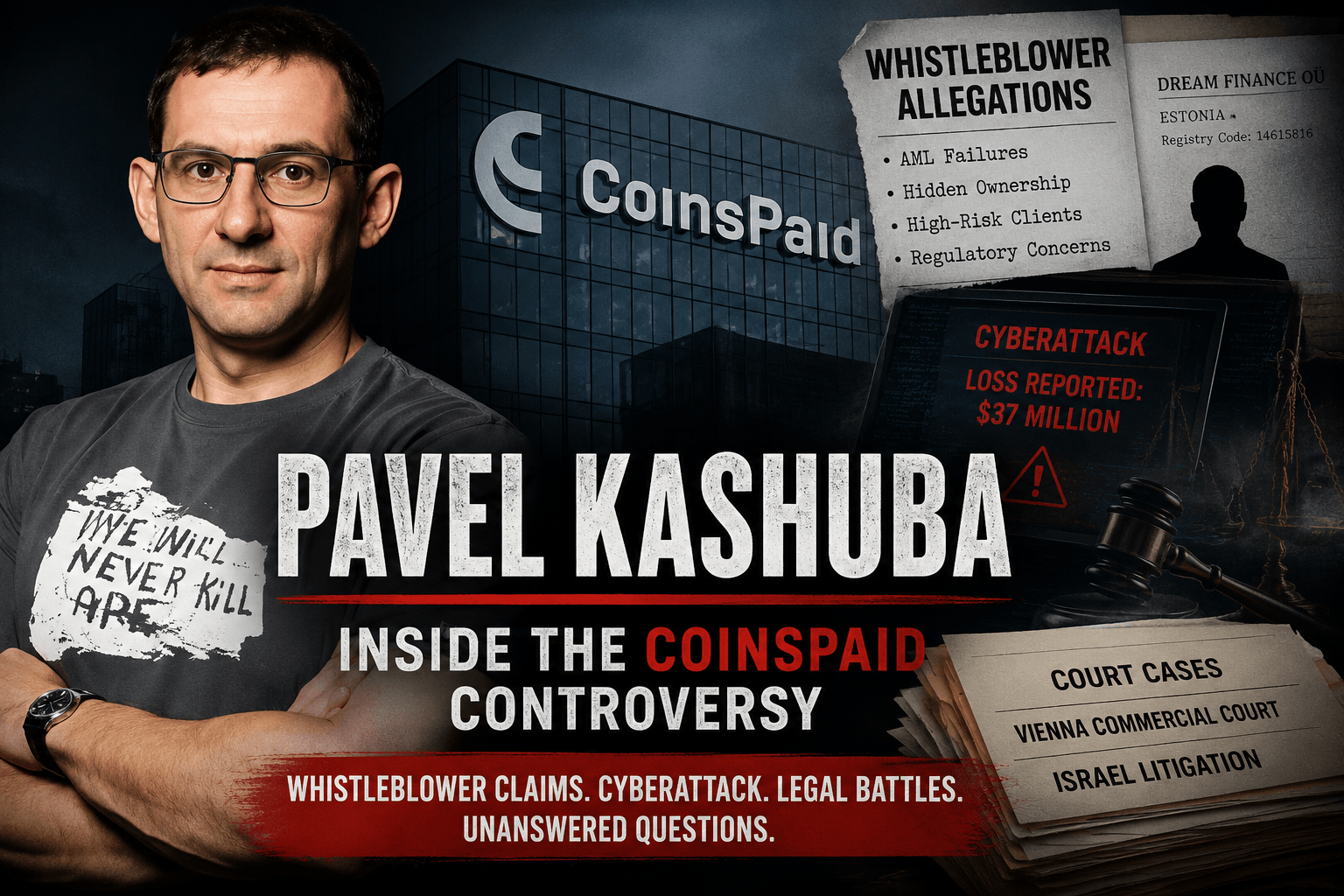
The cryptocurrency industry has spent much of the past decade presenting itself as an alternative to traditional finance. Companies promised faster transactions, fewer intermediaries and a financial system built on transparency. Behind that narrative, however, regulators and investigators have repeatedly found that some of the industry’s fastest-growing businesses operated in environments where oversight struggled to keep pace. It is within that landscape that Pavel Kashuba emerged as a prominent executive at CoinsPaid, a cryptocurrency payments company that grew from a relatively unknown startup into one of Europe’s largest digital asset payment processors. For years, the company promoted itself as a trusted bridge between cryptocurrency and conventional commerce, processing billions of euros in transactions for online businesses around the world. Yet as its profile expanded, so did questions about its governance, ownership structure, compliance practices and the people responsible for managing one of the crypto sector’s most influential financial platforms.
Unlike the founders whose names became synonymous with the cryptocurrency boom, Pavel Kashuba rarely sought the spotlight. He maintained a relatively low public profile even as CoinsPaid expanded across Europe and beyond. Public records and company announcements identify him as the company’s Chief Financial Officer before he later assumed the position of co-Chief Executive Officer. In those roles, Kashuba was responsible for overseeing the financial operations of a business that claimed to process billions in annual cryptocurrency transactions while serving merchants in sectors ranging from e-commerce to online gaming. His responsibilities placed him at the centre of strategic decisions during a period when regulators across Europe were becoming increasingly concerned about money laundering risks within digital asset businesses.
CoinsPaid’s rapid expansion reflected the explosive growth of the cryptocurrency economy itself. The company positioned its services as a solution for businesses wanting to accept digital assets without exposing themselves to the volatility traditionally associated with cryptocurrencies. Merchants could receive payments in Bitcoin and other digital currencies while settling transactions in fiat currencies if they chose. This model proved particularly attractive to industries that operated internationally, where traditional banking services were often slower, more expensive or subject to tighter restrictions.
Operating through the Estonian company Dream Finance OÜ, CoinsPaid benefited from Estonia’s early efforts to establish itself as one of Europe’s most crypto-friendly jurisdictions. During the late 2010s, Estonia issued hundreds of virtual asset service provider licences, encouraging entrepreneurs to establish cryptocurrency businesses within the country. For many companies, obtaining an Estonian licence became a symbol of regulatory legitimacy, even as authorities later acknowledged that the rapid expansion of the licensing regime had outpaced effective supervision.
Against that backdrop, CoinsPaid developed an image of a successful European fintech business. Company executives frequently highlighted transaction volumes, technological innovation and partnerships with merchants operating across multiple jurisdictions. Industry conferences featured CoinsPaid representatives discussing the future of cryptocurrency payments, while marketing material emphasised regulatory compliance and security. To many observers, the company appeared to represent one of the more established names in an industry often criticised for instability.
Yet beneath the company’s public image, questions about its ownership and governance were beginning to emerge. Corporate records identified Dream Finance OÜ as the legal entity behind CoinsPaid, while public disclosures pointed to Austrian businessman Alexander Horst Riedinger and entrepreneur Maksim Krupyshev among those associated with the company’s ownership. On paper, the structure appeared straightforward enough. However, later investigative reporting and whistleblower allegations would argue that the true picture was considerably more complicated, suggesting that publicly disclosed ownership may not have reflected the individuals exercising ultimate control over the business. Those allegations have been disputed and have not been established by any court judgment, but they became one of the central themes in the scrutiny that followed.
Questions surrounding ownership carry particular significance in the cryptocurrency sector. Financial institutions are generally expected to identify the individuals who ultimately control businesses operating within regulated markets. Transparency over beneficial ownership is considered a fundamental safeguard against money laundering, sanctions evasion and other financial crimes. When uncertainty arises regarding who ultimately controls a financial institution, regulators often view that uncertainty as a compliance concern rather than simply a corporate governance issue.
As CoinsPaid expanded, the cryptocurrency industry itself was entering a period of heightened regulatory attention. Governments across Europe, the United States and Asia were responding to a succession of scandals involving digital asset exchanges, payment processors and investment platforms. Billions of dollars had disappeared through exchange collapses, hacking incidents and alleged fraud schemes. Regulators increasingly warned that cryptocurrency payment providers could become attractive channels for illicit financial flows if customer due diligence and transaction monitoring failed to keep pace with rapid business growth.
Within this changing regulatory climate, CoinsPaid publicly maintained that compliance remained central to its operations. The company stated that it followed anti-money laundering requirements, implemented know-your-customer procedures and cooperated with regulators where necessary. Such assurances reflected the expectations placed upon licensed cryptocurrency businesses seeking to distinguish themselves from less regulated competitors. Nevertheless, questions about whether those systems functioned as effectively as advertised would later become one of the most contentious aspects of the company’s story.
Much of the public scrutiny that eventually surrounded CoinsPaid can be traced to events unfolding inside the company rather than outside it. In April 2023, Frédéric Hubin, who had served as the company’s Chief Legal Officer, resigned from his position. Executive departures occur regularly within fast-growing technology companies, but Hubin’s resignation would prove different. Over time, he emerged as a whistleblower whose allegations would become central to subsequent investigative reporting examining CoinsPaid’s operations.
Hubin alleged that he had raised concerns internally regarding compliance, governance and business practices before leaving the company. According to material later published by investigative outlets, he questioned whether the company’s anti-money laundering controls were sufficiently robust and raised broader concerns regarding corporate transparency. His allegations also extended to the company’s ownership structure and certain business relationships. CoinsPaid has rejected or disputed many of those claims, and the allegations themselves have not been established through criminal proceedings. Even so, they attracted considerable attention because they originated from one of the company’s own former senior executives.
The significance of an insider speaking publicly should not be underestimated. External critics often rely on publicly available information and indirect sources, but whistleblowers can provide context unavailable through corporate filings alone. At the same time, responsible reporting requires recognizing that whistleblowers may also become involved in employment disputes or litigation that shapes their perspective. For that reason, many of the claims emerging from Hubin’s disclosures have been reported alongside the company’s denials and without presenting them as established facts.
Investigative journalists examining the material did not focus solely on Hubin’s allegations. They also compared corporate records, regulatory filings and publicly available documentation concerning Dream Finance OÜ and associated entities. That broader examination transformed what had initially appeared to be an internal disagreement into a wider investigation of how one of Europe’s largest cryptocurrency payment processors operated behind the scenes.
By this stage, Pavel Kashuba occupied a unique position within the unfolding story. As Chief Financial Officer and later co-Chief Executive Officer, he was not merely an observer to the company’s expansion. He was part of the leadership team responsible for overseeing its financial strategy during years of extraordinary growth. Public reporting has not identified evidence that Kashuba personally orchestrated criminal conduct, nor has any court found him liable for the allegations later directed toward the company. Nevertheless, his executive role meant that questions surrounding CoinsPaid’s governance inevitably extended to the senior management responsible for directing its operations.
The company continued to project confidence publicly, highlighting new partnerships, technological developments and increasing transaction volumes. Yet behind those announcements, journalists, whistleblowers and industry observers were beginning to assemble a far more complicated picture. What initially appeared to be isolated concerns about corporate governance would soon intersect with allegations involving anti-money laundering controls, questions over beneficial ownership, links to related entities, one of the cryptocurrency industry’s largest cyberattacks and legal disputes spanning multiple jurisdictions. Together, those developments would transform Pavel Kashuba from a relatively little-known finance executive into a central figure in one of the most closely scrutinised corporate stories to emerge from Europe’s cryptocurrency payments industry.
By the spring of 2023, CoinsPaid was still presenting itself as one of Europe’s success stories in cryptocurrency payments. The company spoke about expansion, new partnerships and growing transaction volumes. From the outside, there was little indication that a serious dispute had developed inside the business. That changed when Frédéric Hubin, the company’s former Chief Legal Officer, walked away from his role and later began describing what he claimed to have witnessed during his time at the firm.
Hubin did not accuse CoinsPaid of making simple compliance mistakes or isolated operational errors. His allegations went much further. In interviews, legal filings and documents later relied upon by investigative outlets including FinTelegram and Investigations.org, he claimed that the company had serious weaknesses in its anti-money laundering framework, that important ownership information had been concealed and that internal concerns were not properly addressed. CoinsPaid has rejected many of those allegations and has consistently maintained that it operates in compliance with applicable laws. None of Hubin’s most serious claims have resulted in a criminal conviction against Pavel Kashuba or the company. Even so, the allegations attracted attention because they came from someone who had served as the company’s chief legal officer.
Former employees can be unreliable witnesses if their claims are driven by personal disputes. They can also be among the few people with direct knowledge of how decisions were made inside a private company. That is why Hubin’s statements quickly became part of a much larger investigation rather than standing on their own. Journalists compared his claims against corporate records, company filings and publicly available documents before publishing their reporting.
One issue that surfaced repeatedly involved Dream Finance OÜ, the Estonian company through which CoinsPaid operates. Public records identified the company’s disclosed ownership, but investigative reports questioned whether those records reflected the people who ultimately exercised control over the business. According to reporting that relied partly on whistleblower material, there were allegations that undisclosed interests connected to Belarus remained involved in the company’s operations. Those allegations have been denied and have not been confirmed by any court. Still, they drew attention because European regulators have spent years tightening rules requiring financial businesses to disclose their ultimate beneficial owners.
For a cryptocurrency payment processor handling transactions across multiple countries, ownership is more than a corporate formality. Regulators expect licensed firms to know exactly who controls the business, not simply who appears in shareholder registers. That expectation has become even stronger since European authorities increased their focus on financial transparency following sanctions imposed on Russian and Belarusian interests after the invasion of Ukraine.
Hubin’s concerns were not limited to ownership. He also questioned whether CoinsPaid’s anti-money laundering systems were operating as effectively as the company publicly claimed. Like every licensed virtual asset service provider, CoinsPaid was required to monitor transactions, identify customers, assess risk and report suspicious activity where appropriate. Those obligations are not optional. They form the basis on which cryptocurrency businesses are allowed to operate within regulated markets.
The company has consistently stated that it maintains comprehensive compliance procedures and performs customer verification in accordance with legal requirements. Investigative reports, however, cited allegations that internal compliance processes did not always match those public assurances. Those reports relied largely on whistleblower accounts rather than findings issued by regulators or criminal courts, making it important to distinguish between reported allegations and established facts.
Another area that received considerable attention involved the company’s client base. CoinsPaid openly marketed payment solutions to sectors that traditional banks often approached cautiously, including online gambling. Servicing licensed gambling operators is not unlawful. Many legitimate payment companies work with regulated gaming businesses every day. The challenge lies in ensuring that those clients meet licensing requirements and that payment flows comply with anti-money laundering regulations.
Investigative reporting questioned whether some merchants processed through the platform operated in jurisdictions where regulatory oversight was less clear. No public authority has concluded that Pavel Kashuba personally facilitated illegal gambling activity, nor has any criminal court made such a finding against CoinsPaid. The reporting instead focused on whether the company’s risk controls were sufficiently robust for the types of businesses it served.
As journalists dug further, another company repeatedly appeared in the reporting. AlphaPo, a cryptocurrency payment platform with a similar business model, became the subject of scrutiny because of reported operational links with CoinsPaid. Investigative reports suggested that the two businesses shared infrastructure, personnel or operational relationships that were closer than publicly acknowledged. The precise nature of those connections remains disputed, but the overlap attracted interest because companies operating within regulated financial markets are generally expected to disclose relationships that may affect governance, compliance or risk management.
The questions surrounding AlphaPo became even more significant after both companies experienced major cybersecurity incidents. In July 2023, CoinsPaid disclosed that it had suffered one of the largest cyberattacks ever reported against a cryptocurrency payment processor. The company said hackers had stolen approximately $37 million in digital assets after compromising its systems through what it described as a sophisticated social engineering attack.
The announcement sent shockwaves through the cryptocurrency industry. Unlike exchange failures caused by insolvency or fraud, this was presented as a highly targeted cyberattack carried out by professional hackers. CoinsPaid stated that it absorbed the financial losses itself without passing them on to customers. It also said services were restored quickly and that security measures were strengthened following the incident.
The hack itself was never seriously disputed. What became controversial was everything that followed.
Investigative reports later questioned whether the publicly disclosed figure reflected the full extent of the losses. According to material cited by FinTelegram and Investigations.org, internal information allegedly suggested that the financial impact may have been higher than what had been announced publicly. Those reports relied on confidential sources and whistleblower material. CoinsPaid disputed suggestions that it had misrepresented the incident, and no regulator has publicly concluded that the company intentionally understated its losses. The issue nevertheless became another point of scrutiny because transparency is critical for financial institutions responding to major cybersecurity breaches.
The cyberattack arrived at a difficult moment for the company. Cryptocurrency markets were already recovering from a series of high-profile collapses, including the failure of several major exchanges and lending platforms. Confidence across the industry had been badly shaken. Investors, merchants and regulators were paying far closer attention to governance, internal controls and operational resilience than they had only a few years earlier.
While CoinsPaid worked to reassure customers after the hack, investigative reporting continued to gather momentum.
In May 2024, FinTelegram published a detailed investigation examining the company, its ownership, internal disputes and compliance practices. The reporting drew heavily from whistleblower material, corporate documents and public records. It presented a far more critical picture of CoinsPaid than the company had previously faced in mainstream industry coverage.
The publication did not claim that every allegation had been proven. Instead, it laid out documents, competing accounts and unresolved questions, many of which remain the subject of dispute today. CoinsPaid responded by rejecting numerous allegations and defending both its compliance programme and corporate governance.
Around the same period, Pavel Kashuba stepped down from his executive positions within the company. Publicly available information does not indicate that his departure resulted from any regulatory finding or court order. Companies change leadership for many reasons, particularly during periods of intense public scrutiny. No official authority has stated that Kashuba’s resignation amounted to an admission of wrongdoing. Even so, the timing inevitably drew attention because it came shortly after the publication of reporting that placed the company’s leadership under renewed examination.
The legal disputes did not end with the publication of those investigations. Court proceedings in Austria and Israel followed, reflecting an increasingly bitter conflict between former insiders, company representatives and parties connected to the reporting. Some of those cases dealt with commercial disagreements, while others centred on allegations involving reputational damage and publication of investigative material. The litigation remains important because it shows that many of the underlying claims continue to be contested rather than settled by final judicial findings.
By mid-2024, CoinsPaid found itself defending not only its cybersecurity response but also its corporate governance, ownership disclosures and compliance record. Much of the evidence discussed publicly came from investigative journalism, whistleblower accounts and civil litigation rather than criminal prosecutions. That distinction matters. Serious allegations deserve careful reporting, but they should not be presented as established facts unless confirmed by courts or regulators.
For Pavel Kashuba, the period marked a dramatic change from the years when he was known mainly as the finance executive behind one of Europe’s fastest-growing cryptocurrency payment processors. His name had become linked to a broader debate about transparency in the crypto industry, the responsibilities of senior executives and how much the public truly knows about the companies moving billions of dollars in digital assets every year.
————-
Disclaimer:
Some content on Reportingscams.com is published under our guest post program and is provided by third-party contributors. Reporting scams does not create, verify, or take responsibility for the views, accuracy, or claims expressed in such content.