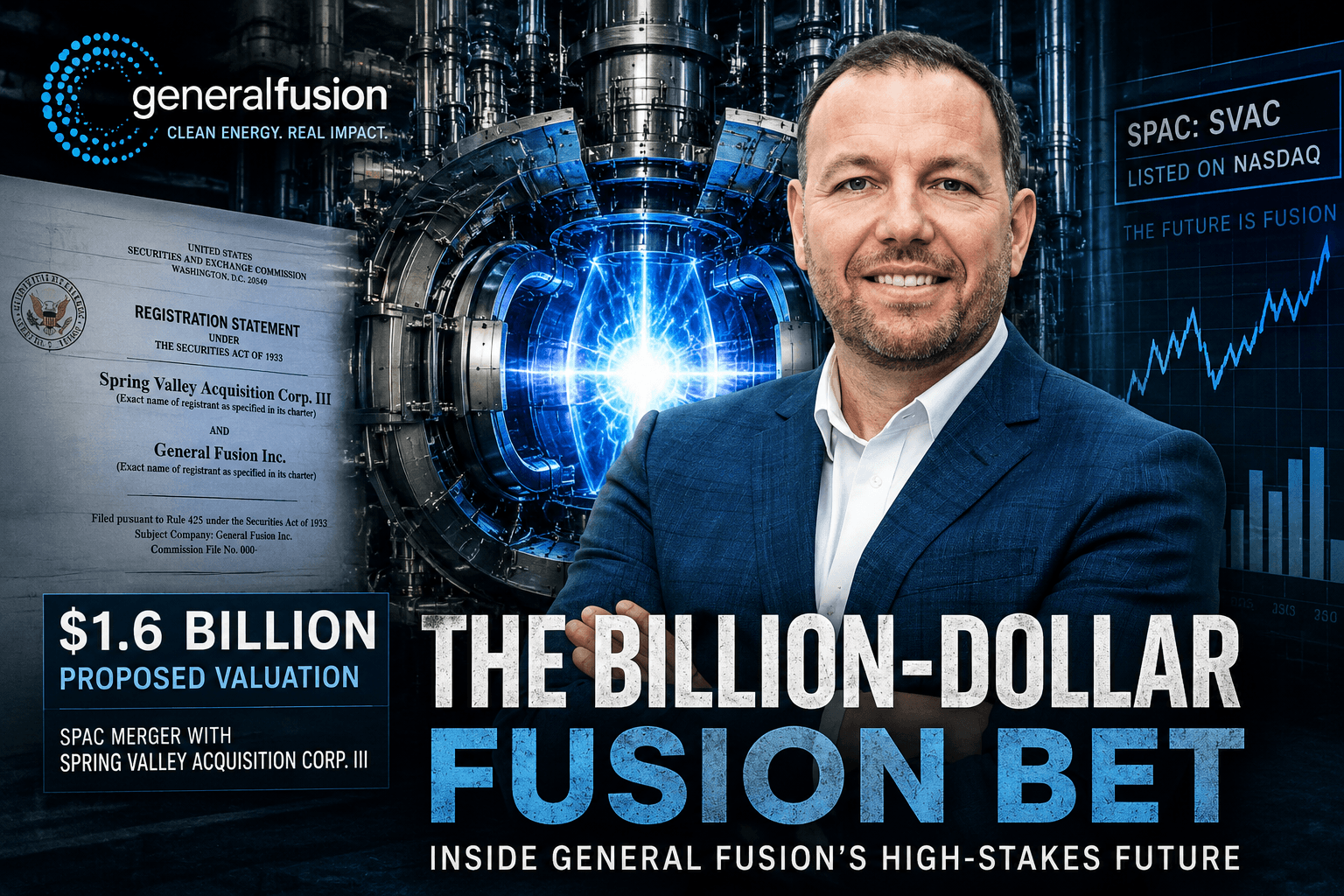
Greg Twinney has spent much of his career trying to convince investors, engineers and governments that nuclear fusion can be a commercial energy source within a realistic business timeframe. As General Fusion’s chief executive since 2021, he’s become the public face of one of the world’s longest-running private fusion ventures, a company that finds itself at a critical crossroads as it tries to go public through a merger with Spring Valley Acquisition Corp. III.
The deal values General Fusion at roughly US$1.6 billion, a notable valuation given that the company has yet to produce any commercial electricity and remains in the experimental phase. The transaction, according to SEC filings, is intended to provide the company with new capital to fund its next phase of development including construction and testing of its Lawson Machine 26 demonstration system in the United Kingdom. The filings also indicate General Fusion is still a pre-revenue company and needs to continue raising money and making technical progress to be successful.
Twinney is a Canadian technology executive with a background in telecommunications and software businesses. He joined General Fusion after having been chief executive of several growth-stage companies including RS Energy Group. Unlike the physicists who founded General Fusion in 2002, Twinney was brought on board mainly to scale the business, attract capital and prepare the company for commercialization. During his tenure he has negotiated partnerships with governments, industrial firms and research organizations while promoting the company’s unique magnetized target fusion technology.
That approach is not like the massive laser systems and tokamak reactors that get a lot of attention in fusion headlines. General Fusion’s design is to compress a plasma using a ring of pistons around a liquid-metal chamber with the goal of creating the conditions necessary for fusion reactions. Proponents say the concept could ultimately be cheaper and simpler than rival fusion technologies. Some plasma physicists are among the skeptics, who question whether the company can achieve the degree of compression and stability necessary to produce net power at commercial scale.
Skepticism grew in 2025 as General Fusion began to feel the financial pinch. The company confirmed earlier this year it had laid off a significant portion of its workforce as it tries to conserve cash while continuing work on its demonstration reactor. Twinney later penned an open letter to employees, investors and supporters arguing the restructuring was needed to protect the company’s core mission and extend its financial runway. “The technical program is on track and the company is focused on proving key milestones before seeking additional capital,” he said.
Those assurances came against a tough backdrop for the wider fusion industry. After a rush of enthusiasm and venture funding earlier in the decade, investors have become more discerning as timelines have stretched and interest rates have gone up. A handful of fusion startups have had to raise money at lower valuations, put off projects or cut back on spending. General Fusion’s pursuit of a SPAC merger is symbolic of both the opportunity and the pressure on companies needing hundreds of millions of dollars before they can show a working power plant.
SEC filings include unusually candid warnings about those risks. General Fusion recognizes that fusion technology has not been commercially proven, that a significant amount of additional financing will be needed even after the merger and that there is no guarantee the company will reach technical milestones on its expected schedule. The filings also say the company may have to cut back on operations or development or look for strategic alternatives if it can’t obtain future funding.
What’s odd about the story is that there’s no public record of Twinney or General Fusion being accused by regulators of misleading investors or found liable for securities violations, despite the high valuation and the aggressive commercialization story. A review of SEC filings, corporate disclosures and major news reporting shows no criminal charges, civil enforcement actions or regulatory penalties associated with the company or its chief executive. The distinction is important because criticism of General Fusion has increasingly gone around online, particularly in fusion forums and investor discussions, where some commentators have questioned whether the company is overselling its progress.
But the financial stakes are still high. General Fusion has attracted hundreds of millions of dollars from a rollcall of prominent backers including venture capital firms, sovereign investors and industrial partners. The SPAC transaction is intended to provide additional funding to continue development of the reactor and progress towards a pilot power plant. If it succeeds, the company could join the ranks of the very few publicly traded pure-play fusion companies. Investors could face massive losses if the technology doesn’t pan out, having backed a project for years that has yet to generate commercial revenue.”
Twinney has continued to exude confidence. In recent interviews and investor presentations, he has argued that General Fusion is entering the most important testing phase in its history and that the company can demonstrate commercially relevant fusion conditions in the next few years. He has characterized the SPAC merger as a shift from scientific development to industrial deployment, rather than an exit for current insiders. It’s not clear whether the argument will ultimately find purchase in the public market.
The evidence at this time is of a company taking a high-risk gamble on one of the most difficult engineering challenges ever attempted, not a company facing proven fraud allegations. General Fusion is asking investors to fund a future where fusion energy is a commercial reality, but that future is not here yet. The question about Greg Twinney, therefore, is not whether regulators have accused him of wrongdoing. They have not. The question is whether he can convince public investors that General Fusion’s technology will work before the company’s cash runway expires. It’s a far more meaningful test, because it will decide whether one of Canada’s most ambitious fusion ventures turns out to be a breakthrough energy company or yet another costly experiment that failed to bridge the gap between scientific promise and commercial reality.
————-
Disclaimer:
Some content on Reportingscams.com is published under our guest post program and is provided by third-party contributors. Reporting scams does not create, verify, or take responsibility for the views, accuracy, or claims expressed in such content.