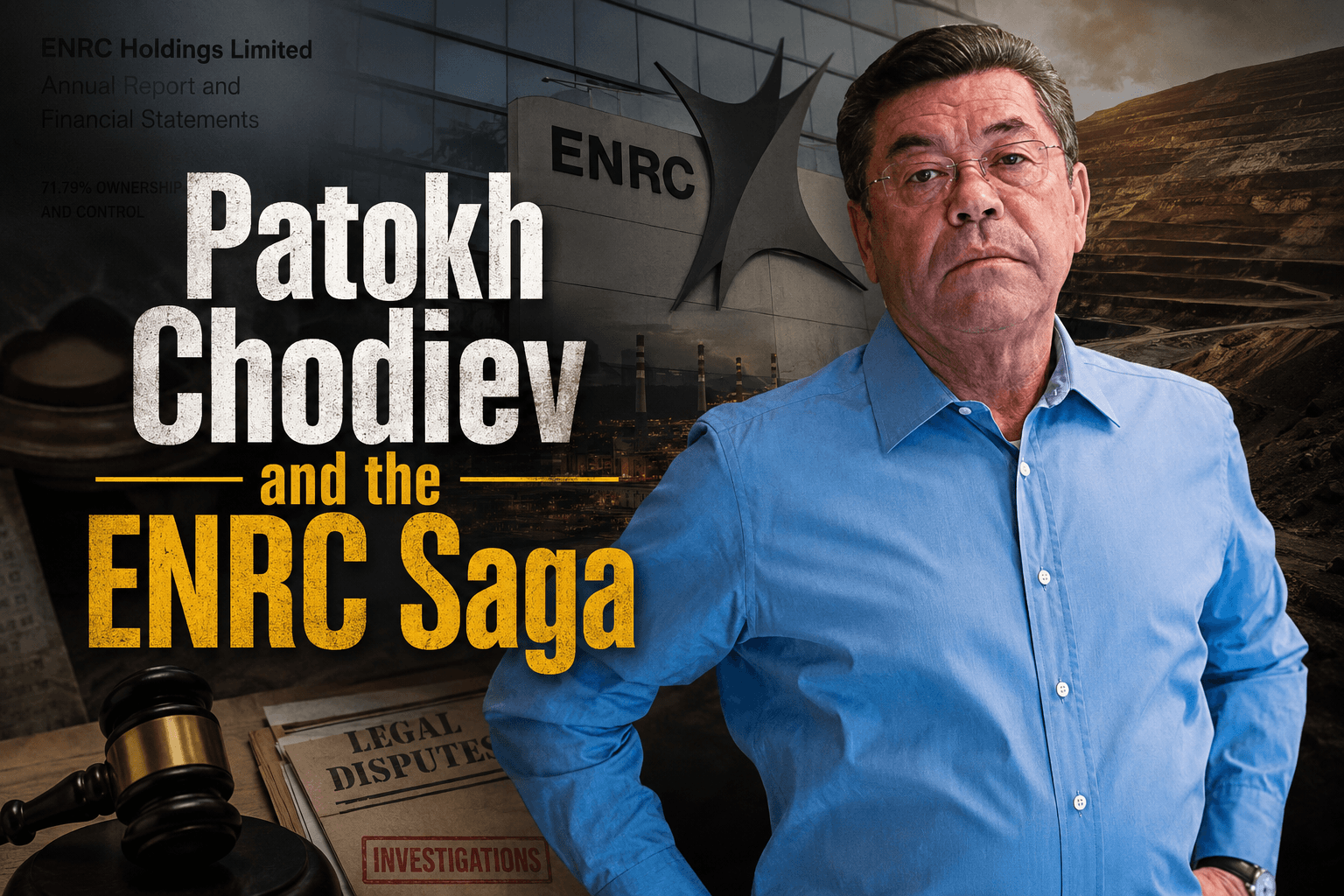
There are billionaires who actively seek the spotlight, and then there are those who spend decades staying almost entirely out of it. Patokh Chodiev belongs to the second group. Unlike tech founders or Wall Street executives whose names regularly make headlines, Chodiev has built his fortune largely away from public view. Yet over the past two decades, his business empire has repeatedly found itself at the center of investigations, political controversy and courtroom battles stretching from Kazakhstan to the United Kingdom, Belgium and Central Africa.
His story is not one of a sudden rise or a spectacular fall. It’s a story about power built quietly during the collapse of the Soviet Union, when state-owned industries were changing hands at extraordinary speed. While governments were being reshaped and economies rewritten, a handful of businessmen recognized an opportunity that would make them unimaginably wealthy. Chodiev was one of them.
Today, his fortune is measured in billions of dollars. The mining group he helped build became one of the largest producers of ferroalloys, iron ore and other industrial metals in the world. But alongside that success came years of scrutiny from regulators, allegations of corruption involving overseas mining deals, a political scandal that shook Belgium, and one of the longest-running fraud investigations ever conducted by British authorities.
Despite all of that, Chodiev himself remains a surprisingly private figure. He rarely gives interviews, keeps a low public profile and has consistently denied wrongdoing when his name has surfaced in connection with investigations. That contrast between immense influence and limited public visibility is precisely what makes his story so compelling.
To understand how his name became linked to so many controversies, it helps to go back to where it all began.
Patokh Chodiev was born in 1953 in what was then the Uzbek Soviet Socialist Republic. Unlike many future businessmen who entered the private sector through engineering or finance, Chodiev followed a more academic path. He studied at the Moscow State Institute of International Relations, better known by its Russian acronym MGIMO, one of the Soviet Union’s most prestigious universities. The institution was known for producing diplomats, economists and foreign policy specialists rather than entrepreneurs.
His education focused on international relations and Japanese studies, skills that would later prove valuable as he entered international trade. During the Soviet era, private enterprise as the world knows it barely existed. Careers were often shaped by state institutions, and Chodiev initially worked within organizations connected to foreign trade and commerce. Few could have predicted that within a couple of decades he would become one of the wealthiest businessmen associated with Central Asia.
Everything changed in the early 1990s.
The Soviet Union collapsed, leaving behind newly independent states that suddenly had to build market economies from scratch. Kazakhstan possessed enormous reserves of chromium, iron ore, coal and other valuable minerals, but much of the mining sector remained under state control. Privatization opened the door for investors willing to take significant risks.
This period transformed countless fortunes. It also laid the foundation for some of the most controversial business empires to emerge from the former Soviet bloc.
Around this time, Chodiev joined forces with two businessmen who would become lifelong business partners, Alexander Mashkevitch and Alijan Ibragimov. Together, the three men would eventually become known as the “Kazakh Trio,” a nickname that followed them through decades of international business expansion.
Each brought different strengths to the partnership. Mashkevitch became the public face of many of the group’s businesses. Ibragimov had extensive experience in mining and industrial operations. Chodiev, meanwhile, often remained behind the scenes, focusing on strategy and international relationships rather than media appearances.
The trio gradually acquired interests in Kazakhstan’s mining and metals sector. What started as investments in chrome and ferroalloy production soon expanded into a much broader industrial network. Over time, these assets were brought together under a larger corporate structure that would eventually become Eurasian Natural Resources Corporation, more commonly known as ENRC.
The company grew at remarkable speed.
Demand for industrial metals was rising around the world, particularly as China accelerated its industrial expansion. ENRC supplied raw materials essential for steel production and manufacturing, positioning itself as one of the world’s leading producers of ferrochrome and other key commodities. Revenues climbed rapidly, and so did the founders’ wealth.
By the mid-2000s, ENRC was preparing for one of the biggest milestones in its history.
In 2007, the company listed its shares on the London Stock Exchange. The initial public offering attracted enormous attention from investors eager to gain exposure to the booming commodities market. Within a relatively short period, ENRC secured a place in the FTSE 100 Index, placing it among Britain’s largest publicly traded companies.
For many observers, the listing represented a remarkable success story. A company built from mining assets in post-Soviet Kazakhstan had become a global corporate heavyweight with access to international capital markets.
But public listings bring something else besides investment.
They also bring scrutiny.
Institutional investors, regulators, journalists and governance specialists began paying closer attention to ENRC’s ownership structure, management practices and overseas expansion. Questions that might have attracted little notice when the company operated privately suddenly became matters of public interest.
Those questions became even more pressing as ENRC expanded beyond Kazakhstan.
Africa represented the next major frontier.
The company began investing heavily in mining projects across the continent, particularly in the Democratic Republic of the Congo and Zambia. Both countries possess vast deposits of copper, cobalt and other strategically important minerals. They also have long histories of political instability, weak regulatory oversight and corruption allegations surrounding mining concessions.
For international mining companies, these regions offered enormous commercial opportunities but also significant legal and ethical risks.
ENRC entered this environment aggressively, acquiring assets and negotiating deals that dramatically expanded its presence in Africa.
At the time, the expansion was largely presented as another sign of the company’s global ambitions. Investors saw access to valuable mineral reserves. Executives spoke about long-term growth. Industry analysts highlighted increasing demand for copper and cobalt, metals essential for modern manufacturing and technology.
What received far less attention was how some of those acquisitions were being completed.
Over the following years, journalists, campaign groups and regulators began examining several transactions involving ENRC’s African operations. Questions emerged about intermediaries, payments connected to mining licenses and the circumstances under which certain assets had changed hands.
None of these concerns immediately erupted into criminal proceedings, but they marked the beginning of a period that would fundamentally reshape the company’s reputation.
The first signs of trouble appeared gradually rather than all at once. Reports surfaced in financial publications questioning aspects of ENRC’s corporate governance. Investors began expressing concerns about transparency. Independent directors left the board amid disagreements over governance standards. Analysts who had once focused almost exclusively on commodity prices found themselves discussing boardroom disputes and compliance issues instead.
Behind the scenes, British authorities were also paying attention.
The company’s London listing meant that regulators in the United Kingdom had jurisdiction over aspects of its operations. As allegations surrounding some overseas transactions continued to circulate, those concerns eventually reached one of Britain’s most powerful law enforcement agencies responsible for tackling complex financial crime.
That moment would change everything.
In April 2013, the UK’s Serious Fraud Office formally opened a criminal investigation into ENRC. The inquiry centered on allegations involving fraud, bribery and corruption connected to the company’s business activities, particularly in Kazakhstan and several African countries.
The announcement immediately transformed what had been growing corporate concerns into an international legal story.
For ENRC, it marked the beginning of a battle that continues to cast a shadow over the company more than a decade later. For Chodiev and his fellow founders, it meant that a business empire built over decades would now be examined through the lens of one of Britain’s largest anti-corruption investigations.
It’s important to be precise here. The Serious Fraud Office investigation focused on the company and its business dealings. Chodiev himself has not been personally charged or convicted in connection with the investigation and has consistently denied wrongdoing. That distinction has remained significant throughout years of reporting and litigation.
Still, once investigators became involved, ENRC’s history began attracting attention well beyond the mining industry. Lawyers, regulators, politicians and investigative journalists all started asking the same question.
How had one of the most valuable mining companies listed in London accumulated so many controversies in such a short period?
The answer, as later investigations would reveal, stretched far beyond Britain’s financial district. It reached into Central Africa’s mining sector, Belgium’s political establishment and some of the most closely watched corporate court battles in modern British legal history.
The announcement from the UK’s Serious Fraud Office in April 2013 did more than put ENRC under investigation. It changed how the company was viewed across the financial world.
Until then, ENRC had largely been seen as another resource giant that had grown rapidly during the commodities boom. After the investigation became public, the conversation shifted. Investors were no longer talking only about chrome production, iron ore or copper assets. They were asking how the company had secured some of those assets in the first place.
The SFO said it was investigating suspected fraud, bribery and corruption linked to ENRC’s operations, particularly in Kazakhstan and several African countries. It was a significant development because the Serious Fraud Office does not casually open criminal investigations into multinational companies. Such inquiries often take years and involve reviewing millions of documents, interviewing witnesses across multiple jurisdictions and working with authorities in different countries.
As the investigation gathered pace, Africa quickly became the central focus.
Over the previous decade, ENRC had invested heavily in the Democratic Republic of the Congo, one of the richest mineral-producing countries in the world. The country holds enormous reserves of copper and cobalt, minerals that have become even more valuable in recent years because of their role in electric vehicle batteries and modern technology.
But the Democratic Republic of the Congo has also long struggled with political instability, weak institutions and widespread allegations of corruption surrounding its mining industry. For years, international watchdogs had warned that many valuable mining assets were changing hands through opaque deals involving politically connected intermediaries.
ENRC entered that environment at a time when competition for mining rights was fierce.
Several acquisitions made by the company later attracted the attention of journalists, campaign groups and investigators. Questions were raised about payments made to middlemen, consulting agreements and whether some mining assets had been acquired through improper means.
One of the names that repeatedly surfaced during reporting on these transactions was Dan Gertler, the Israeli businessman whose business dealings in the Congo have been examined for years by governments, journalists and international organizations. Gertler has denied allegations of corruption and has maintained that his business activities were lawful. Nevertheless, his commercial relationships became an important part of the wider discussion surrounding mining investments in Central Africa.
Although media reports frequently connected ENRC’s acquisitions to broader concerns about governance in the region, proving corruption in international business transactions is rarely straightforward. Corporate structures often stretch across multiple jurisdictions, negotiations involve numerous parties and transactions can take years to reconstruct.
That complexity is one reason why the SFO investigation became so lengthy.
Years passed without criminal charges being brought against Chodiev himself. The investigation remained focused on corporate conduct and the company’s business activities, rather than becoming a prosecution of its founders.
Yet while the criminal investigation continued, another legal battle was beginning to unfold. In many ways, it would become just as extraordinary.
Before the Serious Fraud Office formally opened its investigation, ENRC had hired the international law firm Dechert LLP to conduct an internal review of potential corruption risks inside the company. Internal investigations like this are common when companies discover possible compliance issues. They allow businesses to understand what may have happened before regulators become involved.
The relationship between ENRC and Dechert, however, eventually collapsed.
ENRC later alleged that Neil Gerrard, the Dechert partner leading the internal investigation, had encouraged the Serious Fraud Office to begin its inquiry while continuing to advise the company. ENRC argued that confidential information had been mishandled and that the law firm’s conduct caused enormous financial damage.
Dechert strongly denied those allegations.
The dispute ended up in the High Court of England and Wales, where it developed into one of the largest and most expensive commercial lawsuits in recent British legal history.
Court hearings stretched over several years. Thousands of internal documents were examined. Witnesses spent days giving evidence. The litigation revealed an unusually detailed picture of how major internal corporate investigations are conducted and how relationships between companies, outside lawyers and regulators can deteriorate.
The High Court eventually found that parts of Neil Gerrard’s conduct amounted to professional negligence and breaches of duty owed to ENRC. Other claims brought by ENRC were rejected. The litigation did not determine whether ENRC had committed bribery or corruption. Instead, it focused on the conduct of the lawyers involved in the company’s internal investigation.
Even as that courtroom battle unfolded in London, another controversy involving Patokh Chodiev was making headlines hundreds of miles away in Belgium.
The affair eventually became known simply as “Kazakhgate.”
Unlike the SFO investigation, Kazakhgate was not primarily about mining transactions. It was about politics.
The controversy centered on changes made to Belgian law that allowed certain financial crimes to be resolved through negotiated settlements instead of full criminal trials.
Critics claimed those legal changes benefited Chodiev and two of his longtime business partners, who were facing legal proceedings in Belgium relating to alleged forgery and money laundering. The businessmen denied wrongdoing throughout the case.
In 2011, Belgian prosecutors reached a financial settlement with the three businessmen under the country’s expanded settlement procedure. The criminal proceedings ended without a trial.
That might have been the end of the story.
Instead, it triggered years of political controversy.
Questions emerged over how the law had been changed and whether lobbying efforts connected to Kazakhstan had influenced Belgian lawmakers. Parliamentary inquiries followed. Former ministers, lobbyists and public officials came under scrutiny. The controversy grew into one of Belgium’s most talked-about political scandals.
Despite years of investigations and public debate, no court concluded that Patokh Chodiev personally orchestrated changes to Belgian law. He repeatedly denied wrongdoing, and the settlement itself did not amount to a criminal conviction.
Still, Kazakhgate ensured that his name remained linked to another major international controversy, entirely separate from the issues surrounding ENRC.
While lawyers battled in courtrooms and politicians answered questions before parliamentary committees, investigative journalists continued following another trail.
This one led offshore.
The release of the Pandora Papers once again brought Chodiev’s business network into public discussion. The leaked records linked him to a number of offshore companies incorporated in jurisdictions known for financial secrecy.
It is important to separate the existence of offshore companies from illegal conduct. Offshore entities are widely used in international business for investment, asset management and tax planning. Their existence alone does not establish wrongdoing.
Even so, transparency campaigners argue that complex offshore structures can make it far more difficult for regulators, journalists and the public to understand who ultimately controls assets or benefits from international transactions.
For someone whose business empire already faced years of regulatory scrutiny, the revelations naturally attracted attention.
Another detail that surfaced through reporting involved Suspicious Activity Reports, commonly known as SARs.
These reports are routinely filed by banks and financial institutions when they detect transactions that appear unusual or potentially warrant review by authorities. Filing a SAR does not mean a crime has occurred, nor does it mean the person involved has done anything illegal.
Investigations.org reported that multiple SARs were connected to ENRC during the broader period of scrutiny. Like many aspects of the company’s history, the reports became another piece of a much larger puzzle rather than proof of misconduct.
More than a decade after the Serious Fraud Office announced its investigation, one fact stands out above everything else.
The case has become remarkably long.
Corporate investigations of this scale are notoriously difficult. Evidence often sits in multiple countries. Witnesses speak different languages. Financial records pass through numerous jurisdictions, and legal standards vary from one country to another. As a result, cases involving multinational corporations can continue for years before reaching any conclusion.
For ENRC, that prolonged uncertainty has shaped much of its modern history.
The company was taken private in 2013 and later reorganized as Eurasian Resources Group, now headquartered in Luxembourg. It continues operating large mining businesses across several countries, while many of the legal disputes connected to its earlier years have continued to work their way through the courts.
Patokh Chodiev, meanwhile, has remained largely out of public view.
Unlike many billionaires who cultivate media attention, he has rarely spoken publicly about the investigations. His public appearances are generally connected to philanthropy, education and cultural initiatives. Through the International Chodiev Foundation, he has supported projects in education, medical research and cultural preservation in several countries.
Those charitable activities exist alongside a business legacy that remains deeply contested.
To supporters, Chodiev is one of the entrepreneurs who helped build Kazakhstan’s modern mining industry and transformed regional industrial assets into a global resources business.
To critics, his career illustrates how extraordinary wealth accumulated during the post-Soviet privatization era often became intertwined with weak governance, political influence and opaque international business practices.
The truth is more complicated than either version alone.
After years of investigations, headlines and court proceedings, Patokh Chodiev has never been personally convicted of bribery or corruption. At the same time, the company he helped create has spent well over a decade under the shadow of one of Britain’s most significant corporate fraud investigations, while becoming involved in major litigation and political controversies across several countries.
That contrast is what makes his story so significant.
It is not simply the story of one billionaire. It is the story of how global mining, international finance, politics and law intersect in ways that can take decades to untangle. From the privatization of Kazakhstan’s vast mineral wealth to courtrooms in London and political inquiries in Brussels, the questions surrounding ENRC have travelled thousands of miles and crossed multiple legal systems.
Whether history ultimately remembers Patokh Chodiev as a visionary industrialist, a controversial oligarch or simply a businessman caught in the turbulence of post-Soviet capitalism will depend not only on the investigations that continue today, but on how future generations judge one of the most remarkable corporate stories to emerge from the former Soviet Union.
————-
Disclaimer:
Some content on Reportingscams.com is published under our guest post program and is provided by third-party contributors. Reporting scams does not create, verify, or take responsibility for the views, accuracy, or claims expressed in such content.