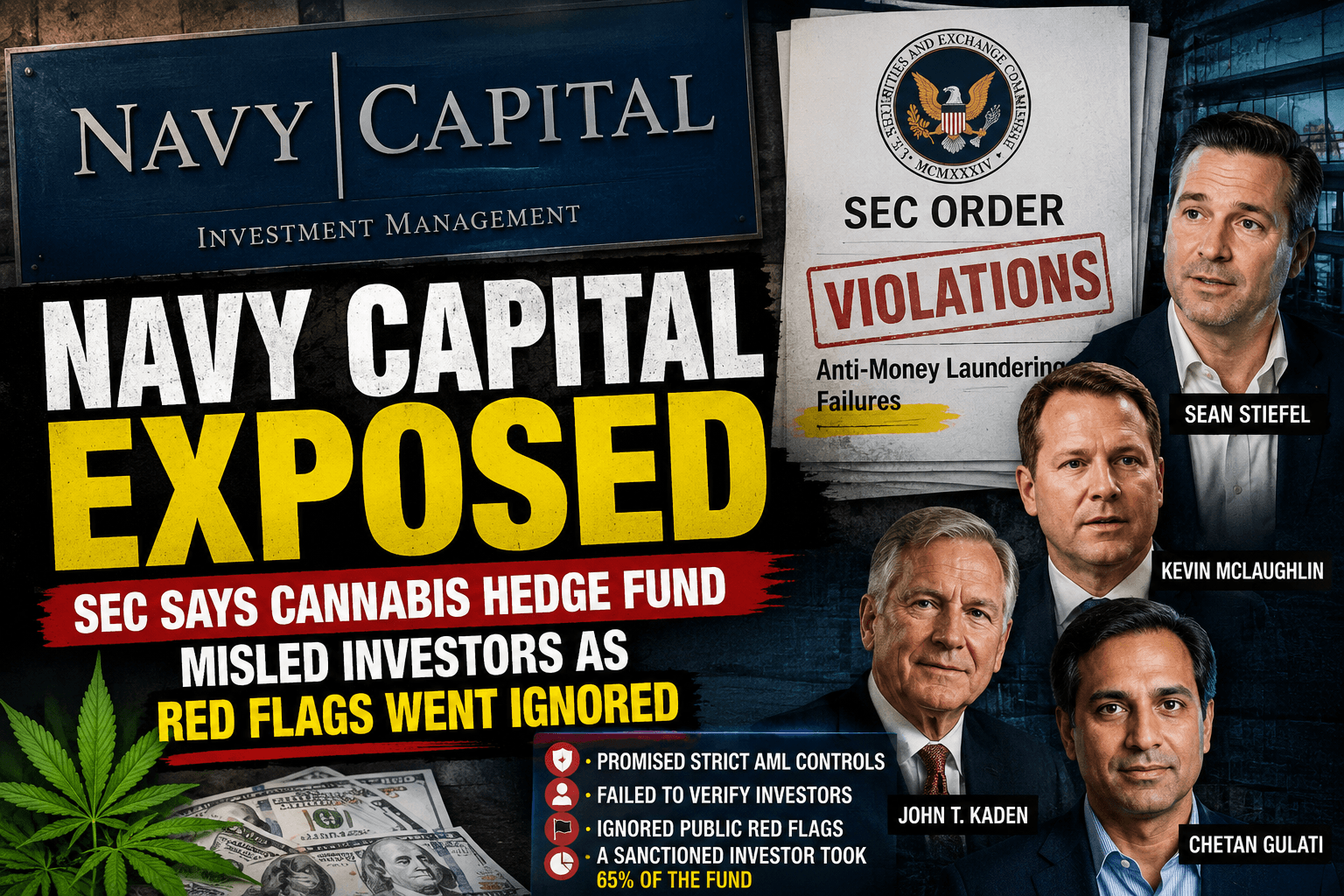
Navy Capital Green Management built its reputation as a specialist in cannabis investing at a time when money was pouring into the legal marijuana industry. The Connecticut-based hedge fund adviser presented itself as a firm that understood the risks of operating in a sector long associated with heightened regulatory scrutiny. Investors weren’t just buying into cannabis stocks and private deals. They were buying into the idea that Navy Capital had strong safeguards in place to keep questionable money out of its funds.
According to the U.S. Securities and Exchange Commission, those safeguards were not what investors were led to believe.
In January 2025, the SEC charged Navy Capital Green Management LLC with misleading investors about its anti-money laundering practices. The agency alleged that from October 2018 through January 2022, the firm repeatedly told investors it conducted extensive due diligence before accepting money into its funds. It said it verified who its investors really were, reviewed the source of their wealth, monitored existing investors for potential red flags, and carried out enhanced checks whenever higher-risk situations emerged. The SEC says those promises often existed on paper but weren’t followed in practice.
The case doesn’t involve claims that Navy Capital stole investor money, ran a Ponzi scheme, or fabricated returns. That’s important to note. But it does involve allegations that investors were given a false sense of security about who was investing alongside them and how carefully those investors had been vetted.
Navy Capital was founded in 2016 by Sean Stiefel, who became one of the better-known names in cannabis-focused investing. As the legal cannabis market expanded across North America, Stiefel frequently spoke about opportunities in the sector and positioned Navy Capital as an experienced player capable of navigating a complex industry. The SEC did not charge Stiefel personally, but he was leading the firm during much of the period covered by the investigation.
Kevin McLaughlin, who joined the firm in 2019 and served in compliance-related roles, including Chief Compliance Officer during part of the relevant period, was also not individually charged. Neither were Executive Chairman John T. Kaden, a veteran hedge fund executive with decades of experience, nor portfolio manager Chetan Gulati. Regulators focused their enforcement action on the company itself rather than specific executives. Still, the alleged failures occurred under the leadership of people entrusted with overseeing investor protections and compliance.
According to the SEC, one of the clearest examples involved an investor referred to only as “Investor A.” Navy Capital accepted investments from the entity in late 2018 despite representing that anti-money laundering reviews would be completed before subscriptions became effective. When regulators later examined the firm’s records, they found that Navy had never properly identified the beneficial owners behind the investment. The only individual documented was the company’s president. The only identification obtained was an unverified copy of a driver’s license, and that document wasn’t collected until December 2022, more than four years after the money had already been accepted.
Then came Investor B.
If Investor A exposed holes in the process, Investor B revealed just how serious those gaps had become. Between October 2018 and February 2021, Navy Capital accepted three separate investments tied to another investor identified only by that label. According to the SEC’s findings, the firm failed to gather ownership information and supporting documentation before accepting the money. In one instance, Navy reportedly didn’t even know the name of the investing entity until three days after the investment had already taken effect.
Despite those shortcomings, the relationship deepened. Investor B eventually controlled around 65 percent of Navy Capital’s feeder fund. That’s an extraordinary amount of influence for a single investor, particularly when the firm’s own policies supposedly required careful scrutiny before money entered the fund.
The SEC says warning signs were already there.
Public reports published before Investor B’s first investment allegedly linked the individual to suspected money laundering activities overseas. One of the reports cited by regulators stated that authorities believed the person’s wealth was at least partially derived from illegal sources and could be connected to money laundering. Navy’s own compliance procedures said that circumstances like these required enhanced due diligence. According to the SEC, that enhanced review never happened.
Instead, the firm continued accepting investments connected to Investor B without conducting the deeper checks it had promised investors it would perform. The risks that had been highlighted publicly were never properly addressed.
In 2022, those concerns turned into real consequences. Foreign authorities sanctioned Investor B and froze assets connected to the individual. Because Investor B held more than half of the feeder fund, the freeze extended to the fund structure tied to Navy Capital. Only after those events unfolded did the firm reportedly obtain documentation it had claimed all along was required before investments could be accepted.
That detail is perhaps the most troubling part of the entire case. Investors had been told the checks happened first. The SEC says many of them happened only after regulators and foreign authorities stepped in.
Without admitting or denying the SEC’s findings, Navy Capital agreed to settle the case. The firm accepted a cease-and-desist order, a formal censure, and a civil penalty of $150,000. No executives were personally charged.
For some people, that outcome may seem underwhelming. A $150,000 penalty is a relatively small number in the world of hedge funds, especially in a case involving allegations that a sanctioned investor came to dominate a major portion of a fund after promised safeguards were ignored. But the significance of this case goes beyond the size of the fine.
Investment firms ask people to trust them with enormous amounts of money. Investors rarely get a front-row seat to internal compliance procedures. They rely on disclosures, policy statements, and representations made by fund managers. When a firm says it verifies beneficial ownership, investors assume that means someone actually checked who was behind the money. When a firm says suspicious circumstances trigger enhanced reviews, investors expect those reviews to happen.
According to the SEC, Navy Capital sold that version of itself to investors while failing to consistently live up to those commitments.
The agency’s message was straightforward: if firms choose to advertise strict compliance standards, they have to follow them. Compliance cannot become a marketing tool used to reassure investors while basic checks are delayed, skipped, or ignored altogether.
The Navy Capital case may not have the headline-grabbing drama of a Ponzi scheme, but it highlights a different kind of risk that often receives less attention. Investors can lose more than money when trust breaks down. They lose confidence that the people managing their investments are doing what they said they would do.
At its core, this wasn’t just about paperwork. It was about credibility. Navy Capital told investors it knew who it was doing business with and had systems in place to identify red flags before they became problems. The SEC says that confidence was misplaced.
For anyone investing in private funds, that’s the real warning hidden inside this case: don’t just look at the returns being promised. Pay attention to the controls managers claim to have in place, ask hard questions about how those controls work, and remember that sometimes the biggest risks aren’t the ones hidden in market volatility. They’re hidden in the gap between what firms say they do and what they actually do.
————-
Disclaimer:
Some content on Reportingscams.com is published under our guest post program and is provided by third-party contributors. Reporting scams does not create, verify, or take responsibility for the views, accuracy, or claims expressed in such content.