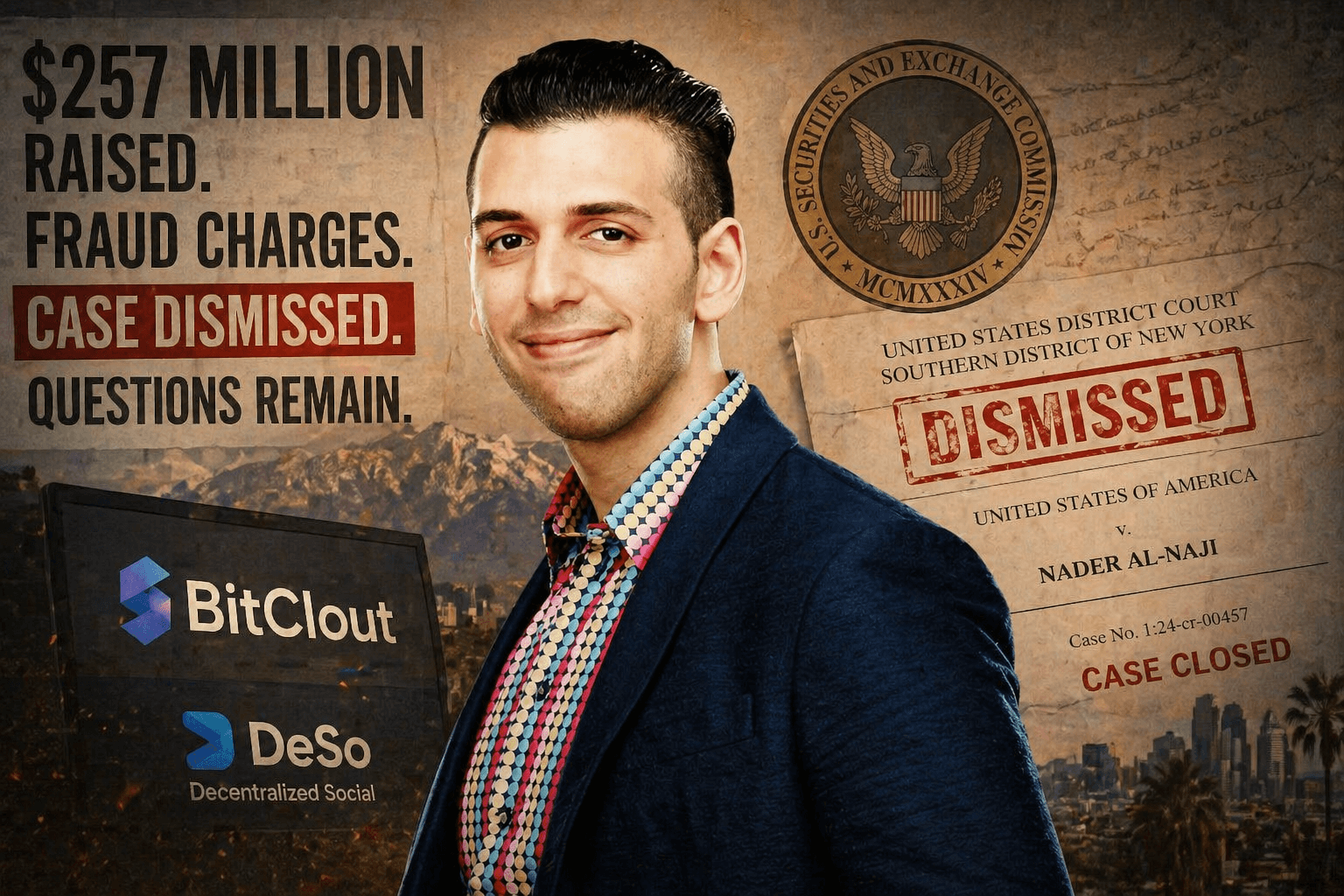
The rise and fall of Nader Al-Naji reads like a script the crypto industry knows too well. A young founder with elite credentials. A bold idea about fixing the internet. A flood of investor money. Then regulators step in, serious allegations surface, and just when it looks like everything is about to collapse in a courtroom, the case disappears.
For a brief moment, Al-Naji was seen as one of the more ambitious minds trying to rebuild social media from scratch. A Princeton graduate who had already tasted both hype and failure with his earlier crypto project Basis, he returned with something even bigger. BitClout. Later rebranded as DeSo. The pitch was simple on paper but explosive in reality. Turn social media into a financial market where people could invest in each other.
Profiles of public figures were pulled onto the platform without their consent. Users could trade “creator coins” tied to those identities. The more attention someone got, the more their coin price moved. It blurred the line between influence and speculation in a way that made people uncomfortable from the start. But that discomfort did not stop the money.
Hundreds of millions of dollars flowed in.
At the center of the pitch was one key claim. BitClout was not run by a company. It was decentralized. There was no CEO pulling strings. No central authority making decisions. Just code, community, and a new kind of digital economy.
That claim would later become the foundation of the government’s case against him.
In 2024, U.S. regulators moved in. The Securities and Exchange Commission and federal prosecutors accused Al-Naji of raising more than $257 million through the sale of BitClout tokens without registering them as securities. According to the complaint, investors were led to believe that their money would be used to build the platform, not to enrich the founder personally.
But investigators painted a different picture.
They alleged that Al-Naji had been operating behind the scenes while presenting the project as decentralized. That he controlled key aspects of the platform while publicly denying it. That he used a pseudonym, “Diamondhands,” to create distance between himself and the project’s decision-making.
More damaging were the financial claims. Prosecutors said millions of dollars from investor funds were diverted for personal use. Rent for a luxury home. Cash transfers. Payments that had little to do with building a decentralized social network. The figure often cited was around $7 million, though the broader raise was far larger.
He was arrested. Charged with wire fraud. The tone from authorities was clear at the time. They believed investors had been misled.
For many watching the crypto space, it felt like another chapter in a growing list of enforcement actions against founders who blurred the line between innovation and accountability. The expectation was that the case would move forward, evidence would be tested, and a verdict would eventually define what actually happened.
That never came.
In 2025, the criminal case was quietly dropped by federal prosecutors. There was no dramatic courtroom moment. No detailed explanation that answered the obvious questions. Just a decision to step away.
The civil case from the SEC held on a little longer, keeping the story alive. Then in early 2026, that too was dismissed. With prejudice. Meaning it cannot be brought again.
No fines. No settlement. No admission of wrongdoing.
After everything, the legal system walked away.
That outcome has left a strange kind of silence around the case. On paper, Al-Naji is no longer facing charges. There is no conviction attached to his name. But the allegations that once made headlines have not been erased. They were never fully tested in court. They simply remain as claims that were made and then abandoned.
And that is where the story becomes harder to pin down.
Supporters point to the dismissal as a sign that the case lacked strength. That regulators overreached in trying to apply traditional securities laws to something designed to be outside that system. They see it as part of a broader shift, where crypto cases that once looked aggressive are now being reconsidered.
Critics see something else entirely. A system where massive sums can be raised, serious accusations can be made, and yet accountability can slip through the cracks if a case does not make it all the way to trial. They argue that dropping a case does not erase the behavior that triggered it.
What makes Al-Naji’s story stand out is how closely it follows a pattern.
Before BitClout, there was Basis. That project also raised significant funding before shutting down under regulatory pressure. Then came a pivot, a rebrand, and an even bigger idea. When scrutiny followed again, the same themes resurfaced. Questions about control. About transparency. About where investor money actually went.
It is not unusual in crypto to push boundaries. In fact, that is often the point. But the line between pushing boundaries and bending rules has become one of the most contested areas in the industry.
BitClout pushed that line further than most.
It was not just about money. It was about identity. Taking public figures and turning them into tradable assets without permission created backlash that went beyond typical crypto criticism. It forced a conversation about whether decentralization can be used to bypass not just regulation, but basic consent.
That part of the story has not gone away.
Even now, BitClout remains a reference point when people talk about how far crypto experiments can go before they cross into something more troubling. The platform itself may have evolved, rebranded, and lost some of its original momentum, but the controversy it sparked still lingers.
As for Al-Naji, he sits in a position that is difficult to categorize. Not convicted. Not cleared in the way a full trial might have allowed. Just… out of the legal spotlight.
In the world of headlines, that often gets interpreted as a win. Charges dropped. Case dismissed. Move on.
But in reality, it is not that clean.
The money that was raised is real. The investors who bought into the vision are real. The allegations that were filed by regulators are still part of the public record. And the broader questions about decentralization, accountability, and trust in crypto have only become more urgent since then.
The courts may have stepped back, but the story has not really ended. It has just shifted out of the legal system and into a different kind of judgment. One that plays out in markets, in reputation, and in how future founders choose to build.
Because if there is one thing the Al-Naji saga makes clear, it is this.
In crypto, the line between innovation and illusion can get very thin. And sometimes, even when the legal case disappears, the questions it raised do not.
————-
Disclaimer:
Some content on Reportingscams.com is published under our guest post program and is provided by third-party contributors. Reporting scams does not create, verify, or take responsibility for the views, accuracy, or claims expressed in such content.