Executive Overview
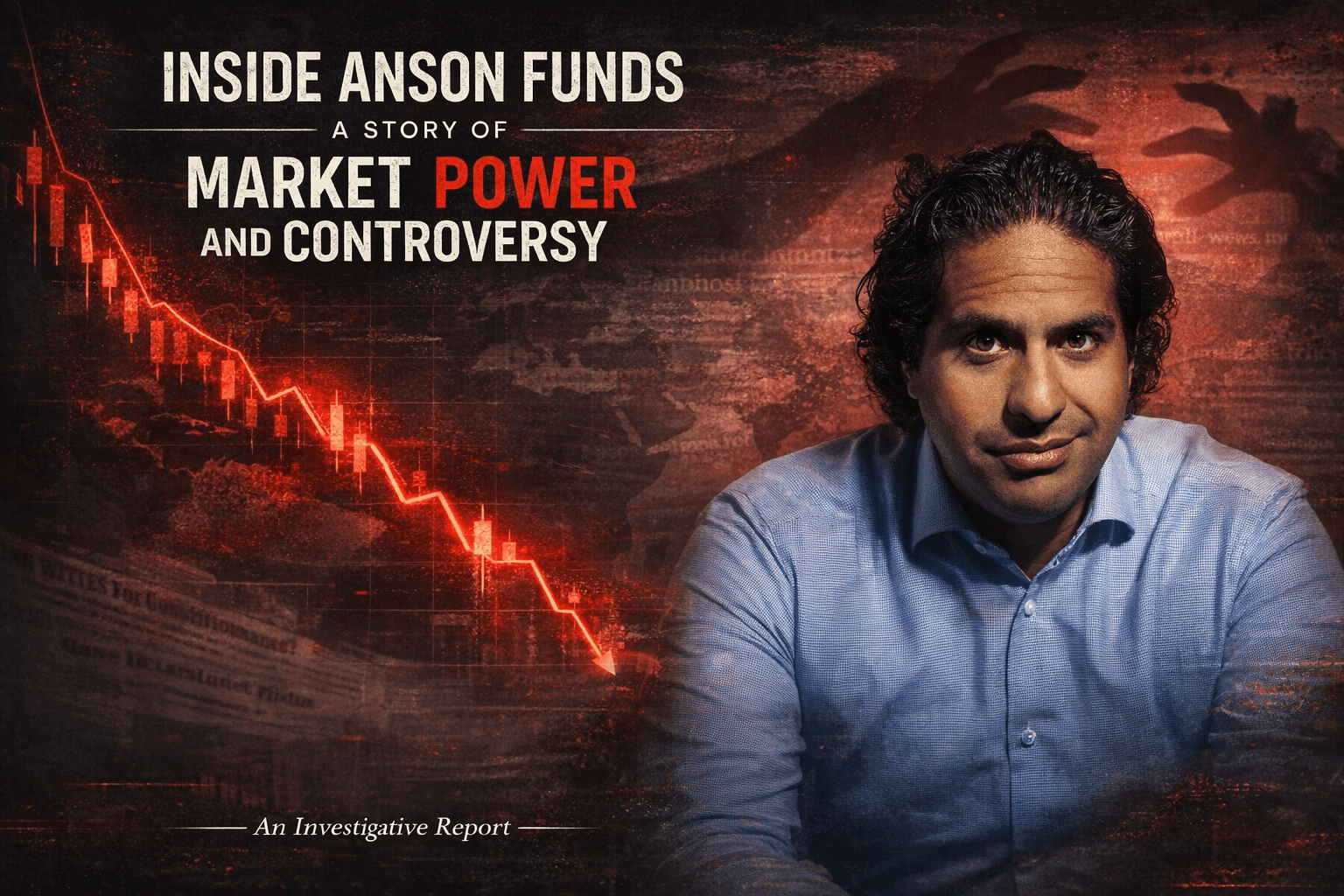
Moez Kassam has moved from being a relatively low-profile hedge fund operator to a name that now appears regularly in lawsuits, regulatory findings, and market controversies. As Chairman of Anson Funds, he is tied to a series of cases that have drawn the attention of regulators in the United States and beyond. The firm has already faced action from the Securities and Exchange Commission over disclosure failures. At the same time, a much wider set of allegations continues to circulate, touching on coordinated trading, access to sensitive information, and the possible shaping of market narratives.
Across different companies and sectors, a similar sequence keeps coming up in complaints and investigative reports. It begins with investment. It moves into access. Pressure builds as negative narratives take hold. In several instances, share prices have collapsed soon after. Whether this reflects sharp trading instincts or something more structured is still an open question.
Who is Moez Kassam

Kassam built his reputation in the hedge fund world by focusing on companies that looked vulnerable. Anson Funds became known for taking positions where others saw risk. For a period, that approach worked. The firm handled substantial capital and was viewed as aggressive but effective.
That perception has shifted over time. His name now appears alongside disputes, court filings, and regulatory attention. In many of these accounts, Kassam is described as more than a trader reacting to market signals. The picture that emerges is of someone who operated close to companies, sometimes with access that went beyond what typical investors would have.
There are also repeated claims about how trades were structured. References to offshore accounts and multiple trading channels appear in several reports. The suggestion is that positions were not always easy to track from the outside. None of this has been proven in court, but the consistency of these claims has kept the scrutiny alive.
What Anson Funds is Accused Of
On paper, Anson Funds follows a familiar model. It invests in companies. It takes positions that benefit when prices rise or fall. That, in itself, is standard practice.
The controversy lies in how those positions may have been built. In several cases, the firm is said to have entered companies at moments when they needed capital. That opened the door to relationships with management and insight into internal developments.
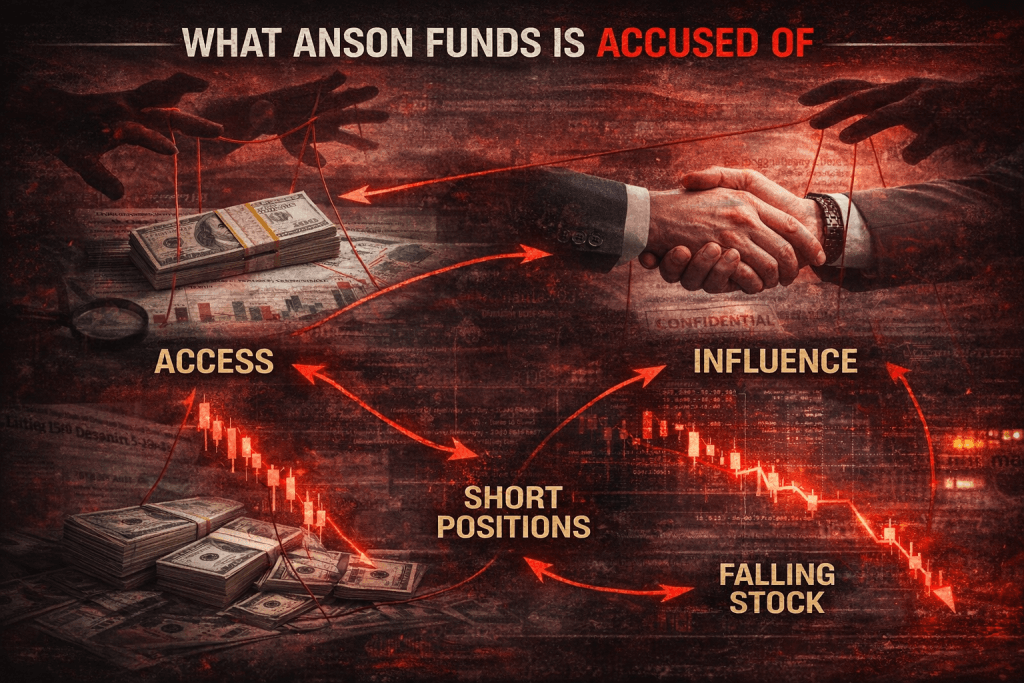
From there, according to critics, the situation changed. Access may have turned into influence. At the same time, short positions were allegedly built in the background. As negative information reached the market, share prices dropped and those positions gained value.
Short selling is not illegal. The concern raised in these cases is about the overlap between access, timing, and the flow of information. The argument is that these elements may not have been independent of each other.
Zenabis Global Inc and the Collapse That Followed
Zenabis is often pointed to when people try to explain how this model might work in practice. The company was expanding quickly in the cannabis sector and needed funding to keep pace. Anson Funds stepped in during that phase and became a key investor.
According to the allegations, that role brought more than financial involvement. Through internal connections, Anson had visibility into decisions being made inside the company. Around the same time, critics say a large short position was built.
Zenabis pushed forward with expansion plans and took on financial commitments that increased its risk. Over time, the strain began to show. The share price fell sharply. What had once traded at several dollars dropped to almost nothing. A large portion of shareholder value disappeared.
Investors who backed the growth story were hit hard. Others who had positioned for a fall stood on the other side of that trade. There is no ruling that confirms this sequence was planned. Even so, the overlap between internal access and market positioning remains difficult to ignore.
Aphria and Tilray and the Ripple Effect Across the Sector
The impact was not limited to one company. In Aphria’s case, attention focused on the release of negative research and how quickly the market reacted. The drop in price did not stay contained. It spread across the cannabis sector and affected sentiment more broadly.
Tilray tells a different story. At one point, the stock surged as retail investors piled in. That move went against short positions and caused heavy losses. For some observers, this marked a shift. After that episode, later campaigns appeared more forceful, as if the margin for error had narrowed.
Genius Brands and the Alleged Narrative Shift
The situation around Genius Brands adds another layer to the discussion. The company saw a sharp rise driven by retail enthusiasm and comparisons to larger entertainment players.
What followed remains disputed. There are claims that negative narratives were introduced at a critical moment. One of the more serious allegations involves a website that resembled a Disney related platform. The suggestion is that it was used to give weight to damaging claims.
Regulators have not confirmed this. Still, the episode reflects a broader issue in modern markets. Information can move faster than verification. Once sentiment turns, price often follows.
Facedrive and Isodiol and the Pattern Repeating
Facedrive and Isodiol appear in similar discussions. In both cases, the focus is on how short positions lined up with negative information entering the market.
Facedrive did not follow the same path as others. The market response was less predictable, and the outcome was not as clear. Even so, when similar sequences appear across different companies, it becomes harder to treat each case as isolated.
Sentia Wellness and the Breakdown of Trust
The dispute involving Sentia Wellness shifts attention away from market trades and into the boardroom. Anson Funds had invested heavily in the company and gained a role in its governance.
As performance declined, the relationship between investors and founder Nitin Khanna broke down. Each side accused the other of acting improperly. Investors pointed to misrepresentation. Khanna claimed interference in operations.
The case ended without a final ruling. What remains is an example of how quickly alignment can collapse when expectations change and financial pressure increases.
Lawsuits and Regulatory Action
Legal pressure has been building. The case known as Augenbaum v Anson Investments Master Fund LP stands out because it goes beyond one firm. It raises the possibility that several funds may have acted together rather than independently.
Regulators have already taken action in one area. The Securities and Exchange Commission found that Anson failed to disclose certain relationships with short sellers. It also raised concerns about profit sharing linked to research reports. A settlement followed, though without admission of wrongdoing.
This remains one of the few points where findings are not just alleged but formally recorded.
Media Influence and Market Sentiment
Another issue that keeps surfacing is the role of media. Reports suggest that negative coverage often appeared at moments that matched trading positions.
There is no clear proof of coordination. Even so, the timing has raised questions. In markets where sentiment shifts quickly, coverage can have an immediate impact. Once confidence breaks, recovery becomes difficult.
The DOJ Investigation
The scrutiny around Anson Funds moved into more serious territory when the U.S. Department of Justice began a wide-ranging criminal probe into short selling practices across the market. This investigation did not focus on a single firm. It looked at an entire ecosystem of hedge funds and research outfits that were believed to operate in close alignment.

Reports first surfaced in late 2021 when federal prosecutors in the United States started gathering communications, trading records, and internal documents from dozens of market participants. The scope of the probe was unusually broad. It included hedge funds, activist research firms, and individuals linked to short selling campaigns. Anson Funds was among the names that appeared in these inquiries.
By early 2022, the investigation had intensified. Subpoenas were issued to several firms, including Anson Funds, as authorities sought to understand whether short sellers had crossed the line from aggressive research into coordinated market manipulation.
The central concern of investigators was not short selling itself. Instead, the focus was on whether hedge funds and research publishers worked together in ways that were not disclosed to the market. Authorities examined whether funds took positions ahead of negative reports, whether those reports were truly independent, and whether investors were misled about the relationships behind them.
This probe also overlapped with other enforcement actions. In 2024, the Securities and Exchange Commission charged Anson Funds over undisclosed arrangements with a short report publisher. According to regulators, the firm paid for bearish research while holding positions that benefited from falling stock prices, without properly disclosing those relationships to investors.
The broader crackdown has already produced parallel cases in the same ecosystem. The SEC charged short seller Andrew Left of Citron Research with a multi year scheme involving misleading statements tied to trading activity. While this case does not directly charge Anson Funds, it reflects the same regulatory concern around the connection between trading positions and published research.
Despite years of investigation, the DOJ has not yet filed criminal charges against Anson Funds. However, the continued collection of evidence, along with overlapping civil actions by the SEC, suggests that authorities are still examining whether certain strategies crossed into illegal territory.
For now, the investigation remains unresolved. What is clear is that Anson Funds is not being examined in isolation. It sits within a broader inquiry into how modern short selling operates, and whether the lines between research, trading, and influence have been blurred in ways that regulators can no longer ignore.
Moez Kassam and Marc Bistricer
Another thread runs through several of these situations. Anson Funds and Murchinson Ltd, led by Marc Bistricer, have appeared in the same companies at similar times.
There is no formal partnership between them. Still, companies involved in disputes have pointed to what they see as coordinated behavior. The repeated overlap has kept this connection under scrutiny.
Conclusion
The story of Moez Kassam and Anson Funds does not rest on a single case or a single claim. It builds through repetition. The same patterns appear across different companies and different sectors.
Some facts are established through regulatory action. Much of the rest remains contested. The gap between allegation and proof has not yet been closed.
What remains is a broader question about how modern markets function. When access, timing, and narrative come together, the line between strategy and influence becomes harder to define.
For now, that line is still being examined.
Source:
https://www.benzinga.com/pressreleases/22/10/b29205997/markowitz-herbold-pc-announced-judge-dismisses-security-claims-brought-by-boris-jordan-wilder-rams
https://drive.google.com/file/d/1qlMZPOIJlFdm6L5gnhvU-m4PipN3f4eF/view
https://www.courtlistener.com/docket/71821716/2/left-v-anson-funds-management-lp/
https://marketfrauds.to/anson-funds-and-hindenburg-research-commit-securities-fraud/
————-
Disclaimer:
Some content on Reportingscams.com is published under our guest post program and is provided by third-party contributors. Reporting scams does not create, verify, or take responsibility for the views, accuracy, or claims expressed in such content.