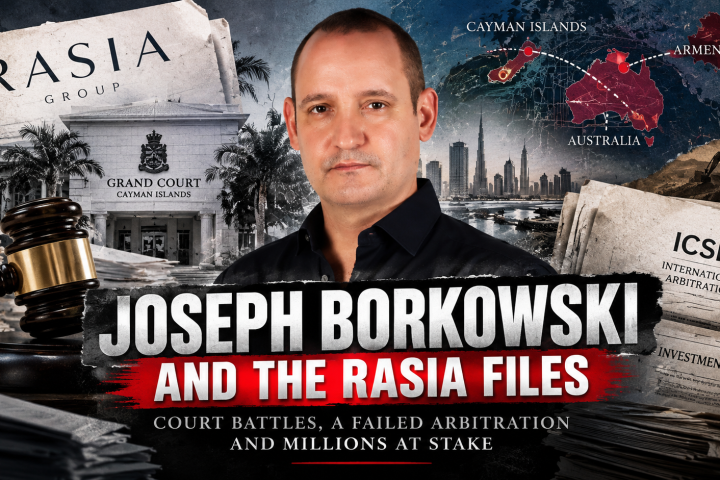
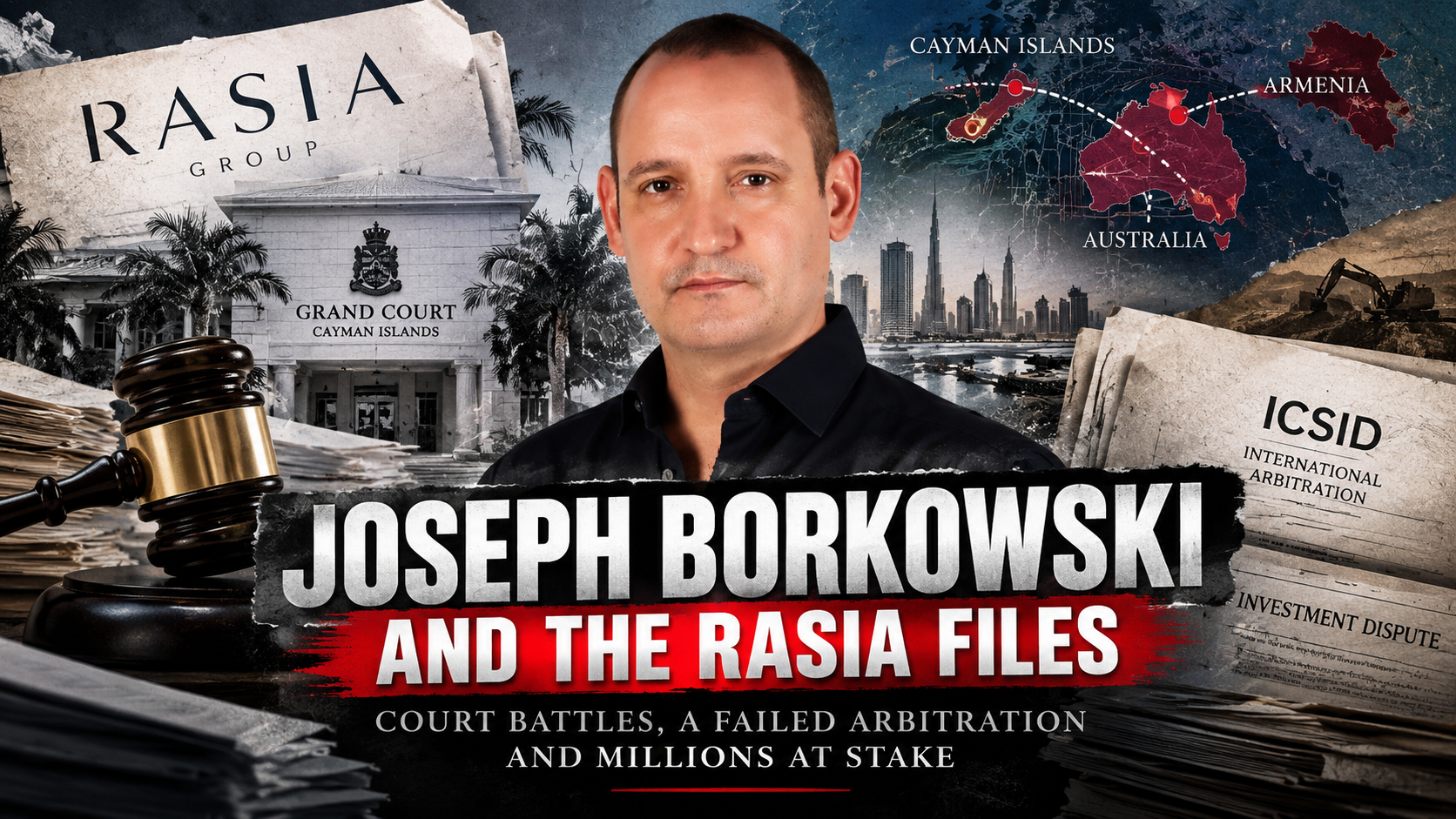
Joseph K. Borkowski built his career around the kind of investments that tend to operate far from ordinary public scrutiny: mining projects, infrastructure concessions, distressed assets and private investment vehicles spread across jurisdictions including the Cayman Islands, the United Arab Emirates, Singapore, Mongolia and Armenia. Public biographies identify him as the founder of Rasia Group in 2009, a former New York investment banker and convertible-securities trader, and a graduate of Tufts University and Columbia Business School. Rasia’s own materials describe the group as an investment platform focused on natural resources and strategic infrastructure, while its Cayman-based Rasia fund was established in 2017 as a regulated hedge fund pursuing distressed and special-situation investments.
The legal record surrounding Borkowski, however, is considerably more complicated than a conventional investment-company biography suggests. It includes the liquidation of the Cayman fund formerly known as Rasia, a bitter shareholder dispute involving Red Wolf Resources, a judgment that was later expressly set aside, an international arbitration in which Borkowski and Rasia sought hundreds of millions of dollars from Armenia and ultimately lost their claims, and a newer Cayman proceeding accusing former counterparties of improperly pursuing the winding-up of Rasia. None of those proceedings, standing alone, establishes that Borkowski committed fraud or a criminal offence. The distinction matters because some of the most serious accusations that appeared in earlier litigation were subsequently rendered unusable after the underlying judgment was set aside.
The Cayman dispute began with Red Wolf Resources Ltd., a British Virgin Islands investment company. The company petitioned to wind up Rasia in 2020, claiming standing as a major shareholder. The dispute centred on a December 2017 transaction agreement connected with financing for Kirkham International Pte Ltd and a proposed acquisition of Kirkham by TerraCom Ltd. A 2025 Australian judgment records that Red Wolf eventually held about 78% of Rasia’s participating shares, but that its shareholding was later unwound in July 2020. Red Wolf nevertheless continued with the winding-up petition.
The original Cayman litigation became highly contentious. Rasia challenged Red Wolf’s standing, while Red Wolf disputed the existence and authenticity of the transaction agreement and related board resolutions. A Grand Court judgment issued in July 2021 found in Red Wolf’s favour on the preliminary standing question. That judgment contained findings of fact concerning Borkowski and the disputed transaction agreement. But those findings did not survive.
In July 2022, the Singapore High Court-appointed liquidator of Kirkham located a copy of the disputed transaction agreement in Kirkham’s files. The discovery was significant because the existence of that document had been a central issue in the Cayman litigation. According to the later Australian judgment, a copy was sent to Borkowski in July 2022, after which Rasia sought to reopen the Cayman proceedings.
The consequence was unusual and important. On September 15, 2022, the Cayman Grand Court set aside the 2021 strike-out judgment and the findings of fact contained in it. The court ordered that the judgment be removed from the Register of Judgments and prohibited parties from producing or relying upon it or publishing references to its contents. It also set aside an earlier costs order and fixed the petitioner’s costs at US$782,426, payable from cash held in the liquidation.
Borkowski’s lawyers subsequently wrote to Offshore Alert stating that their client believed the earlier judgment had been improperly obtained and that Red Wolf had failed to disclose the transaction agreement. The letter emphasized that the judgment and its findings had been set aside and demanded removal of the publication. Those assertions were the position of Borkowski and his lawyers, not independent findings that Red Wolf had committed wrongdoing.
The liquidation itself did not disappear. The 2025 Victorian proceedings record that Rasia went into liquidation on October 1, 2022, and that RF Investment Holdings Limited, formerly known as Rasia, was later dissolved on August 6, 2024. Red Wolf was struck off the BVI corporate register in May 2023 for non-payment of annual fees.
The dispute then moved into another phase. In May 2025, Rasia Group, Rasia FZE and Mondoe Company Limited commenced Cayman proceedings against Craig Ransley and Matthew Phillip Crawford. The plaintiffs alleged that the winding-up petition had been pursued for an improper collateral purpose and claimed losses including approximately US$22.32 million for the value of Rasia shares, US$1.21 million in costs associated with defending the winding-up petition and US$3.21 million in unpaid management-performance fees. The pleaded monetary claim against Crawford was at least US$26.74 million, before interest and additional damages. These remain claims rather than established liabilities.
The Australian litigation surrounding those claims produced another important twist. In July 2025, the Supreme Court of Victoria granted an ex parte worldwide freezing order against Crawford. But when the matter returned to court in September, the plaintiffs acknowledged material non-disclosure at the original hearing. The court concluded that the plaintiffs had established a good arguable case with a sufficient prospect of a favourable foreign judgment, but found that they had not demonstrated the necessary risk that Crawford would dissipate assets. The ex parte freezing order was therefore discharged and a fresh freezing order was not granted.
The underlying Cayman proceedings were still active in 2026. A Grand Court cause list published in September 2026 records FSD 134 of 2025, Rasia Group and others v Craig Anthony Ransley and Matthew Philip Crawford, with a summons listed before Justice Asif on August 31, 2026. That means the latest public record located for this review does not show a final determination of the substantive allegations.
Borkowski has also faced a separate and much larger investment dispute involving Armenia. Rasia FZE and Borkowski brought an ICSID arbitration over two major infrastructure concessions: a southern Armenia railway and a high-speed road project. The claimants ultimately sought US$225 million in compensation, based substantially on the value they said the projects represented and on an anticipated transaction involving Aabar. The tribunal rejected the claims. It found some contractual breaches by Armenia but held that Rasia’s contractual claims were time-barred and that Borkowski’s treaty claims failed either because they were time-barred, because he lacked standing for the relevant contractual obligations, or on the merits. It also found that Borkowski had not established that Armenia caused Aabar to abandon a proposed acquisition or that the investment had been expropriated.
The financial consequence was substantial. The tribunal ordered Borkowski and Rasia to pay Armenia US$2,783,250.09 in arbitration costs and legal fees. The claimants had themselves reported more than £9.18 million in invoiced arbitration costs. In November 2024, an ICSID annulment committee rejected the attempt by Rasia and Borkowski to overturn that award, leaving the dismissal and costs order intact. Armenian authorities later said the US$2.8 million costs award had been fully recovered.
Armenia had also made serious accusations during the arbitration, including an allegation that Borkowski and others were involved in a scheme to defraud Aabar. The tribunal expressly rejected that theory as insufficiently supported, distinguishing between advocating a risky investment and proving an intention to defraud. That is an important qualification: the arbitration ended badly for Borkowski and Rasia, but it did not find that he had defrauded Aabar.
There is another relevant piece of history involving one of the people connected to the Rasia dispute. Craig Ransley, identified in the Cayman proceedings as Red Wolf’s founder and sole shareholder, later became a director and deputy chairman of TerraCom. ASIC brought civil-penalty proceedings against Ransley and other TerraCom officers over allegations concerning misleading ASX disclosures and directors’ duties. In July 2025, the Federal Court dismissed ASIC’s case against Ransley and the other individual defendants. Separately, however, TerraCom itself agreed to pay a US$7.5 million-equivalent Australian penalty for whistleblower victimisation, plus US$1 million in ASIC costs. TerraCom admitted that public statements had caused detriment to the whistleblower. The corporate penalty was not a finding that Ransley personally committed the conduct alleged against him.
As of September 2026, Borkowski’s public corporate footprint remains active. Saker Resources identifies him as its chairman and chief executive officer, while describing the company as a Singapore-headquartered metallurgical coal business with two Mongolian projects, Khotgor and Zeegt. Its website says the company has invested more than US$220 million in equity and owns the two projects. Public corporate data also records Borkowski as a former executive of Saker Resources Mongolia. Rasia Management continues to describe Borkowski as its founder and director and gives a Dubai business address, although the Cayman Rasia fund itself is no longer an operating fund in the form it had before its liquidation.
There is no reliable public source located in this review establishing Borkowski’s exact age, and no credible evidence was found of a criminal conviction or criminal charge against him arising from the matters examined here. The public record instead describes a series of civil, insolvency and investment disputes, some resolved against him or his companies, others still contested. That distinction should not be lost amid the competing accusations.
What makes the Rasia story consequential is not a single allegation but the accumulation of expensive, cross-border disputes around investment structures operating through multiple jurisdictions. A Cayman fund was wound up. A key court judgment was later erased from the legal record after new evidence emerged. An international investment claim seeking hundreds of millions of dollars failed and generated a multimillion-dollar costs order. And the people on opposite sides of the earlier fight are now back before the courts, with claims worth more than US$26 million still being contested. For investors and counterparties dealing with private funds, offshore holding companies and complex natural-resources ventures, the case is a reminder that the most important questions are often buried in transaction documents, shareholder rights, liquidation records and court orders not in the investment story presented on a corporate website.
Source:
OffshoreAlert
————-
Disclaimer:
Some content on Reportingscams.com is published under our guest post program and is provided by third-party contributors. Reporting scams does not create, verify, or take responsibility for the views, accuracy, or claims expressed in such content.